Culture · Beginner
Chinese New Year Food: Lucky Dishes, Easy Recipes and What to Say at the Table
Dumplings, fish, nian gao, spring rolls and tangyuan: what each dish wishes for, easy recipes to cook together and the Mandarin to say while you cook and eat, with audio
- Level:
- Beginner · HSK 1
- Format:
- Workbook · PDF · 14 pages · US Letter (prints on A4)
- Price:
- Free · free with a saymei account · updated Nov 4, 2026
Listening audio: play every track free, no account needed.
Download the free PDF: create a free SayMei account on this page, and we'll email you a copy too.
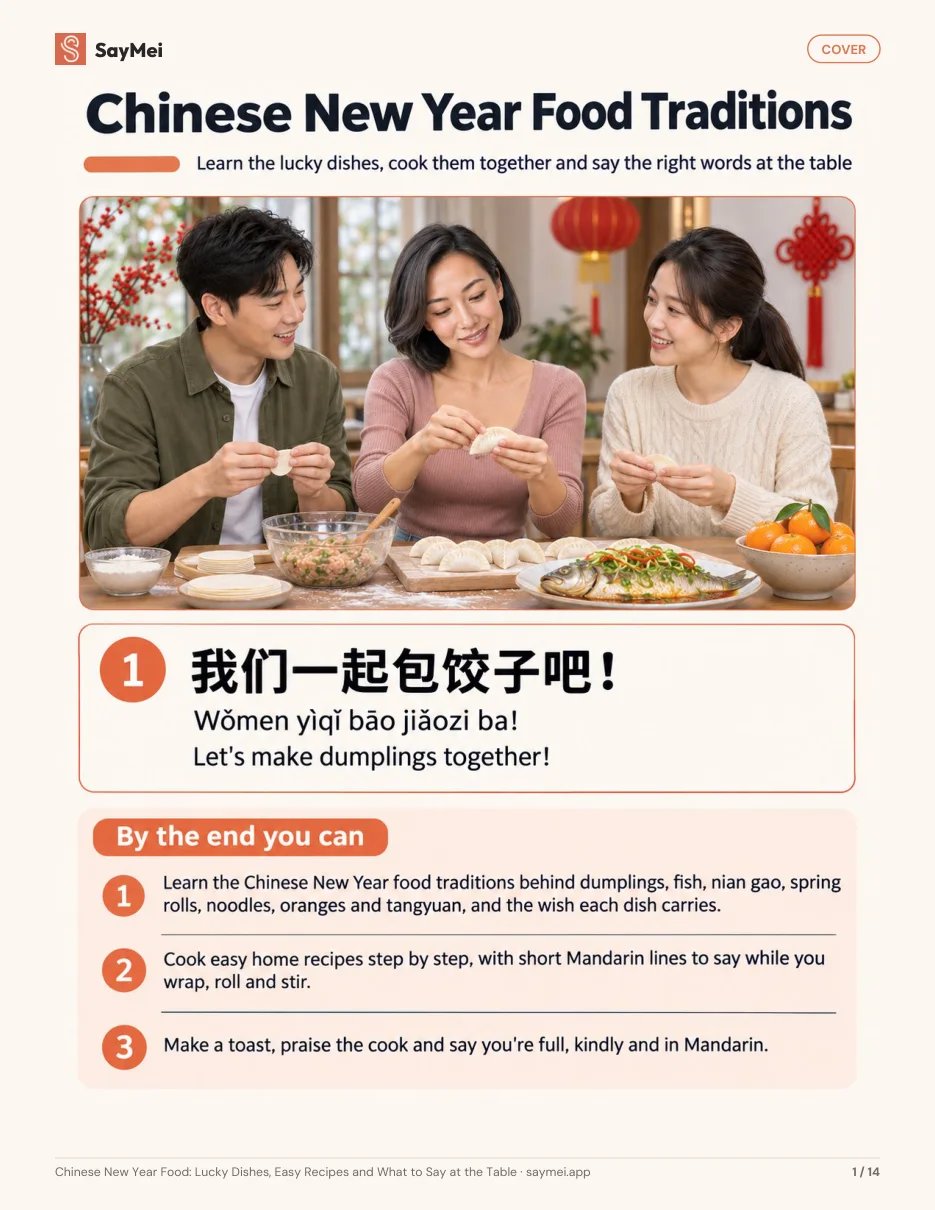
我们一起包饺子吧! · Wǒmen yìqǐ bāo jiǎozi ba! · Let's make dumplings together!
By the end you can
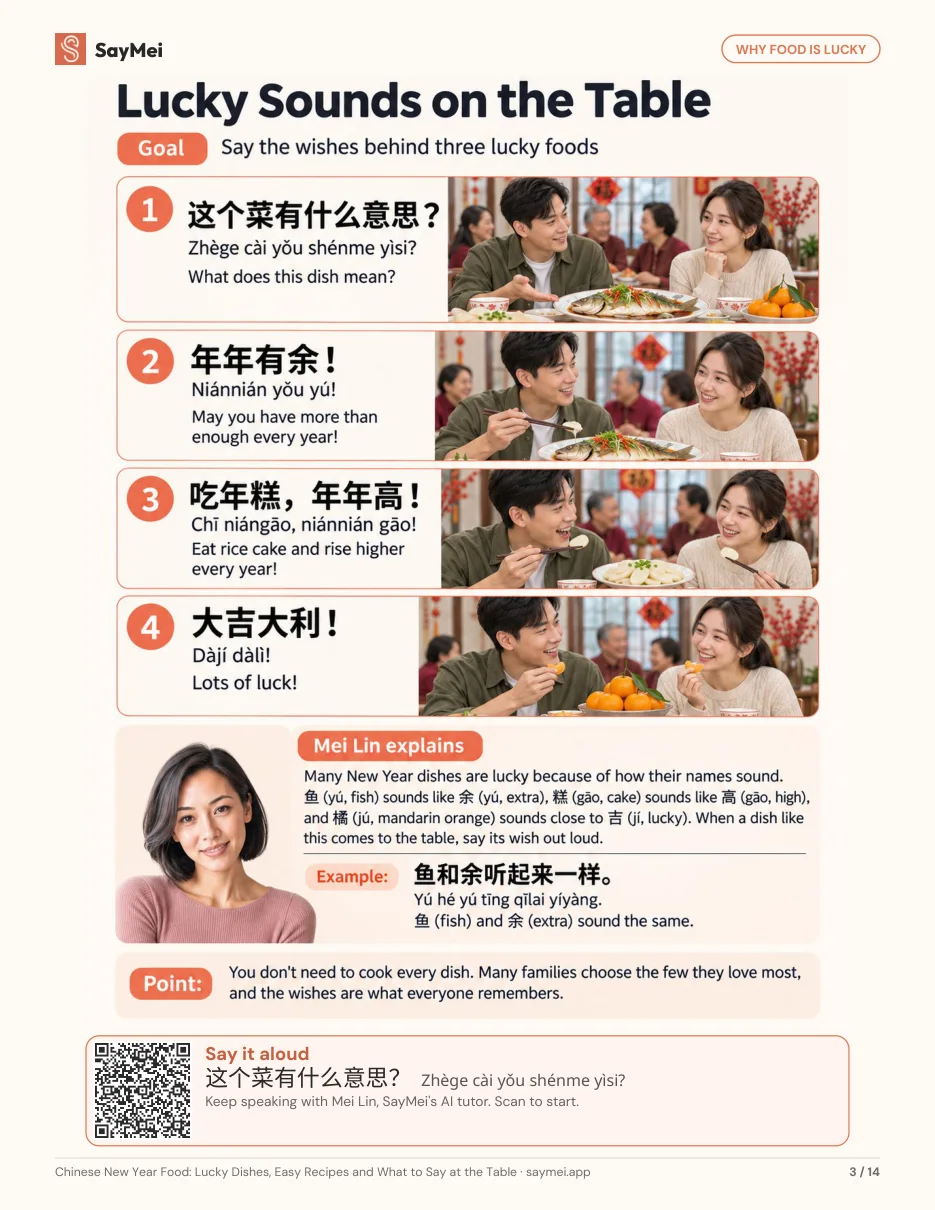
- Say the wish behind each lucky dish. Many dishes are lucky for how they sound: 鱼 sounds like 余 (extra), 糕 like 高 (high) and 橘 close to 吉 (lucky).
年年有余! · Niánnián yǒu yú! · May you have more than enough every year! - Wrap dumplings together and praise the wrapper. A simple pork and spring onion filling, then verb + 得 + description to say who wraps well or fast.
你包得真好看! · Nǐ bāo de zhēn hǎokàn! · Yours look really nice! - Steam a whole fish and serve it with the right wish. Steam it with ginger and spring onion, count it with the measure word 条, and leave a little for the year ahead.
鱼来了,年年有余! · Yú lái le, niánnián yǒu yú! · Here's the fish: plenty every year! - Steam sweet nian gao and say how it tastes. Use 太 + adjective + 了 for "so" or "too", and 不太 for "not very".
有点儿黏。 · Yǒudiǎnr nián. · It's a bit sticky. - Roll oven-baked spring rolls and give the steps in order. Cabbage, carrot and bean sprouts, baked in the oven, with 先 … 再 … to say what comes first and next.
先放菜,再卷起来。 · Xiān fàng cài, zài juǎn qǐlai. · Put the vegetables in first, then roll it up. - Offer oranges and sweets and wish someone a long life. Serve long-life noodles uncut, offer a mandarin orange, and use 别 + verb, as in 别客气, to tell guests to help themselves.
祝您长命百岁! · Zhù nín chángmìng bǎisuì! · Wishing you a long, long life! - Roll tangyuan for the Lantern Festival. Glutinous rice flour and warm water, rolled into balls, with 有点儿 before an adjective (a bit too) and 一点儿 after it (a bit more).
搓圆一点儿。 · Cuō yuán yìdiǎnr. · Roll it a bit rounder. - Make a toast, praise the cook and say you're full. Raise tea or juice if you don't drink, and stop a host from refilling your bowl kindly.
我吃饱了,谢谢! · Wǒ chī bǎo le, xièxie! · I'm full, thank you!
What’s inside
- Why Food Is Lucky: Lucky Sounds on the Table
- Dumplings: Make Dumplings Together
- Fish: A Whole Fish for the New Year
- Nian Gao: Sweet Rice Cake (Nian Gao)
- Spring Rolls: Easy Oven Spring Rolls
- Noodles and Oranges: Long Noodles and Sweet Treats
- Tangyuan: Tangyuan for the Lantern Festival
- At the Table: Toasts, Thanks and "I'm Full!"
- Practice: Kitchen and Table Practice
- Review: New Year's Eve in the Kitchen
- Menu: Your 2027 New Year Menu
How to use this book
Each chapter is one dish: why many families eat it, three or four lines, one language point and a short recipe. Play the free audio while you cook and say each line back. A grown-up handles knives, boiling water and the oven.
- Early January: Read the dishes and choose. Read pages 3 to 10 with the audio and pick 3 or 4 dishes. Do the practice page and the review on pages 11 and 12.
- Week of 25 January: Shop. Buy the glutinous rice flour, brown sugar, soy sauce and frozen wrappers from the list on page 13.
- 3 and 4 February: Cook ahead. Steam the nian gao on Wednesday; it keeps a few days in the fridge. Wrap the dumplings on Thursday and freeze them on a tray.
- Fri 5 February: New Year's Eve dinner. Steam the fish, bake the spring rolls and boil the dumplings. Say 年年有余! as the fish comes to the table, and practise the table lines on page 10 the day before.
- Sat 20 February: Lantern Festival. Roll tangyuan together and say 元宵节快乐!
Who it’s for
Adult beginners cooking for Chinese New Year 2027 with a partner, family, friends or children, who want to know what each dish wishes for and say the Mandarin while they cook and eat.
Before you start: Nothing. Every line has characters, pinyin and English, and the free audio reads each one with a pause to say it back. The recipes are short, numbered and use everyday supermarket ingredients.
Frequently asked questions
Why do people eat fish at Chinese New Year?
鱼 (yú, fish) sounds like 余 (yú, extra), so a whole fish wishes everyone more than enough in the year ahead: 年年有余. Many families leave some of the fish on the plate on New Year's Eve, so there is something extra for the new year.
Can children help with the recipes?
Yes. Children can mix, wrap, roll and set the table, while a grown-up handles knives, boiling water and the oven. The steps are short and numbered, so a child can read the order with you, and page 7 teaches 先 … 再 … to say it in Mandarin.
Do I have to drink alcohol to join a toast?
No. Raise tea or juice and say 我以茶代酒 (wǒ yǐ chá dài jiǔ), "tea in place of wine". Page 10 has the lines for the toast itself, for praising the cook and for saying you're full.
Is this workbook free?
Yes. The whole 14-page PDF is free, and you can look through its pages here before you download. There's no card and nothing to pay.
Do I need a SayMei account?
Yes, to download the PDF, and the account is free: sign up with Google, Apple or your email address. With it we email you a copy of the workbook, keep every workbook you download on your account on all your devices, save your place in the free online practice, and you can practise speaking with Mei Lin, SayMei's AI tutor.
How do I print it?
The PDF is US Letter size. On A4 paper, choose "Fit to page" (or "Scale to fit") in the print dialog so nothing is cut off. Print the whole workbook or only the pages you need; colour looks best, and black and white works too.
Can I print copies for my class?
Yes. Print as many copies as you like for your own class or family. To share it, send this page: everyone can download their own copy.
Keep going
Learn Chinese with C-Dramas: 100 Phrases You Hear in Every Drama · Chinese Wishes for Every Occasion: Birthdays, Weddings and Get Well · Mid-Autumn, Dragon Boat and Other Chinese Festivals: What to Say and Do · Chinese Sayings for Beginners: 40 Everyday Expressions and Easy Chengyu · Browse all 294 workbooks
Version 2026-11 · Updated Nov 4, 2026 · Report a correction