Grammar · Beginner
Chinese Verbs List: 100 Common Verbs with Examples
The 100 verbs you need most, each with pinyin, meaning and an example sentence, in 10 groups, with audio
- Level:
- Beginner · HSK 1
- Format:
- Reference guide · PDF · 15 pages · US Letter (prints on A4)
- Price:
- Free · free with a saymei account · updated Nov 4, 2026
Listening audio: play every track free, no account needed.
Download the free PDF: create a free SayMei account on this page, and we'll email you a copy too.
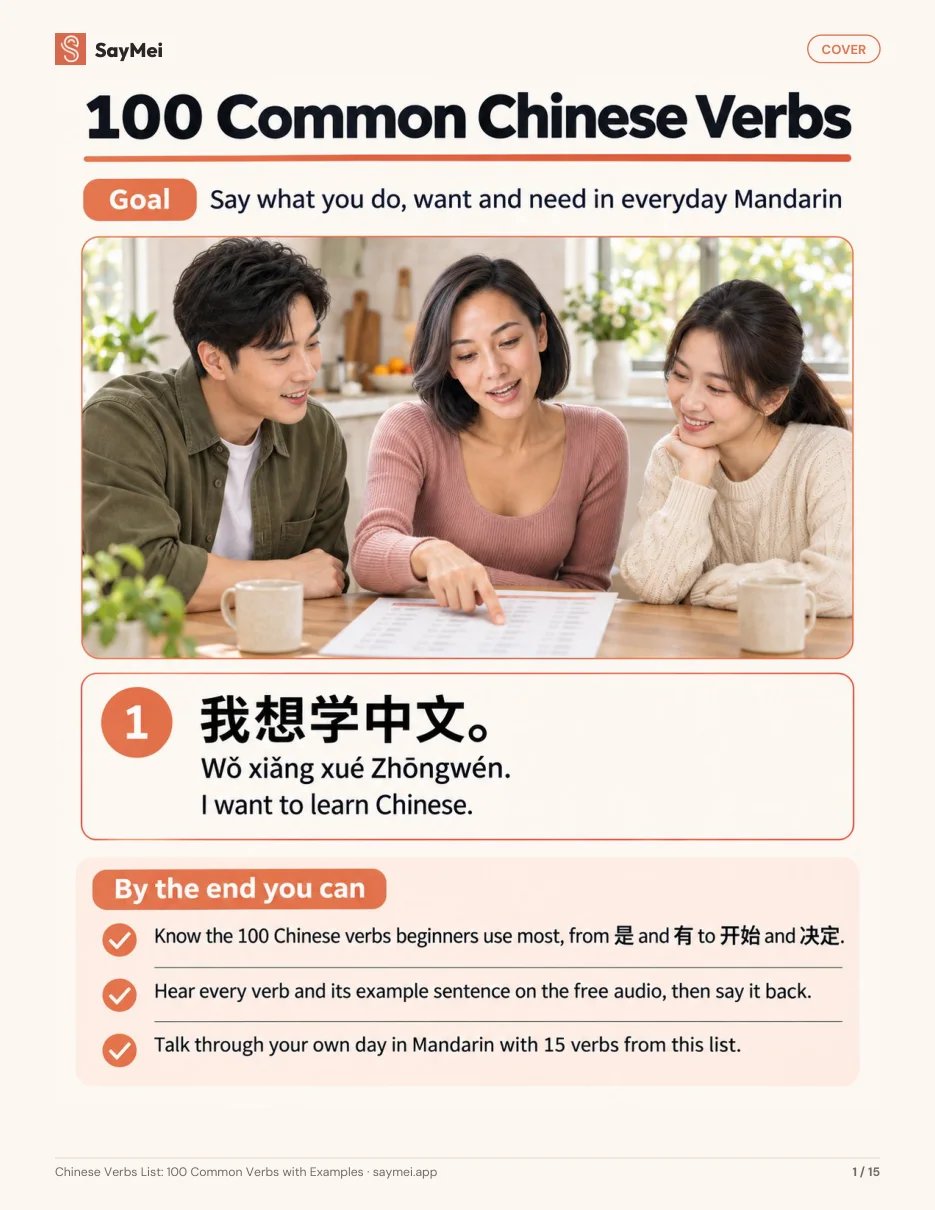
我想学中文。 · Wǒ xiǎng xué Zhōngwén. · I want to learn Chinese.
By the end you can
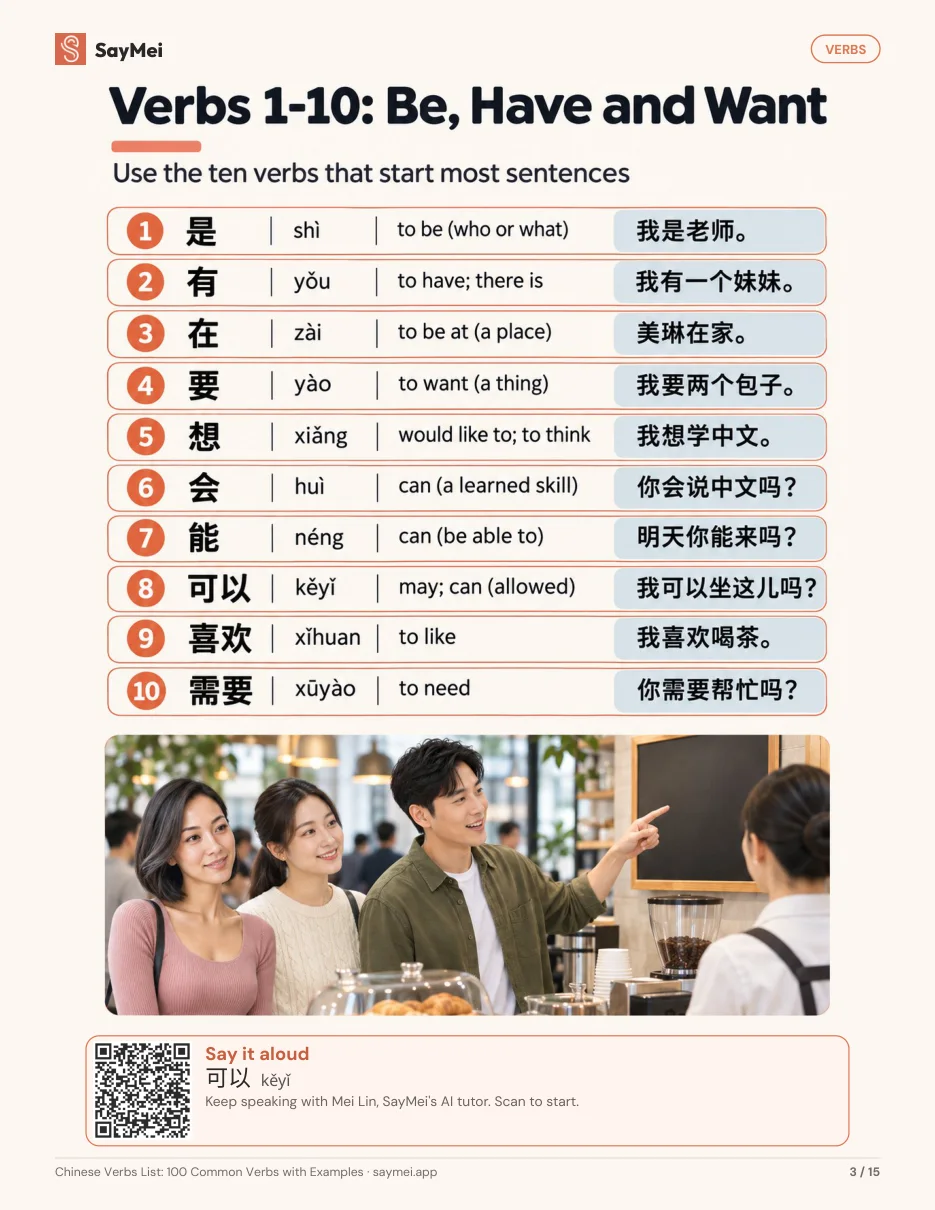
- Use the ten verbs that start most sentences. Say who you are with 是, what you have with 有 and what you want with 要 and 想, and tell 会, 能 and 可以 apart: a learned skill, being able, being allowed.
会 · huì · can (a learned skill) - Say where you go and how you get there. Use 去, 来, 回 and 到 for coming and going, and 坐 for the subway or bus, as in 我坐地铁上班 and 我六点回家.
坐 · zuò · to sit; to take (a bus, train) - Talk about your day, your job and your classes. Say when you 起床, 上班, 下班 and 睡觉, and talk about study with 学习, 写, 考试 and 练习.
起床 · qǐchuáng · to get up - Ask, tell and chat with people. Ask with 问, tell with 告诉, introduce with 介绍 and treat a friend with 请, as in 今天我请你吃饭.
请 · qǐng · to invite; to treat - Say what you know, think and feel. Use 知道 for a fact and 认识 for a person, give an opinion with 觉得, and say what you remember, hope or worry about.
认识 · rènshi · to know (a person) - Shop, borrow, and look for and find things. Buy, give and borrow with 买, 送 and 借, and pair 看 with 看见 and 找 with 找到: looking and seeing, searching and finding.
看见 · kànjiàn · to see - Start, plan and finish things, then tell your whole day. Use 开始, 打算, 决定 and 完 after a verb, as in 我吃完了, then describe a day from morning to night with 15 verbs from the list.
打算 · dǎsuàn · to plan
What’s inside
- Verbs: Verbs 1-10: Be, Have and Want · Verbs 11-20: Move and Go · Verbs 21-30: Daily Life · Verbs 31-40: Say, Ask and Talk · Verbs 41-50: Think and Feel · Verbs 51-60: Work and Study · Verbs 61-70: Buy, Give and Use · Verbs 71-80: See, Hear and Find · Verbs 81-90: Make, Open and Close · Verbs 91-100: Start and Finish
- Practice: Pick the Verb, Make the Sentence · Tell Your Day with 15 Verbs
How to use this book
Ten pages of ten verbs, then a practice page and a review. Play the free audio, which reads each verb and its example, say it back in the pause, then change one word to make the sentence about you. A page a day takes about two weeks.
- Days 1–2: Be, have, want and go. Verbs 1 to 20. Start with 是, 有 and 想, sort out 会, 能 and 可以, then say how you get to work with 坐.
- Days 3–5: Daily life, talking and feelings. Verbs 21 to 50. Say your morning with 起床 and 吃, then practise 知道 for facts and 认识 for people.
- Days 6–8: Work, shopping and finding. Verbs 51 to 80. Talk about your job and classes, then pair 看 with 看见 and 找 with 找到.
- Days 9–10: Home, plans and finishing. Verbs 81 to 100. Say what you do at home, plan your weekend with 打算, and say 我吃完了 when you're done.
- Days 11–12: Pick the verb, tell your day. Pages 13 and 14. Choose the right verb in each pair, write the verbs you hear, then tell your own day with at least eight verbs. Check your answers at the back.
Who it’s for
Beginners who want the verbs they'll use every day in one place, from 是 and 有 to 开始 and 决定, each in a short example sentence. It works as a reference beside any course, and pairs with the Beginner Chinese Grammar Workbook for the patterns behind the sentences.
Before you start: Some pinyin helps: every verb has its pinyin and English, and the example sentences are in characters. The free audio reads each verb and its example with a pause to say it back.
Frequently asked questions
Do Chinese verbs change for past, present or person?
No. 我去, 他去 and 我们去 all use the same 去, so you learn each verb once and use it everywhere. Page 2 of the book explains this.
What's the difference between 会, 能 and 可以?
All three can mean "can". 会 is a skill you learned (你会说中文吗?), 能 is being able to (明天你能来吗?) and 可以 is being allowed (我可以坐这儿吗?). They're side by side on page 3.
Which verbs are in the list?
The 100 verbs beginners use most, in ten groups of ten: be, have and want; moving and going; daily life; saying and asking; thinking and feeling; work and study; buying and using; seeing and finding; making, opening and closing; and starting and finishing.
Is this workbook free?
Yes. The whole 15-page PDF is free, and you can look through its pages here before you download. There's no card and nothing to pay.
Do I need a SayMei account?
Yes, to download the PDF, and the account is free: sign up with Google, Apple or your email address. With it we email you a copy of the workbook, keep every workbook you download on your account on all your devices, save your place in the free online practice, and you can practise speaking with Mei Lin, SayMei's AI tutor.
How do I print it?
The PDF is US Letter size. On A4 paper, choose "Fit to page" (or "Scale to fit") in the print dialog so nothing is cut off. Print the whole workbook or only the pages you need; colour looks best, and black and white works too.
Can I print copies for my class?
Yes. Print as many copies as you like for your own class or family. To share it, send this page: everyone can download their own copy.
Keep going
Chinese Sentence Structure: Build Sentences from Short to Long · Chinese Measure Words List: The Ones You Need, in Real Sentences · Two Essential Uses of 了 (le) · How to Use 吧, 吗, 呢 and 啊 in Chinese · Browse all 294 workbooks
Version 2026-11 · Updated Nov 4, 2026 · Report a correction