Conversation · Beginner to intermediate
Chinese Vocabulary List by Topic: 1,000 Everyday Words in 40 Topics, with Pinyin and Audio
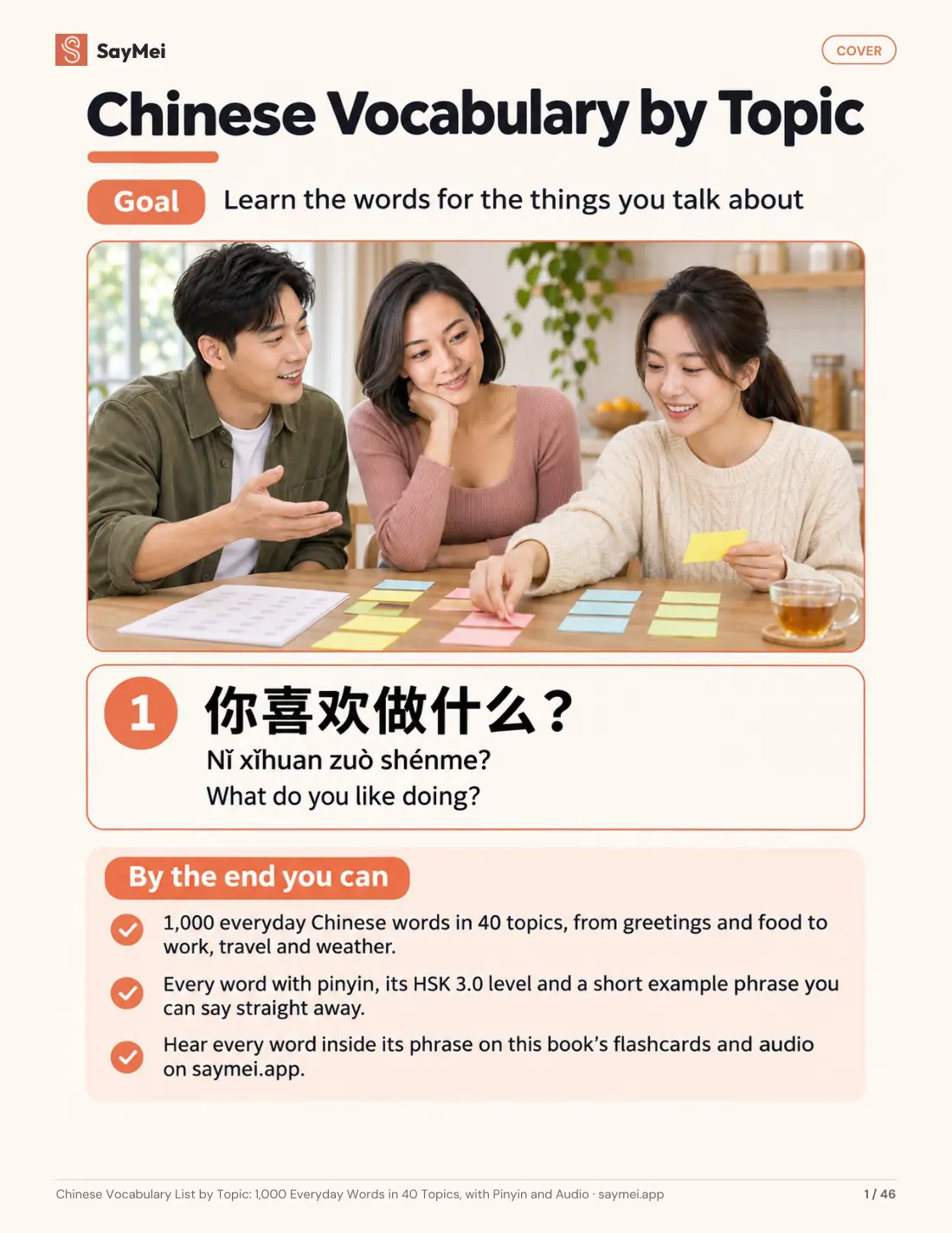
1,000 everyday Chinese words sorted into 40 topics, from greetings, food and family to work, travel and weather, each with pinyin, HSK 3.0 level and a short example phrase.
- Level:
- Beginner to intermediate · HSK 1–3
- Format:
- Reference guide · PDF · 46 pages · US Letter (prints on A4)
- Price:
- Free · free with a saymei account · updated Nov 17, 2026
Listening audio: play every track free, no account needed.
Download the free PDF: create a free SayMei account on this page, and we'll email you a copy too.
你喜欢做什么? · Nǐ xǐhuan zuò shénme? · What do you like doing?
By the end you can
- Learn the words for what you talk about. Each topic page holds the 25 words you need for one part of life, so you can get ready for a meal out, a doctor's visit or a first day at work in one sitting.
点菜 · diǎncài · to order (food) - Start with the most useful words. Inside each topic the words run from most useful to least, so the first ten on any page are the ones to learn first.
天气 · tiānqì · weather - See every word's HSK level. A small tag under the pinyin gives the word's HSK 3.0 level, so beginners can tick the HSK 1 and 2 words first and exam learners can see what's ahead.
护照 · hùzhào · passport - Learn words inside short phrases. Every word has a short example phrase with pinyin and English, like 带伞 for 伞 and 去超市 for 超市, so you learn it the way people say it.
带伞 · dài sǎn · take an umbrella - Say one useful sentence for every topic. Each topic opens with a Say it line, a full sentence that uses the topic's top words, to say aloud before you start the list.
你今天心情怎么样? · Nǐ jīntiān xīnqíng zěnmeyàng? · How are you feeling today? - Hear every phrase. Scan the QR code on any topic page for this book's flashcards on saymei.app, and play the topic's audio track to hear each example phrase.
听音乐 · tīng yīnyuè · listen to music
What’s inside
- Start Here: Which Topic First? · One Frame, Many Sentences · Self-Check: Words by Topic
- Word list: Chinese Vocabulary by Topic
How to use this book
Start with the Start Here pages, then pick a topic from the map and learn ten words a day. Say each example phrase aloud, check it on the flashcards with audio, and tick the box once you can use the word without looking.
- Day 1: Start Here. Pages 3 to 5. Pick your first topics from the map, learn the sentence-frame trick and do the self-check.
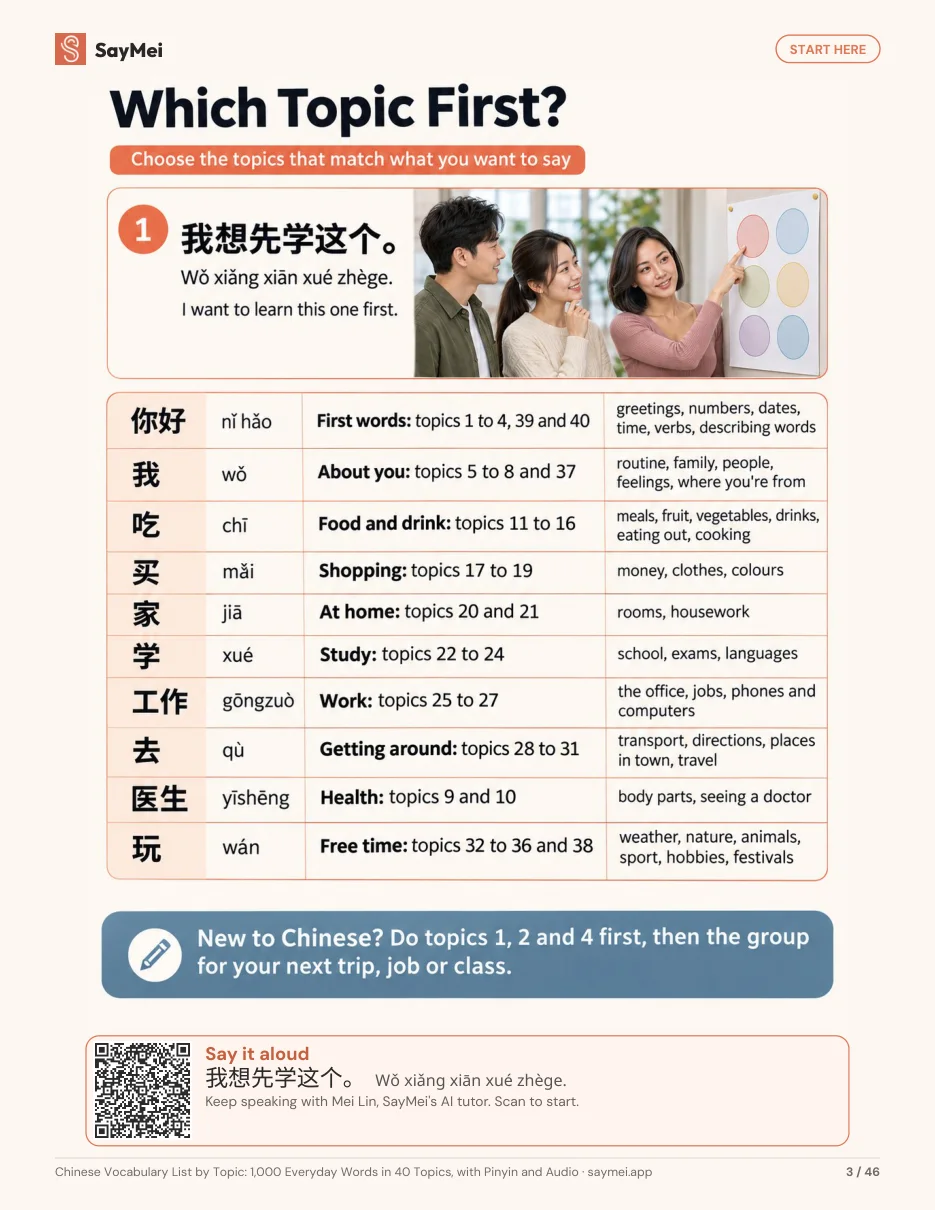
- Days 2–13: First words. Topics 1 to 4, 39 and 40: greetings, numbers, dates, time, everyday verbs and describing words.
- Days 14–60: Your topics. The groups on the map that fit your life: food, travel, work, study or home. One topic every two or three days.
- Days 61–100: The rest of the book. Finish the other topics, then go back over every word you haven't ticked.
Who it’s for
Adult learners and students who want everyday Chinese vocabulary sorted by topic in one printable list, to learn on their own or beside any course.
Before you start: Knowing pinyin helps: every word and example has its pinyin and English. The book's flashcards on saymei.app play every word.
Frequently asked questions
Which topics are in the book?
Forty everyday topics: greetings, numbers, dates, time, daily routine, family, people, feelings, body, health, food, fruit, vegetables, drinks, eating out, cooking, shopping, clothes, colours, home, housework, school, exams, languages, work, jobs, phones and the internet, transport, directions, places in town, travel, weather, nature, animals, sport, hobbies, countries, festivals, everyday verbs and describing words.
How were the words chosen?
We chose the 25 words a learner needs most for each topic and put them in order of use, the most useful first. Each word appears once in the book, in the topic where you would reach for it. The HSK levels come from the 2025 HSK 3.0 syllabus; words such as fruit and vegetable names that aren't on the HSK list say "no HSK level".
Is there audio?
Yes. Scan the QR code on any topic page to open this book's flashcards on saymei.app, which play every word. Each topic also has an audio track that reads its Say it line and every example phrase.
How is this different from the 1,000 most common words list?
The most common words list puts words in order of how often they're used overall. This book sorts words by what you're talking about, so it also has the words you need for one situation, like 菜单 at a restaurant or 护照 at the airport, even when they aren't among the most common words. About half of its words are on both lists.
What should I use next?
The 1,000 Most Common Chinese Words gives the most used words in order of frequency, and the Chinese Vocabulary Charts turn twelve topics into picture posters to pin up.
Do I need a SayMei account?
Yes, to download the PDF, and the account is free: sign up with Google, Apple or your email address. With it we email you a copy of the workbook, keep every workbook you download on your account on all your devices, save your place in the free online practice, and you can practise speaking with Mei Lin, SayMei's AI tutor.
How do I print it?
The PDF is US Letter size. On A4 paper, choose "Fit to page" (or "Scale to fit") in the print dialog so nothing is cut off. Print the whole workbook or only the pages you need; colour looks best, and black and white works too.
Keep going
Chinese Vocabulary Charts: 12 Printable Topic Posters with Pinyin and Audio · The 1,000 Most Common Chinese Words: Frequency List with Pinyin and Audio · Chinese Slang and WeChat Texting Cheat Sheet · Chinese Numbers 1–100 Chart: Pinyin, Tones and Practice · Browse all 367 workbooks
In these collections: Chinese Vocabulary Lists to Print · Chinese Cheat Sheets and Charts · Mandarin Conversation Workbooks · HSK 3 Chinese Workbooks
Version 2026-11 · Updated Nov 17, 2026 · Report a correction