Getting started · Total beginner to beginner
Chinese Worksheets for Beginners: 15 Topics with Answer Key
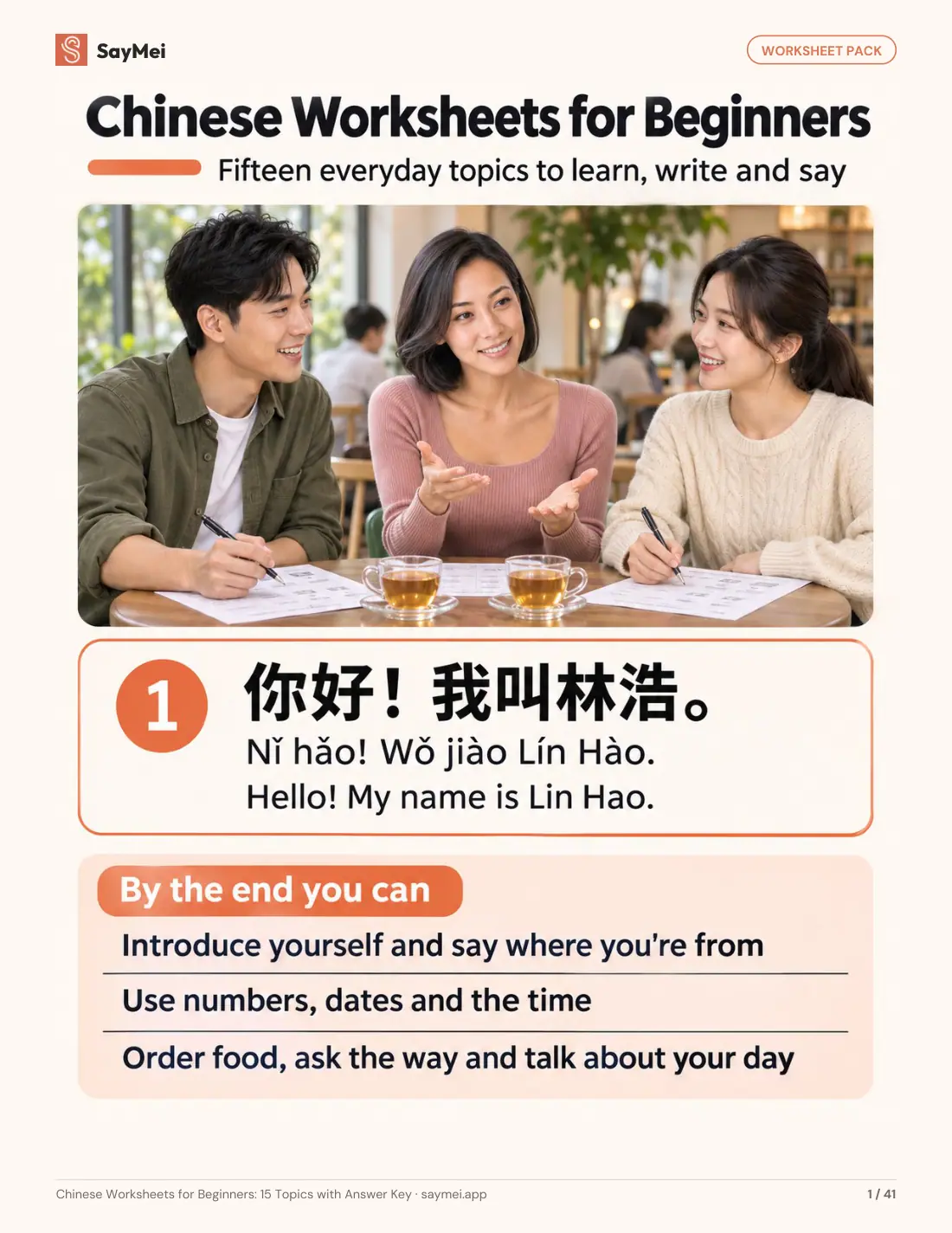
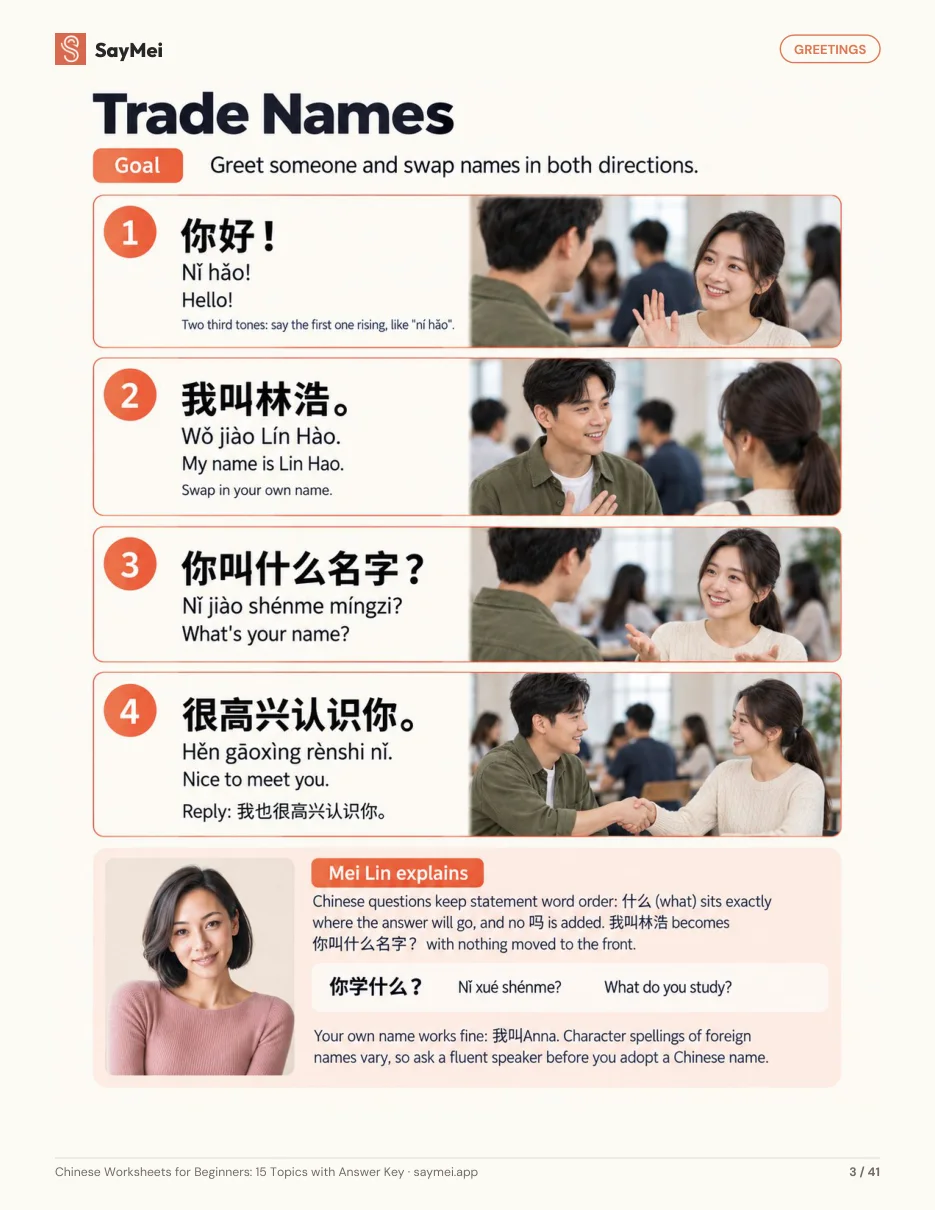
You trade names, build numbers up to 99, order tea and dumplings, give two-step directions and say how you feel, with the answers to every exercise at the back. Made for learners starting from zero.
- Level:
- Total beginner · HSK 1
- Format:
- Worksheet pack · PDF · 42 pages · US Letter (prints on A4)
- Price:
- Free · free with a saymei account · updated Nov 11, 2026
Download the free PDF: create a free SayMei account on this page, and we'll email you a copy too.
你好!我叫林浩。 · Nǐ hǎo! Wǒ jiào Lín Hào. · Hello! My name is Lin Hao.
By the end you can
- Introduce yourself and say where you're from. Greet someone, swap names both ways, add 人 to a country for your nationality, then send the question back with 你呢 instead of repeating it.
我来自上海。你呢? · Wǒ láizì Shànghǎi. Nǐ ne? · I'm from Shanghai. And you? - Build any number up to 99. A digit before 十 multiplies it and a digit after adds to it, so 四十 is 40 and 十四 is 14. The Practice page adds 二 or 两 and numbers up to 一万.
七十八 · qīshíbā · 78 - Say and write dates from big to small. Put the year, then the month, then the day, say 号 and write 日, find the missing weekday and give your own birthday.
二〇二六年九月五号 · èr líng èr liù nián jiǔyuè wǔ hào · September 5, 2026 - Tell the time and describe your morning. Use 点, 半 and 分, say 两点 and never 二点, then tell someone when you wake up, get up and eat breakfast.
我七点起床。 · Wǒ qī diǎn qǐchuáng. · I get up at seven. - Talk about your parents, brothers and sisters. Pick 哥哥, 姐姐, 弟弟 or 妹妹 by age, say how many you have with 有, and ask someone else with 吗.
我有一个哥哥。 · Wǒ yǒu yí ge gēge. · I have an older brother. - Ask for what you want in a café or a shop. Order water, tea, coffee, rice, noodles and dumplings with 我要 or 我想要, answer 吗 questions with 要 or 不要, and ask for clothes with 我想买.
我想要水,谢谢。 · Wǒ xiǎng yào shuǐ, xièxie. · I'd like water, thank you. - Say thank you and choose the right sorry. Reply to thanks with 不客气, apologise for a real mistake with 对不起, and use 不好意思 for small trouble, with the tone change on 不.
不好意思,我来晚了。 · Bù hǎoyìsi, wǒ lái wǎn le. · Sorry I'm a bit late. - Give and follow two-step directions. Go straight, turn left or right, join the steps with 先 and 然后, and check you've understood with 对吗.
一直走,然后左转。 · Yìzhí zǒu, ránhòu zuǒzhuǎn. · Go straight, then turn left. - Chat about the weather, your hobbies and how you feel. Say 是晴天 but 下雨, ask someone's hobby with 爱好 and 喜欢, and say how you feel with 很, never 是.
今天天气怎么样? · Jīntiān tiānqì zěnmeyàng? · How is the weather today?
What’s inside
- Greetings: Trade Names · Swap Names Both Ways
- Where you're from: Say Where You're From · Origins and Asking Back
- Numbers: Build Any Number Up to 99 · Build and Fix Numbers
- Dates: Dates Go from Big to Small · Dates and Weekdays
- Time: What Time Is It? · Telling the Time
- Family: Parents, Brothers and Sisters · Practice: Parents and Siblings
- Drinks: Water, Tea and Coffee · Ask for a Drink
- Food: Rice, Noodles and Dumplings · Order Food, Answer Yes or No
- Thanks and sorry: Thank You and You're Welcome · Two Kinds of Sorry · Thanks or Sorry?
- Directions: Go Straight, Then Turn · Direction Drills
- Weather: Sunny, Cloudy or Rainy? · Talk About Today's Sky
- Hobbies: Asking About Hobbies · Practice: Asking About Hobbies
- Feelings: Happy, Sad and Tired · Practice: Basic Feelings
- Clothes: Name the Clothes You Want · Pick the Right Clothes Word
- Daily routine: Your Morning Routine · Morning Routine Practice
The pages come from How to Introduce Yourself in Chinese: Phrases and Follow-Up Questions · Chinese Numbers, Dates and Telling Time: Prices, Weekdays and the Clock · Talk About Your Day: Mandarin Daily Routines Workbook · Family Members in Chinese: Family Tree Chart and What to Call Every Relative · Order Food and Drinks in Mandarin · Thank You, Sorry and Please in Chinese: Polite Phrases and Saying No · Directions in Chinese: Left, Right, Taxis and the Subway · Weather & Seasons: Read Forecasts and Make Plans · Hobbies in Chinese: Sports, Free Time and Invitations · Feelings in Chinese: Happy, Sad, Tired and How to Say Why · Clothes and Colors in Chinese: Sizes, Prices and Shopping Phrases.
How to use this book
Fifteen topics, each a Learn page and a Practice page. Do one topic a day, or start with the one you need this week. The answers to every exercise are on pages 34 to 41.
- Days 1–2: Meeting people. Names, then where you're from. Read the Learn page aloud twice, then cover the English and say each line from the Chinese.
- Days 3–5: Numbers, dates and the time. Build numbers, write dates from big to small and tell the time. Do each Practice page without looking back.
- Days 6–8: Family, drinks and food. Your brothers and sisters, then ordering in a café and answering 吗 questions.
- Days 9–11: Thanks, directions and weather. Thank you and two kinds of sorry, two-step directions, and what the sky is doing today.
- Days 12–15: Hobbies, feelings, clothes and your morning. Talk about what you like, how you feel, what you want to buy and what you do after you wake up.
- Every day: Check and say it. Mark your page with the answer key, then say every corrected line out loud. The Say it box has no single right answer: say your own version.
Who it’s for
Adult beginners who want printed practice on everyday topics, and tutors who need a ready worksheet on one topic. Each pair of pages comes from one of SayMei's beginner workbooks.
Before you start: Nothing. Every line on the Learn pages is printed in characters, pinyin and English, and each topic stands on its own, so you can start anywhere.
Frequently asked questions
What topics do these worksheets cover?
Fifteen: greetings, where you're from, numbers, dates, the time, family, drinks, food, thanks and sorry, directions, the weather, hobbies, feelings, clothes and your morning routine. Each has a Learn page and a Practice page on pages 3 to 33 (thanks and sorry has two Learn pages), and the answer key is on pages 34 to 41.
Where do the pages come from?
Every worksheet is a page from one of SayMei's beginner workbooks, such as How to Introduce Yourself in Chinese and Order Food and Drinks in Mandarin, renumbered for this pack. Page 2 names the workbook behind each topic, so you can download the full book when you want more on that topic.
Do I need to know any Chinese first?
No. The Learn pages print every line in characters, pinyin and English, and explain one small point each, such as when to say 两 instead of 二 or why 我很累 needs no 是. The Practice pages then ask you to write and say the lines yourself.
How long does the pack take?
One topic a day takes you through all fifteen in fifteen days. You can also take topics in any order: each one stands on its own.
Is there audio?
No, the pack has no audio. Every Chinese line has pinyin with tone marks, and the Learn pages add pronunciation notes, such as saying the second 谢 in 谢谢 short and light.
What should I use after this pack?
Pick the topic you enjoyed most and download its full workbook from page 2's list. For speaking day by day, Your First 14 Days of Spoken Mandarin builds one short exchange a day, from your name to ordering a drink and asking the way.
Do I need a SayMei account?
Yes, to download the PDF, and the account is free: sign up with Google, Apple or your email address. With it we email you a copy of the workbook, keep every workbook you download on your account on all your devices, save your place in the free online practice, and you can practise speaking with Mei Lin, SayMei's AI tutor.
How do I print it?
The PDF is US Letter size. On A4 paper, choose "Fit to page" (or "Scale to fit") in the print dialog so nothing is cut off. Print the whole workbook or only the pages you need; colour looks best, and black and white works too.
Keep going
Free Mandarin Textbook for Beginners: The SayMei Practice Book · Chinese Level Test: Beginner to HSK 4, with Answer Key and Audio · Chinese Quiz for Beginners: 20 Printable Quizzes on Pinyin, Words and Characters, with Answers and Audio · Spoken Mandarin in 60 Days: The Complete Speaking Course · Browse all 340 workbooks
Version 2026-11 · Updated Nov 11, 2026 · Report a correction