Grammar · Beginner
Chinese Grammar Lesson Plans: Teacher Guide to Chinese Sentence Structure
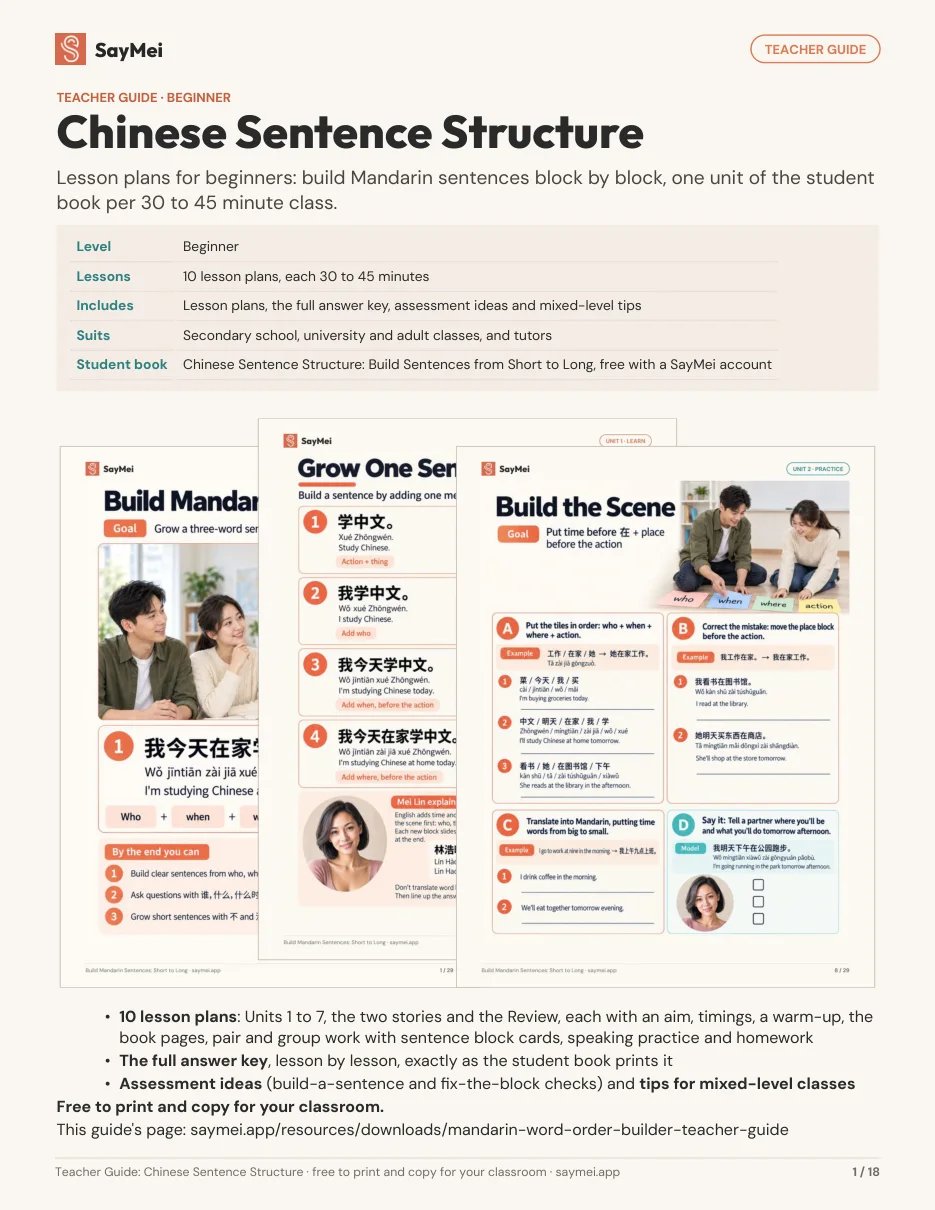
10 lesson plans of 30 to 45 minutes for beginners, teaching Chinese word order with sentence block cards, with pair and group work, homework, the full answer key and assessment ideas
- Level:
- Beginner · HSK 1
- Format:
- Teacher guide · PDF · 18 pages · US Letter (prints on A4)
- Price:
- Free · free with a saymei account · updated Nov 5, 2026
Download the free PDF: create a free SayMei account on this page, and we'll email you a copy too.
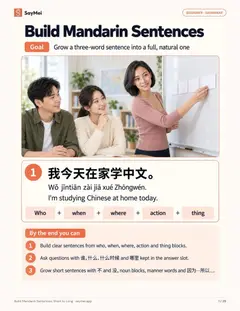
我今天在家学中文。 · Wǒ jīntiān zài jiā xué Zhōngwén. · I'm studying Chinese at home today.
By the end you can
- Plan ten classes from the course map. The course map lists each lesson with its student book pages and a model sentence to build with block cards on the board.
- Make one set of sentence block cards for the term. One word or block per card, coloured by slot as in the book: who, when, where and action, with more colours for how, thing, negatives and question words.
我今天在家学中文。 · Wǒ jīntiān zài jiā xué Zhōngwén. · I'm studying Chinese at home today. - Teach time and place before the action. In Lessons 1 to 3 students hold the cards and line up as human sentences, fix broken lines in pairs and build sentences about Lin Hao's busy week.
林浩在图书馆看书。 · Lín Hào zài túshūguǎn kàn shū. · Lin Hao reads at the library. - Turn answers into questions without moving a block. Lesson 4 swaps one block for 谁, 什么, 什么时候 or 哪里 and leaves everything else in place, with no 吗.
你什么时候去上海? · Nǐ shénme shíhou qù Shànghǎi? · When are you going to Shanghai? - Teach 不 and 没, then the noun block. Lesson 5 places 不 or 没 after the time, right before the action. Lesson 6 builds a noun block from small cards and clips it together with a paper clip.
我昨天没上班。 · Wǒ zuótiān méi shàngbān. · I didn't go to work yesterday. - Add how and why, then repair broken sentences. Lessons 7 to 9 add a how word and 因为…所以…, read Xiaoyu's rainy day, and turn students into block doctors who fix a sentence and name the block they moved.
因为下雨,所以我在家吃饭。 · Yīnwèi xiàyǔ, suǒyǐ wǒ zài jiā chīfàn. · Because it's raining, I'm eating at home. - Check progress with build, fix and say tasks. A midway check after Lesson 5 and an end-of-book check in Lesson 10, plus a three-step scale and the mistakes to listen for, unit by unit.
- Adapt each lesson for a mixed-level class. Keep everyone on the unit's new block and change how many blocks each student handles. Heritage speakers name each block and its slot and act as block doctors.
- Mark homework with the answer key. The book's answers by lesson. Where the key adds Also, accept either order. The Say it tasks and the Your Turn page have no single answer.
Use it with
The student book: Chinese Sentence Structure: Build Sentences from Short to Long. Your class downloads it free with a SayMei account.
Chinese Sentence Structure: Build Sentences from Short to Long
Beginner · 30 pages · practice online
What’s inside
- Course map: Course map
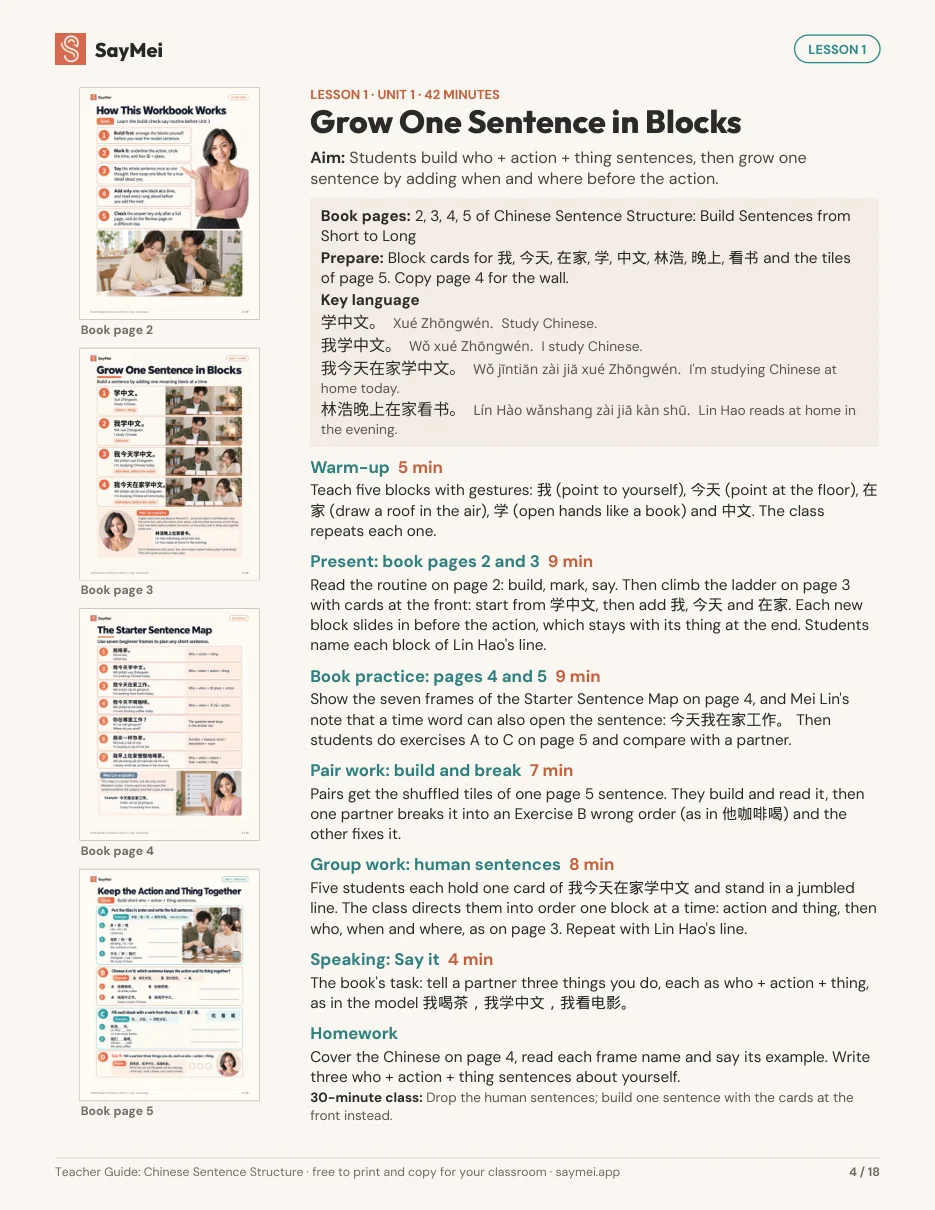
- Lesson 1: Grow One Sentence in Blocks
- Lesson 2: Put Time and Place Before the Action
- Lesson 3: Lin Hao's Busy Week
- Lesson 4: Leave the Question Word in Place
- Lesson 5: Put 不 or 没 Before the Action
- Lesson 6: Build the Noun Block First
- Lesson 7: Add How and Why
- Lesson 8: Xiaoyu's Rainy Day
- Lesson 9: Fix the Smallest Broken Block
- Lesson 10: Plan a Weekend and Build Your Own Sentence
- Assessment: An exit sentence every lesson, the midway and end-of-book checks, a three-step scale, writing checks and the mistakes to listen for. Check building, fixing and saying
- Mixed levels: Support and stretch ideas built around the block cards, plus heritage speakers and students who missed a lesson. Teach a mixed-level class
- Answer key: The student book's answers, lesson by lesson, with the book page for each set of exercises. Answer key · Answer key · Answer key
How to use this book
One lesson per unit or story of the student book, 41 to 45 minutes each, with a note on what to drop for a 30-minute class.
- Before term: Make the cards and the wall map. Cut block cards big enough to read from the back and keep a set per unit in an envelope. Put the seven frames of the book's Starter Sentence Map on the wall.
- Each lesson: Build, mark, say. Warm-up, the Learn page, the Practice page, pair work with cards, a group activity and the book's Say it task. When a sentence goes wrong, point to its frame on the wall.
- After Lesson 5: Midway check. Five minutes per student or pair with the book closed: build a sentence from tiles, fix two broken ones, ask a question and say one true sentence.
- Before Lesson 10: Leave a day. The book asks for the Review on a different day, so leave a day between Lessons 9 and 10.
- Lesson 10: End-of-book check. Each student says their own sixth-rung sentence without reading, answers a question, fixes two sentences and builds one long sentence from cards.
Who it’s for
Teachers of beginner Mandarin who want word order taught hands-on: school, university and adult classes, and tutors working with a small group. Once a week, the ten classes fill a term.
Before you start: Your class needs the student book, Chinese Sentence Structure: Build Sentences from Short to Long, free with a SayMei account. Students download their own copy, or you hand out printed pages. You also need card for the block cards.
Frequently asked questions
What level are the students?
Beginners. The book uses everyday words such as tea, coffee, home and the library, so attention stays on the order. Every line is printed in characters, pinyin and English.
How many classes does it take?
Ten lessons of 41 to 45 minutes: the seven units, the two stories and the Review. Once a week, they fill a term. Three times a week, they take about a month.
What are sentence block cards?
Cards you make with one word or block each, coloured by its slot in the sentence. Students hold them and rearrange themselves in a line, or pairs move small cards at their desks. The guide's how-to page explains how to make them.
Is there audio?
No. The student book has no audio, so you are the model for every line.
Is this teacher guide free?
Yes. The whole 18-page PDF is free, and you can look through its pages here before you download. There's no card and nothing to pay.
Do I need a SayMei account?
Yes, to download the PDF, and the account is free: sign up with Google, Apple or your email address. With it we email you a copy of the workbook, keep every workbook you download on your account on all your devices, save your place in the free online practice, and you can practise speaking with Mei Lin, SayMei's AI tutor.
How do I print it?
The PDF is US Letter size. On A4 paper, choose "Fit to page" (or "Scale to fit") in the print dialog so nothing is cut off. Print the whole workbook or only the pages you need; colour looks best, and black and white works too.
Can I copy it for my class?
Yes. Print and copy as many pages as you like for your own classes. Your students can download the student book from its page, free with a SayMei account.
Keep going
Chinese Sentence Structure: Build Sentences from Short to Long · Chinese Measure Words List: The Ones You Need, in Real Sentences · Two Essential Uses of 了 (le) · How to Use 吧, 吗, 呢 and 啊 in Chinese · Browse all 294 workbooks
Version 2026-11 · Updated Nov 5, 2026 · Report a correction