Read Chinese News: Headlines, Summaries & Fact–Opinion Practice
You put back the words headlines drop, read 同比 and 环比 figures, and follow stories on robot waiters and a school phone ban. For learners who read everyday Chinese but stall on the news.
Level:
Upper intermediate · HSK 4
Format:
Workbook · PDF · 35 pages · US Letter (prints on A4)
Price:
Free · free with a saymei account · updated Oct 8, 2026
Download the free PDF: create a free SayMei account on this page, and we'll email you a copy too.
你今天看新闻了吗? · Nǐ jīntiān kàn xīnwén le ma? · Have you read the news today?
By the end you can
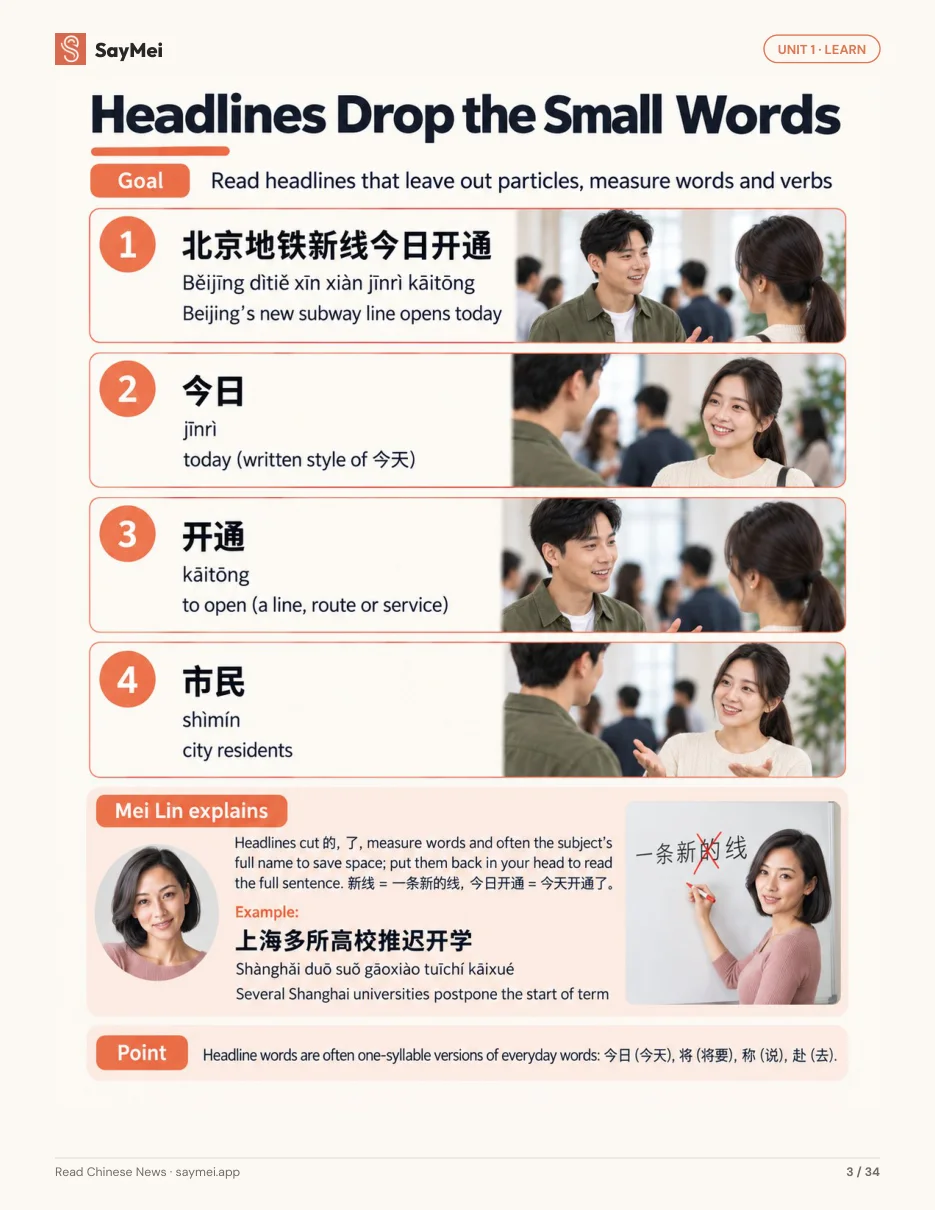
Expand a compressed headline into a full sentence. Headlines cut 的, 了, measure words and often part of a name. Put them back in your head: 新线 is 一条新的线, 今日开通 is 今天开通了. 北京地铁新线今日开通 · Běijīng dìtiě xīn xiàn jīnrì kāitōng · Beijing's new subway line opens today
Recognise one-character headline verbs. A single character usually stands for a spoken two-character word: 获 for 获得, 遭 for 遭到, 拟 for 打算, 将 for "will", 赴 for "go to". 外交部长将赴日本访问 · Wàijiāo bùzhǎng jiāng fù Rìběn fǎngwèn · Foreign minister will travel to Japan for a visit
Work out who did what, and when. Read 被, 遭 and 获 headlines and see who was affected, then place the event in time with written-style words like 日前, 近日, 截至 and 此前. 一名男子被警方带走 · Yì míng nánzǐ bèi jǐngfāng dàizǒu · A man is taken away by police
Find who, what, when and where in a news lead. Chinese news packs the key facts into the first sentence: time, place, who, what. Spot 据报道, 记者从…获悉 and 该, which points back to a noun already mentioned. 据报道 · jù bàodào · according to reports
Read growth, decline and comparison numbers. Tell 同比 (on last year) from 环比 (on the period before), a 5% rise from a rise of 5 百分点, and read 万 and 亿 without counting zeros. 同比增长 · tóngbǐ zēngzhǎng · year-on-year growth
Identify the source and how strongly it speaks. The reporting verb shows how the writer treats a claim: 指出 presents it as valid, 表示 is neutral, 声称 keeps its distance, and 据悉 means the source is not named. 该公司声称产品没有问题 · Gāi gōngsī shēngchēng chǎnpǐn méiyǒu wèntí · The company claims there is nothing wrong with the product
Tell facts from opinions. Facts can be checked: dates, numbers, actions. Opinions come with signal words like 认为, 应该, 显然 and 不合理, and one sentence can hold both. 票价为两元,但很多人认为太贵了 · Piàojià wéi liǎng yuán, dàn hěn duō rén rènwéi tài guì le · The fare is two yuan, but many people think it is too expensive
Summarise a news item in two sentences. Sentence one is who, what and when from the lead; sentence two is the key number, reason or reaction. Leave out quotes and opinions unless they are the news. 报道称 · bàodào chēng · the report says
What’s inside
Unit 1: Learn: Headlines Drop the Small Words · Learn: One-Character Headline Verbs · Practice: Unpack the Headline
Reference: Headline Word Bank
Unit 2: Learn: The Passive in Headlines · Learn: Time Words in News · Practice: Who Did What, and When?
Unit 3: Learn: The News Lead
Story 1: A New Bus Route · Practice: Find the Facts
Unit 4: Learn: Numbers Up and Down
Reference: Number and Trend Words
Story 2: Travel Over the Holiday · Practice: Read the Numbers
Unit 5: Learn: Who Says So? Reporting Verbs · Practice: Track the Source
Unit 6: Learn: Fact or Opinion?
Story 3: A Phone Ban at School · Practice: Sort Fact from Opinion
Unit 7: Learn: Summarise in Two Sentences
Story 4: Robots in the Restaurant · Practice: Write the Summary
Unit 8: Cards: News Section Words
Story 5: Electric Cars Go Abroad · Practice: Read Like an Analyst
Review: Talking About the News · Headline Challenge
Planner: Your Daily News Habit
How to use this book
Eight short units and five news stories, from headlines to a whole finance item. Work through one unit a sitting, then finish with the 10-minute daily habit on page 30.
Sitting 1: Headlines. Unit 1 and the headline word bank. Expand each practice headline into a full spoken sentence out loud.
Sitting 2: Who did what, and when. Unit 2: passive headlines and news time words.
Sitting 3: The lead and numbers. Units 3 and 4 with stories 1 and 2. Pull who, what, when, where and every number from each item.
Sitting 4: Sources, facts and opinions. Units 5 and 6, then Story 3. Mark each sentence of the phone-ban story as fact or opinion.
Sitting 5: Summaries and the analyst read. Unit 7 and Story 4, the news section words in Unit 8, then Story 5 with every skill at once.
Then daily: Your news habit. Do the two review pages, then follow the 10-minute routine on page 30 with a real Chinese news site.
Who it’s for
Upper-intermediate learners who can read everyday Chinese but stall on news: compressed headlines, written-style words and dense numbers.
Before you start: Read everyday Chinese in characters and know intermediate grammar. Every example has pinyin and English; the story texts are in characters with key words glossed.
Frequently asked questions
What does the book cover?
Eight short units and five news stories: a new bus route, holiday travel figures, a phone ban at school, robots in a restaurant and electric cars going abroad. The units run from headline verbs like 获 and 拟 to news time words, the lead, numbers, reporting verbs, fact and opinion, summaries and the words that label each news section.
Is there pinyin on the news stories?
The Learn pages give pinyin and English for every example. The five news stories are printed in characters, as real news is, with key words glossed underneath.
What level do I need?
Upper intermediate: you should read everyday Chinese in characters and know intermediate grammar. If you still want shorter texts first, Intermediate Chinese Short Stories has eight stories in characters only.
What's the difference between 同比 and 环比?
同比 compares with the same period last year; 环比 compares with the period just before. Unit 4 also explains why a rise of 5% is not the same as a rise of 5 百分点.
How long does it take?
Five sittings take you through the units and stories, ending with Story 5, which uses every skill at once. Then the 10-minute daily routine on page 30 has you keep going with a real Chinese news site.
What could I use next?
Write a Clear Chinese Essay, at the same upper-intermediate level, turns this into writing: planning paragraphs, citing data with 据调查 and 数据显示, and revising your draft.
Do I need a SayMei account?
Yes, to download the PDF, and the account is free: sign up with Google, Apple or your email address. With it we email you a copy of the workbook, keep every workbook you download on your account on all your devices, save your place in the free online practice, and you can practise speaking with Mei Lin, SayMei's AI tutor.
How do I print it?
The PDF is US Letter size. On A4 paper, choose "Fit to page" (or "Scale to fit") in the print dialog so nothing is cut off. Print the whole workbook or only the pages you need; colour looks best, and black and white works too.
Read Chinese News: Headlines, Summaries & Fact–Opinion Practice
You put back the words headlines drop, read 同比 and 环比 figures, and follow stories on robot waiters and a school phone ban. For learners who read everyday Chinese but stall on the news.