Characters · Beginner to intermediate
Traditional vs Simplified Chinese: See the Difference and Read Both
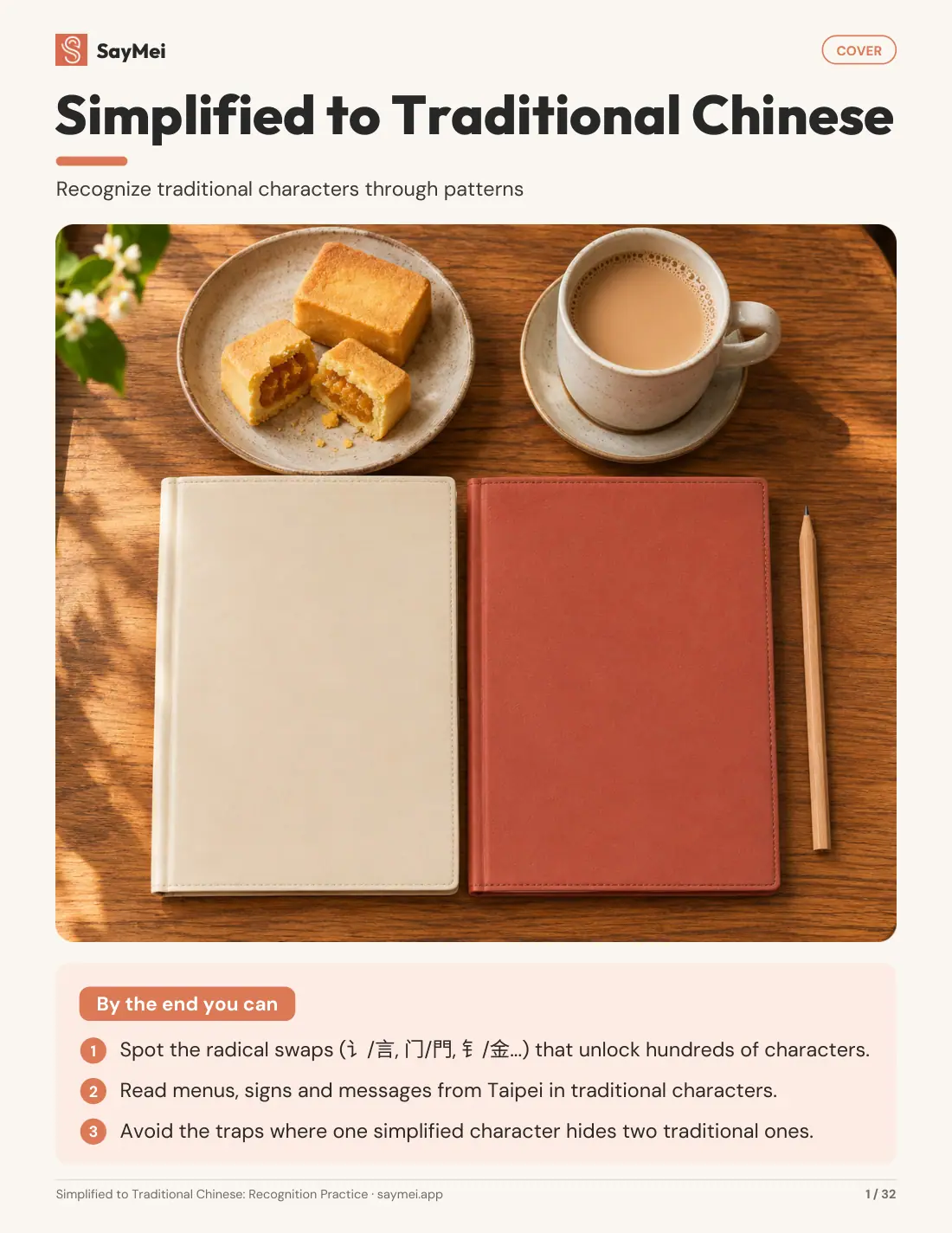
You see 讠 become 言 and 门 become 門, learn the top ten whole-character changes like 國 and 這, then read a Taipei menu in traditional characters. For learners who already read a few hundred simplified characters.
- Level:
- Beginner to intermediate · HSK 1–3
- Format:
- Workbook · PDF · 33 pages · US Letter (prints on A4)
- Price:
- Free · free with a saymei account · updated Oct 8, 2026
Download the free PDF: create a free SayMei account on this page, and we'll email you a copy too.
我看得懂繁体字。 · Wǒ kàn de dǒng fántǐzì. · I can read traditional characters.
By the end you can
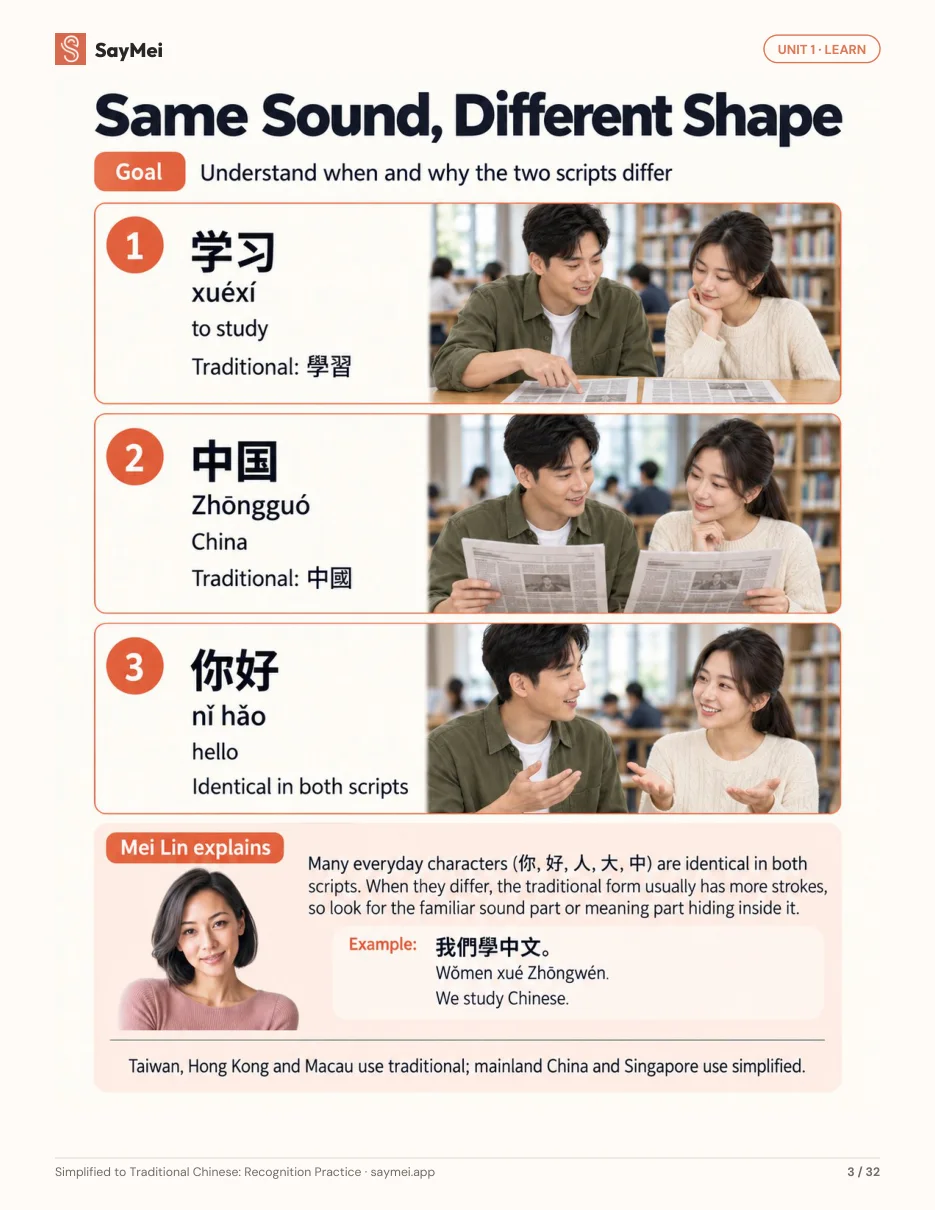
- Know when the two scripts differ, and when they don't. Many everyday characters, like 你, 好, 人, 大 and 中, are the same in both. When they differ, look for the familiar sound or meaning part inside the traditional form.
我們學中文。 · Wǒmen xué Zhōngwén. · We study Chinese. - Read the speech radical 言. The two-stroke 讠 always becomes the seven-stroke 言, and the right side usually stays the same: 說話, 謝謝, 認識, 漢語.
請說中文。 · Qǐng shuō Zhōngwén. · Please speak Chinese. - Spot the radical swaps for doors, money, food, silk and shells. 门 becomes 門, 钅 becomes 金 and 饣 becomes 飠, so you can read prices and menus. Then 糸 and 貝 for a night-market shopping trip.
我餓了,去吃飯吧。 · Wǒ è le, qù chīfàn ba. · I'm hungry, let's go eat. - Recognise 馬, 鳥, 魚 and 車. Animal and vehicle pictures regain their full shape, with legs and a full cart. Because 吗 contains 马, the question word 嗎 appears in almost every traditional message.
你媽媽會開車嗎? · Nǐ māma huì kāichē ma? · Can your mom drive? - Learn the high-frequency whole-character changes by sight. Some simplified forms swapped a whole part for a shortcut like 又, as in 对 to 對 and 汉 to 漢. The book gives the top ten to memorise, including 個, 這, 會 and 國.
我很喜歡漢字。 · Wǒ hěn xǐhuan Hànzì. · I really like Chinese characters. - Pick the right form when one simplified character hides two. Simplification merged some characters, so you convert by meaning: 发 is 髮 for hair but 發 for send, and 后 is 後 for after but stays 后 for queen.
他發了照片給我,以後再聊。 · Tā fā le zhàopiàn gěi wǒ, yǐhòu zài liáo. · He sent me a photo; we'll chat later. - Read real messages and a Taipei menu. Two stories, a dinner invitation from Mei Lin and a full menu dialogue are printed in traditional characters, with a conversion table and a checklist to finish.
你看得懂這個菜單嗎? · Nǐ kàn de dǒng zhège càidān ma? · Can you read this menu?
What’s inside
- Unit 1: Learn: Same Sound, Different Shape · Practice: Same or Different?
- Unit 2: Learn: Speech Radical: 讠 Becomes 言 · Practice: Spot the 言 Radical
- Unit 3: Learn: Door Radical: 门 Becomes 門 · Practice: Open the Door: 門 Words
- Unit 4: Learn: Money and Food: 金 and 飠 · Practice: Reading Prices and Menus
- Unit 5: Learn: Silk and Shells: 糸 and 貝 · Practice: Night Market Shopping
- Unit 6: Learn: Animals and Carts Get Legs · Practice: Reading Text Messages
- Reference: Radical Conversion Table
- Unit 7: Learn: Whole-Character Changes · Practice: Memory Match
- Unit 8: Learn: One Simplified, Two Traditional · Practice: Pick the Right Meaning
- Story 1: Lin Hao Asks the Way · Practice: Check Your Reading
- Story 2: A Message from Mei Lin · Practice: Reply to Mei Lin
- Cards: Top Traditional Characters
- Review: Reading a Taipei Menu
- Planner: Recognition Checklist
How to use this book
Eight short units, each a Learn page that shows a simplified word next to its traditional form, then a Practice page. Read before you convert: most of the time the shape you know is still inside.
- Unit 1: Same or different. See which characters are identical in both scripts and which change, and where each script is used.
- Units 2–6: Radical swaps. 言, 門, 金 and 飠, 糸 and 貝, then 馬, 鳥, 魚 and 車. Do each Practice page straight after its Learn page.
- Units 7–8: No-rule changes and traps. Memorise the whole-character changes, then choose between split forms like 髮 and 發 by meaning.
- Stories: Read real text. Read Lin Hao Asks the Way and Mei Lin's dinner message, check the details, and convert the key words.
- Review: A Taipei menu. Keep the radical conversion table and the top-character cards nearby, act out the menu dialogue, then tick off your checklist.
Who it’s for
Learners who read simplified characters and want to read traditional ones too: for travel to Taiwan or Hong Kong, family messages, or books and films from there.
Before you start: Read a few hundred simplified characters. Every word and story has pinyin and English, with the simplified form alongside.
Frequently asked questions
What's inside?
Eight short units, each a Learn page and a Practice page: which characters stay the same, the radical swaps for 言, 門, 金 and 飠, 糸 and 貝, then 馬, 鳥, 魚 and 車, whole-character changes, and characters that split in two. Then two stories, a conversion table, cards with the top characters, a Taipei menu dialogue and a checklist.
Is traditional Chinese pronounced differently?
No. The two scripts are two ways of writing the same words, so 說話 and 说话 are both read shuōhuà. The book is about reading the shapes.
What do I need to know before I start?
A few hundred simplified characters. Every word and story has pinyin and English, with the simplified form alongside, and many everyday characters, like 你, 好, 人 and 大, are the same in both scripts.
Why can one simplified character have two traditional forms?
Simplification merged some characters, so you convert by meaning. 发 is 髮 for hair but 發 for send, and 后 is 後 for after but stays 后 for queen. Pages 18 and 19 practise these.
Will I learn to write traditional characters?
This book is recognition practice. You convert words and fill in short answers, with answers to check each Practice page, but the aim is to read traditional text with confidence, not to drill stroke order.
What should I use next?
Taiwan Mandarin Phrasebook: Traditional Characters, Zhuyin and Pinyin gives you phrases to use in Taiwan. Zhuyin–Pinyin Bridge: Sounds, Symbols & Practice matches each bopomofo symbol to its pinyin.
Do I need a SayMei account?
Yes, to download the PDF, and the account is free: sign up with Google, Apple or your email address. With it we email you a copy of the workbook, keep every workbook you download on your account on all your devices, save your place in the free online practice, and you can practise speaking with Mei Lin, SayMei's AI tutor.
How do I print it?
The PDF is US Letter size. On A4 paper, choose "Fit to page" (or "Scale to fit") in the print dialog so nothing is cut off. Print the whole workbook or only the pages you need; colour looks best, and black and white works too.
Keep going
100 Common Chinese Characters, Learned by Component · Chinese Radicals Workbook: 50 Radicals to Read New Characters · How Chinese Characters Work: Radicals, Components and Stroke Order Basics · Learn 100 More Useful Chinese Characters by Component · Browse all 379 workbooks
In these collections: Traditional Chinese and Taiwan Mandarin Workbooks · Chinese Reading Workbooks · Chinese Character and Writing Workbooks · HSK 3 Chinese Workbooks
Version 2026-10 · Updated Oct 8, 2026 · Report a correction