World classic, retold in simple Mandarin
Greek Myths
希腊神话
Greek Myths (希腊神话, Xīlà shénhuà) is a legend, retold in simple Mandarin as a 6-chapter story with audio for learners at about HSK 1 (Beginner).
Six ancient Greek myths retold in simple Chinese: Pandora's box, King Midas, Echo and Narcissus, Arachne, Icarus and Persephone. Retold from the public-domain tales of ancient Greece.
Meet the voices
- Narrator · 旁白 — An old storyteller who tells these ancient Greek tales plainly, like a grandfather by the fire.
- Pandora · 潘多拉 — A curious young woman who cannot stop thinking about the closed box.
- Epimetheus · 爱比米修斯 — Pandora's cheerful, obedient husband.
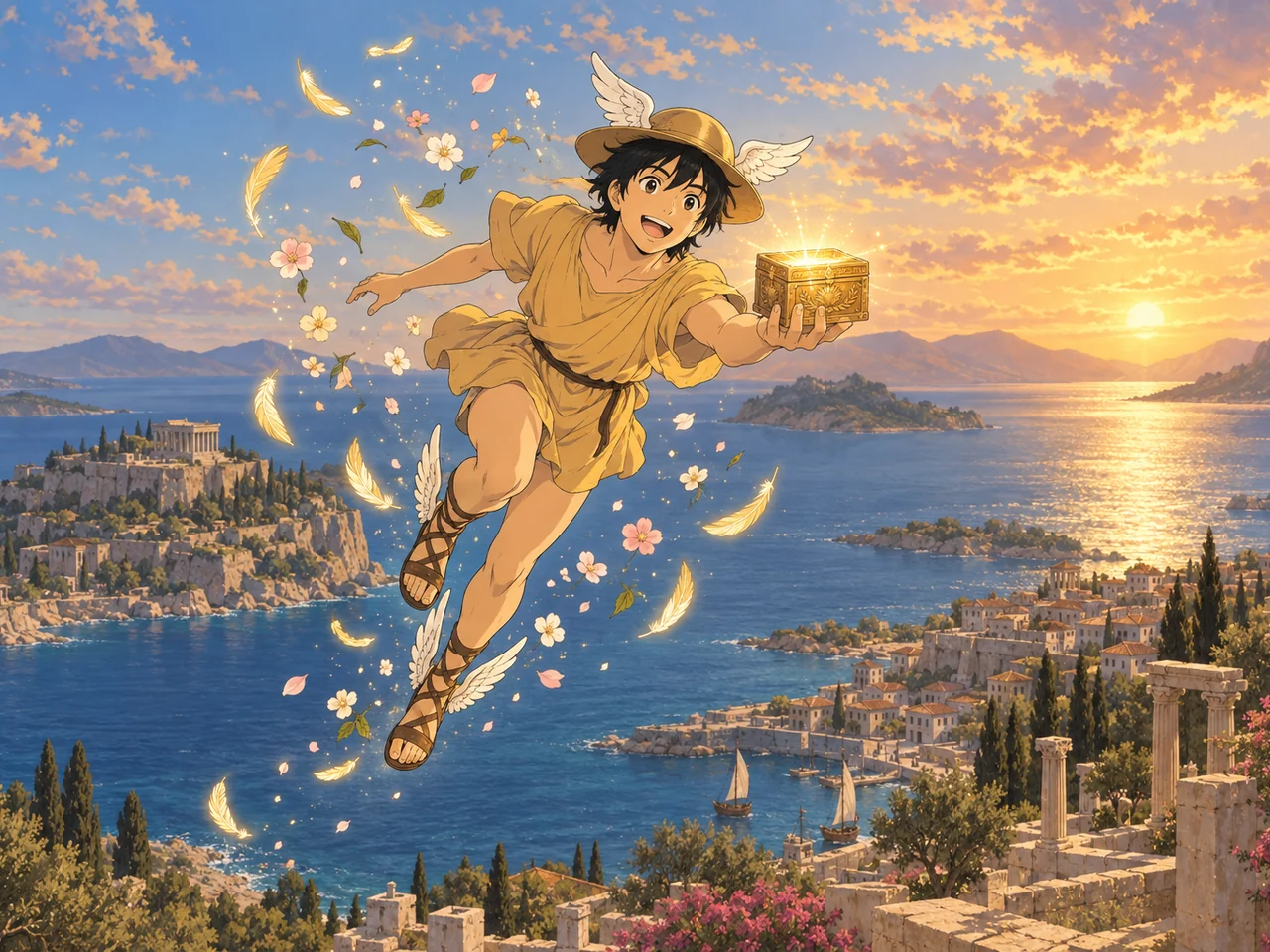
- Hermes · 赫尔墨斯 — The gods' cheeky messenger, always rushing off and always late.
- Trouble · 麻烦 — The sly voice inside the box.
- Hope · 希望 — A tiny gentle voice that stays in the box.
- King Midas · 迈达斯 — A king who loves gold more than anything, until it costs him everything.
- Midas's Daughter · 小公主 — Midas's sweet little girl who only wants her father to play.
- Dionysus · 狄俄尼索斯 — The merry wine god who grants Midas his wish.
- Echo · 回声 — A talkative mountain nymph who can only repeat the last words she hears.
- Hera · 赫拉 — The proud queen of the gods.
- Narcissus · 纳西索斯 — A handsome hunter who loves only himself.
- Arachne · 阿拉克涅 — A brilliant weaver who is too proud to listen.
- Arachne the Spider · 阿拉克涅 — Arachne after Athena turns her into a spider.
- Neighbor · 邻居 — A village woman who admires Arachne's weaving.
- Athena · 雅典娜 — The wise goddess of weaving and wisdom.
- Daedalus · 代达罗斯 — A clever inventor and loving father.
- Icarus · 伊卡洛斯 — A thrilled young boy who forgets his father's warning.
- Persephone · 珀耳塞福涅 — A gentle girl who loves flowers.
- Demeter · 得墨忒耳 — The goddess of the harvest and Persephone's loving mother.
- Hades · 哈迪斯 — The serious, fair king of the underworld.
6 chapters, one journey
Chapter 1: Pandora and the Box
不要打开!
Pandora is told never to open a little box, but the box whispers to her. When she peeks, something flies out.
Free to read
Chapter 2: The Golden Touch
变成金子
King Midas wishes that everything he touches turns to gold. The wish comes true, and at breakfast he learns what it really costs.
SayMei Stories
Chapter 3: Echo and Narcissus
回声
Echo talked too much, so a goddess made her repeat other people's words. Then she met a boy who loved only himself.
SayMei Stories
Chapter 4: The Best Weaver
织布比赛
Arachne brags that she weaves better than the goddess Athena. Then Athena walks in the door.
SayMei Stories
Chapter 5: Wings of Wax
蜡做的翅膀
Daedalus and his son Icarus are stuck on an island, so Daedalus builds wings. He warns Icarus: not too high, not too low.
SayMei Stories
Chapter 6: Six Seeds
六个石榴籽
Persephone finds a golden flower, and the ground opens. Her mother cannot find her, and the whole world grows cold.
SayMei Stories
Key words in Greek Myths
Behind the story
These six stories come from ancient Greece, and were told and retold for thousands of years. Many are best known from the Roman poet Ovid, who collected tales of people who change shape. Pandora's story goes back to the Greek poet Hesiod. Their Chinese name is 希腊神话, and Chinese readers meet them in school books, picture books and library shelves.
Some of the stories have taken on a life of their own in Chinese. People say 潘多拉的盒子 for a small act that lets loose big trouble, and 点石成金 (touch a stone and turn it to gold) is an old Chinese saying, from Taoist legends rather than from King Midas, that people use for turning something ordinary into something valuable. In Chinese culture the pomegranate (石榴) is a lucky fruit: its many seeds stand for many children and a big happy family.
Did you know?
- Pandora's container was a big jar in the oldest story. The word became a box when a Renaissance scholar mistranslated it about five hundred years ago.
- The sea near the Greek island of Ikaria is still called the Icarian Sea, after Icarus.
- The narcissus flower is 水仙 in Chinese, and it is a favorite flower at Lunar New Year. Echo is a mountain nymph in Greek myth, and the word 回声 means echo. The word arachnid comes from Arachne's name.