Mandarin Blueprint review: is the characters-first course worth it?
Our Mandarin Blueprint review: the Hanzi Movie Method, its 88 levels against the new HSK, what's free, and what Fluency Lab costs since mid-2026.


Look up Mandarin Blueprint reviews and you'll find prices from $39 a month to $1,224 for life. Its website sells none of them now.
This review is for you if you've tried Mandarin Blueprint's free levels, or seen its videos, and want to know whether paying is worth it. We read its website, terms and help centre in November 2026, dated its prices from its own archived pages, and counted its latest reviews.
Key takeaways
- The character method is the real draw. Each character becomes a short mental movie that holds its parts, its sound and its tone.
- Every sentence uses only what you've learned. Words come after their characters, and sentences after their words, so you read without pinyin early.
- By size, the full course matches the top of the HSK. Its 3,050 characters are about as many as the new HSK asks for at its highest levels, though it doesn't follow the HSK lists.
- Speaking is the weak side on your own. The course gives you pronunciation videos and audio to copy, but only Fluency Lab adds a person who listens.
- The price went up, and the paid route changed. Lifetime access has gone from under $1,000 to $2,000 in three years, and its website now sends you to a sales call to join.
- Start with the free levels. They show you whether the method suits you before anyone asks for money.
Strong for reading characters, thin on speaking
Mandarin Blueprint does one big job very well: it makes thousands of characters stick. We read its course pages, terms, help articles and store searches, then scored each part against what a learner needs:
What you need · Verdict · What Mandarin Blueprint gives you
Learning to read characters
Strong
Each character's parts, sound and tone, held in a memory scene
A path you can follow
Strong
88 levels in a fixed order, from your first character to advanced
Reading without pinyin
Strong
Sentences and stories built only from characters you know
Pronunciation and tones
Partly
A 10-unit pronunciation course and native audio to copy, with no tone checker
Speaking with feedback
Partly
Weekly 30-minute tutor sessions, in Fluency Lab only
An HSK path
Partly
Big enough for the top HSK levels, but not built on the HSK lists
Traditional characters
Missing
Simplified only
Sources: Mandarin Blueprint's website, terms and help centre, read 6 November 2026. Each row is explained below.
If you want to read Chinese and you like a system, we think it's one of the most thorough courses there is. If you want to talk, plan for a second tool from the start, or for Fluency Lab's price.
The course runs 88 levels, from zero to advanced
Mandarin Blueprint is mainly a video course. Its main course, The Blueprint, runs 88 levels, from your first character to advanced reading.
The levels come in stages. Five foundation phases take you to level 36: characters, then words, simple sentences, short readings and stories. Then come three longer courses, Intermediate, Upper-Intermediate and Advanced. Around it sit smaller courses, such as Pronunciation Mastery and a phrase course for survival Chinese.
The teachers on screen are the founders, Luke Neale and Phil Crimmins. Neither is a native speaker. They write that they passed the top level of the old HSK in 2016, after two years of part-time study. Native speakers record the audio for every word and sentence.
Four things we think you should know first:
- It's Simplified only. Mandarin Blueprint's own FAQ said the course covers only Simplified characters, the script of mainland China.
- Handwriting is optional. The same FAQ says you can skip writing and still learn to read.
- There's no app in the stores. Lessons play on Kajabi, a course platform, in a browser or Kajabi's app. Its newer practice tools run in its own web app, which you can add to a phone's home screen. We found no Mandarin Blueprint app on the App Store or Google Play.
- It takes a long time. Mandarin Blueprint's estimate for an upper-intermediate level is 870 to 1,600 hours of study.
To us, that last number matters most. At an hour a day, even the hopeful end is more than two years. The course is built for people who'll keep going that long.
The Hanzi Movie Method turns each character into a scene
At the heart of the course is the Hanzi Movie Method. Each character becomes a short movie you imagine, and every part of the movie stands for something about the character. Here's how the cast works:
An actor
- Stands for
- The start of the syllable
- What you choose
- A person you know: one for each of 55 starts
A set
- Stands for
- The rest of the syllable
- What you choose
- A place you know well: 13 in all
A room
- Stands for
- The tone
- What you choose
- The entrance for tone 1, up to the roof for the neutral tone
Props
- Stands for
- The character's parts
- What you choose
- An object for each part: over 250 of them
The script
- Stands for
- The meaning
- What you choose
- What the actor does with the props
Source: Mandarin Blueprint's articles on the method and on its pinyin chart. It regroups pinyin, the system for spelling Chinese sounds, so there are more starts and fewer endings.
Take mum, 妈. Your "m" actor stands at the entrance of your "a" set, because it's tone 1. Your props for its two parts, woman, 女, and horse, 马, act out "mum". That scene is our example, but the rules are Mandarin Blueprint's.
The rooms are the clever part. Buy, 买, and sell, 卖, sound alike to a beginner. Put buy in the bedroom, for tone 3, and sell in the bathroom, for tone 4, and the tone has somewhere to live.
Mandarin Blueprint says that once you're used to it, you can learn 30 to 60 characters an hour.
It admits there's a learning curve at the start, and its help centre is more modest later on. In the Intermediate course, it suggests about 15 characters an hour if you study characters alone.
We think this is the most complete character system we've seen in a paid course. Its strength is that the sound and the tone live in the same scene as the meaning, so one memory holds all of it.
Does the Hanzi Movie Method work?
Memory images do help, and the research we found suggests the ones you make yourself help most. Mandarin Blueprint gets that part right: you choose your own actors and places, and you can swap any prop it suggests.
In one study of 92 high-school students, learners who made up their own memory aids for characters did better than those given ready-made pictures, ready-made verbal hints or plain translations. They also spent longer on the task.
An older study found the flip side. Students given ready-made memory images had no advantage after a delay of two days or a week, and they had forgotten more than students who learned by plain repetition.
So the scene alone isn't the whole method. Mandarin Blueprint pairs every scene with spaced repetition, flashcards that come back just before you'd forget them. That pairing matters: in the older study, the images faded within days.
One caveat: we found no published study of the Hanzi Movie Method itself. The evidence is for memory images in general, and the claim of 60 characters an hour is Mandarin Blueprint's own.
Our advice if you try it: make every scene yours. A scene built from your sister, your old flat and your kitchen will outlast one you borrowed.
Every sentence uses only what you've learned
Mandarin Blueprint's other big idea is its order. It calls it OCLO, its "optimal character learning order", and says it's patent-pending.
The rule is simple. You meet a character only after you've learned its parts. You meet a word only after you know its characters, and a sentence only when you know every word in it. Here's the company's own picture of how characters chain together:
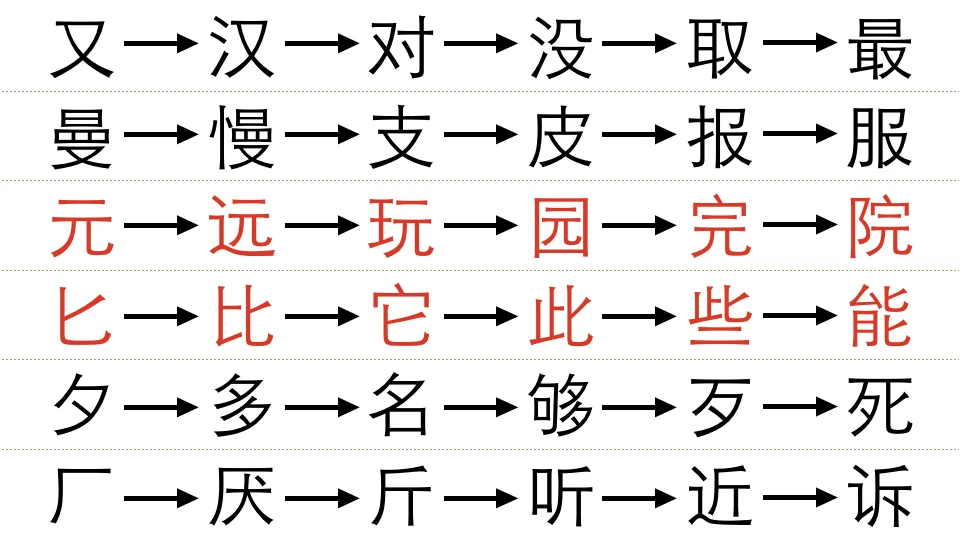
That's why you can read early. By level 20, Mandarin Blueprint says, you can read 800 sentences with no pinyin or English. By level 30 you're reading short dialogues and articles, and by level 36, whole graded stories.
Grammar comes from those sentences, not from rules. Mandarin Blueprint's FAQ calls grammar teaching a "bonus", and lets the example sentences do the work. Every sentence has male and female audio.
We see one trade-off. The order follows the characters, not your needs this month. If you're travelling soon, the Blueprint won't teach you to order food first. Mandarin Blueprint's own help centre points speaking-first learners to its phrase courses instead.
If you like knowing that every new thing builds on the last, this order is a pleasure. If you need survival phrases soon, start those alongside it.
By size, the full course reaches the top of the new HSK
Mandarin Blueprint doesn't teach to the HSK, the Chinese proficiency exam. Its help centre says so plainly. But it publishes how many characters and words you'll know at each stage, so we set those counts against the new exam's lists.
The new HSK, from the 2025 syllabus, lists the characters you should read at each level. We counted them, adding each level to the ones below:
Source: Mandarin Blueprint's phase pages and its course page archived in May 2025; our count of the characters to recognise in the 2025 HSK syllabus. Mandarin Blueprint doesn't publish its character list, so this compares sizes, not the characters themselves. Words, for the same stages: 961 by level 36, against 1,000 for HSK 3; 11,800 in the full course, against 11,000 for HSK 7–9.
Words tell the same story. By level 36 you've met about as many words as the new HSK 3 list holds, and the full course teaches a little more than the whole syllabus.
Mandarin Blueprint's own promises are mostly more modest than those counts, and they've moved over the years:
| Where you stop | Mandarin Blueprint says you can pass | By character count, about |
|---|---|---|
| Level 30 | HSK 1 | HSK 2 to 3 |
| Level 36 | HSK 1 to 2 | HSK 2 to 3 |
| Level 57 | HSK 3 | HSK 5 |
| Level 68 | HSK 4 to 6 | HSK 6 |
| Level 88 | HSK 7 to 9 | HSK 7 to 9 |
Source: Mandarin Blueprint's help centre, updated May 2025, and its phase pages. In 2020 its pricing page promised an "HSK 4 Guaranteed Pass"; its 2025 description of MB Pro says "Pass the new HSK 9".
Why the gap? Size isn't coverage. The HSK tests the words on its own lists, and Mandarin Blueprint picks its words by a different rule. In 2025 its MB Pro FAQ said the course covers all the vocabulary the HSK requires, but its list isn't public, so we couldn't check. An exam also tests listening and timed reading, and from HSK 3, the new exam adds a speaking test.
If you're aiming at an exam, our advice is to use Mandarin Blueprint for reading and track the HSK list for your level next to it. Our guide to the new HSK explains what changed in the 2025 lists.
Speaking means copying audio, unless you pay for tutors
Mandarin Blueprint teaches pronunciation carefully, but its lessons never hear you. Here's what its courses give you without a tutor:
- Pronunciation Mastery, a 10-unit course on every sound and the tones, which Mandarin Blueprint suggests you take first.
- Native audio for everything, with male and female voices on every sentence, to listen to and shadow.
- Phrase courses. The Speaking and Listening Kickstarter has over 1,000 phrases to listen to and repeat, and the Phrase Vault over 7,000.
How do you know if you're saying it right? Mandarin Blueprint's own answer is to record yourself and compare, or to find a tutor. In Fluency Lab, its practice app also lets you say your answers: it writes down what you said and scores whether the Chinese is right. We found nothing that scores your tones.
Fluency Lab is where the tutors are. Its terms promise weekly 30-minute speaking sessions with native Mandarin tutors over Zoom. You also get a Fluency Coach, a fluent non-native speaker who plans your study with you.
There are rules to know. Each session costs a credit, and booked sessions can't be cancelled. You can move one once, with a day's notice, and Mandarin Blueprint says most members do best with one or two a week.
Fluency Lab also adds Language Islands: sentences you want to say about your own life, which Mandarin Blueprint translates and records for you. It's a good idea, and it's in the paid tier only.
Reviewers see both sides. In our count of recent reviews, a September one was titled "Mandarin Blueprint got me speaking!" Another reviewer, two months in, said their pronunciation was still a work in progress.
If you're on the free levels or the old lifetime course, we suggest speaking practice from week one. Tones you never say out loud don't stick.
What learners say: praise for the method, mostly early on
Mandarin Blueprint's reviews are glowing. On Trustpilot it scores 4.9 from 748 reviews, nearly all of them five stars.
We read the 100 most recent, from March to November 2026. Every one gave four or five stars. Here's what they talk about:
Source: our reading of Mandarin Blueprint's Trustpilot page, sorted by most recent, on 6 November 2026. A review can count under several themes, and the counts are our judgment. "Still early" means the reviewer says they're within about three months, or at level 36 or below. Our rules.
Two things stood out to us. Many reviewers are near the start: a quarter say they're early on, and 13 are on the free levels. Very few mention Fluency Lab, the part that now costs money.
The complaints are small and consistent. Nine reviewers say the first days felt confusing or the setup daunting. One July review is titled "Easy to understand once set up". Others mention a phase that wouldn't unlock, loose sentence translations and slow progress.
We couldn't read Reddit, the other big place where learners compare courses: its site blocked our reader. So read these reviews for what they are: keen learners, many of them in their first months.
How much does Mandarin Blueprint cost now?
You can start free. On its website, the paid course now comes only inside Fluency Lab, which costs $2,000 to join, then a subscription whose price Mandarin Blueprint doesn't publish.
Here's what each tier includes, from Mandarin Blueprint's home page:
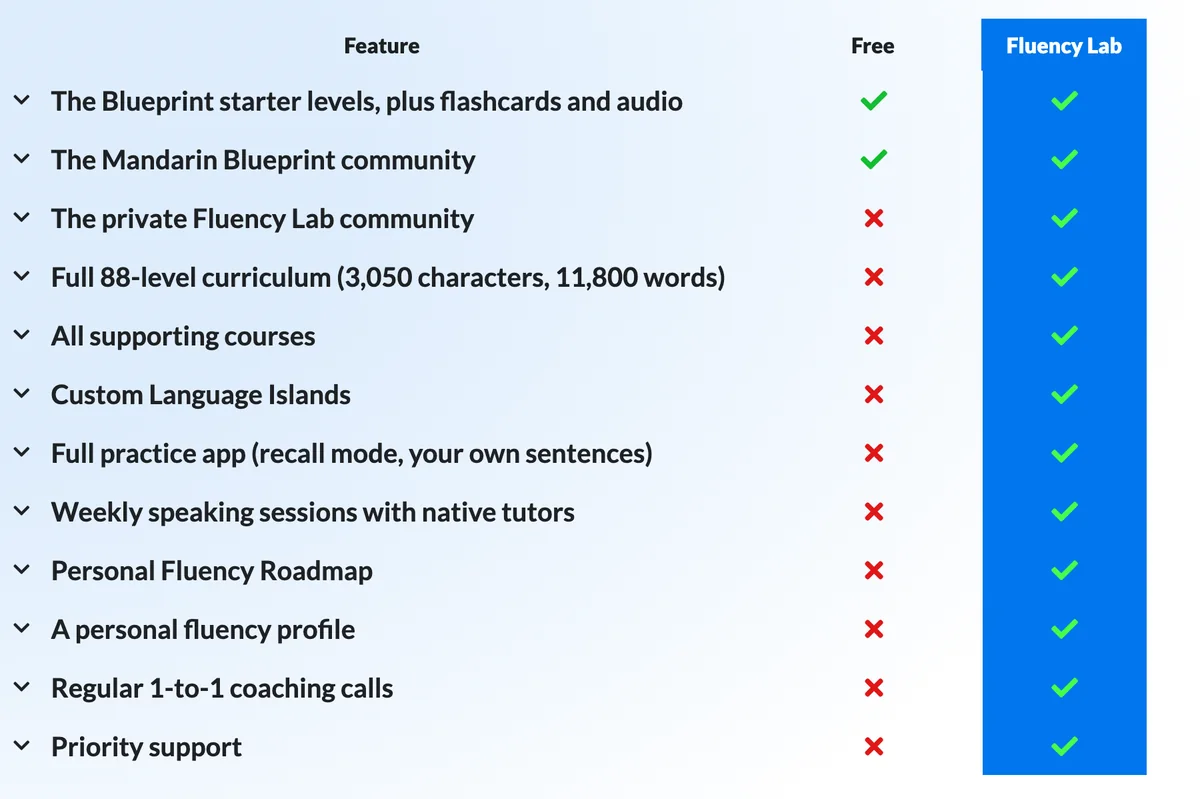
The free tier gives you "the first few levels" with flashcards and audio. The page for its free community puts that at 20 levels, the same as its 2025 challenge. Its home page says no card is needed.
To get the rest, its website has you book a call. Mandarin Blueprint's pricing page now sends you to its home page, and the home page asks you to book a free half-hour call. The only price in writing is in its Fluency Lab terms, dated July 2026:
- A $2,000 joining fee, which includes your first month of coaching and tutoring.
- Then a subscription, billed every four weeks or once a year, at a price the terms don't give.
- Lifetime access to the core courses, even if you stop the subscription, so the fee buys the course for good.
- A four-week trial. Within four weeks you can ask for everything back, the fee included; after that, refunds are only at Mandarin Blueprint's discretion.
- No pause. You can cancel and come back later without paying the fee again.
The price has changed more than most reviews show. In 2020, Mandarin Blueprint was a subscription, at $30 a month. Since then it has sold lifetime access, and we dated each price from its own archived pages:
Source: Mandarin Blueprint's pricing pages as archived by the Wayback Machine: 2021, 2022, 2023, 2024, 2025 and May 2026; its Fluency Lab terms for November 2026. Fluency Lab's fee also buys a first month of tutoring and coaching. In December 2024, the same MB Pro page also offered $599 up front plus a subscription from $39 a month.
Most of those plans could also be paid in instalments. MB Pro bought from October 2024 came with 365 days to ask for a refund, against Fluency Lab's four weeks.
If you join Fluency Lab, we suggest asking for the subscription price in writing before you pay. The four weeks are your chance to find out whether the tutoring is worth the monthly fee.
The reviews you'll find quote prices that are gone
When we searched "Mandarin Blueprint review", six of the reviews near the top quoted a price. Here's what each one says:
- Dated
- April 2021
- Price it quotes
- $1,224 bundle, $449.25 on sale
- Dated
- November 2024
- Price it quotes
- $997, or $97 a month for a year
- Dated
- October 2024
- Price it quotes
- $997, or $97 a month for a year
- Dated
- Undated
- Price it quotes
- $39 a month, or $599 to $799 for life
- Dated
- January 2025
- Price it quotes
- $39 a month, or $599 once
- Dated
- October 2025
- Price it quotes
- About $997, "reported"
Source: each review, read 6 November 2026.
None of them mentions Fluency Lab. Even Mandarin Blueprint's own help centre still lists MB Pro at $1,499, in an article from September 2025, though the MB Pro page now sends you to the home page.
So if a review quotes a price, check its date. The method they describe hasn't changed much, but what you pay and what you get for it have.
Who should use Mandarin Blueprint
We recommend Mandarin Blueprint if:
- You want to read Chinese. It's built to get thousands of characters into long-term memory.
- You like a system. One fixed order runs from your first character to advanced reading, with reviews every day.
- You enjoy memory tricks. If making odd mental movies sounds fun, the method will suit you.
- You'll study for years. By its own estimate, an upper-intermediate level takes more than two years at an hour a day.
We suggest skipping it, or pairing it with something else, if:
- You want to speak soon. The course gives you audio to copy, but no tutor listens unless you're in Fluency Lab.
- You need Traditional characters. It teaches Simplified only.
- You have an HSK date. It doesn't follow the exam's lists, so add the list for your level and some practice tests.
- You'd rather not have a sales call. On its website, the way into the full course is a call, and the subscription price isn't published.
The best alternatives for each goal
No one course does everything. If Mandarin Blueprint isn't the right fit, here's our pick for each goal:
The same parts-first idea, for less
- Pick
- Hanzi Hero
- Price
- $15 a month, $120 a year or $349 once
- Why
- Memory aids for parts, sounds and 3,000+ characters, Simplified or Traditional
Characters by their parts, for free
- Pick
 SayMei Radicals
- Price
- Free with an account
- Why
- A picture and a story for each of the 1,940 HSK 1 to 6 characters
Writing practice that checks each stroke
- Pick
 Skritter
- Price
- $14.99 a month or $99.99 a year
- Why
- Handwriting with spaced repetition
Flashcards you build yourself
- Pick
 Anki
- Price
- Free, or $24.99 on iPhone
- Why
- Any deck, with spaced repetition
A course app from zero
- Pick
 HelloChinese
- Price
- $11.99 a month or $69.99 a year
- Why
- Pinyin, characters and grammar, step by step
A human ear for your tones
- Pick
 An italki tutor
- Price
- About $20 an hour
- Why
- The median of 783 Chinese teachers
Speaking practice that answers back
- Pick
- SayMei
- Price
- $5.99 a month for 200 minutes
- Why
- Mei Lin asks questions and corrects your tones
Source: each company's pricing page or US App Store listing, 6 November 2026; italki's median from our tutors guide.
We think Hanzi Hero is the closest match: it also teaches parts before characters, with memory aids, for a fraction of the price. Our guide to flashcard apps compares Anki, Skritter and the rest in more depth.
For a broader look at paid courses, read our comparison of online Chinese courses, which sets Mandarin Blueprint next to Yoyo Chinese and live classes.
Where SayMei fits, and where it doesn't
SayMei has tools for both halves of the job: learning characters, and talking. Its character tools are free with a SayMei account, and lessons with Mei Lin come with SayMei Premium.
- Radicals shows the parts inside each of the 1,940 characters of HSK 1 to 6, with a picture and a story. Each story says whether it's the real origin, a traditional explanation or just a memory aid.
- Characters is handwriting practice: watch the strokes, trace them, then write from memory.
- Lessons with Mei Lin, SayMei's AI tutor, are spoken conversations at your level. She corrects your tones as you answer. SayMei Premium costs $5.99 a month for 200 minutes.
Here's where Mandarin Blueprint beats us:
- A full video course. Two teachers explain every step on camera; SayMei has no video course.
- Sound in every scene. Its actors, sets and rooms store each character's pronunciation. Our stories are memory aids for meaning and shape.
- An order built on what you know. Its sentences and stories use only characters you've learned. SayMei's reading isn't sequenced that strictly.
- People. Fluency Lab has native tutors and a coach, and its community is large.
- More characters. It teaches 3,050; our Radicals path stops at the 1,940 characters of HSK 6.
If you want a complete, guided course in reading Chinese and can afford it, Mandarin Blueprint does that better. Many learners would do best with both: a character method for reading, and someone to talk to.
What to do next
- Start with the free levels. They're enough to see whether the movie scenes work for you.
- Make every scene your own. Use people and places you know well, and do your reviews every day.
- Add speaking from the first week. Say your sentences out loud to a tutor or a speaking partner, not only to the audio.
- Get the full price in writing. Before you join Fluency Lab, ask what the subscription costs, and note when your refund window closes.
- Check the HSK list if you have an exam. Track the words for your level next to the course.
If you'd rather try the parts-first idea before any course, start with SayMei's Radicals, free with an account.
FAQ
Is Mandarin Blueprint free?
Partly. You can start free: Mandarin Blueprint's home page offers "the first few levels" of its course, with flashcards and audio, and says no card is needed. The page for its free community puts that at 20 levels, yours to keep. On its website, the rest of the course comes only with Fluency Lab, its paid program, which costs $2,000 to join.
How much does Mandarin Blueprint cost?
Today its website sells the paid course only with Fluency Lab. Its terms set a one-time joining fee of $2,000, then a monthly or yearly subscription whose price isn't published; to join, you're asked to book a sales call. The fee includes lifetime access to the core courses. Older prices, such as $1,499 for lifetime access, are no longer on its website.
What is Mandarin Blueprint's Fluency Lab?
It's the paid program that replaced MB Pro on Mandarin Blueprint's website in 2026. It adds the full course to weekly half-hour speaking sessions with native tutors on Zoom, a Fluency Coach who plans your study, and Language Islands, your own sentences translated and recorded. You pay $2,000 to join, then a subscription after the first month, and can ask for a full refund within four weeks.
Does the Hanzi Movie Method work?
Memory images do help you learn characters, and research suggests the ones you make yourself work best. In one study, students who invented their own memory aids beat those given ready-made pictures or verbal hints. Another found ready-made images faded faster than plain repetition. So make your scenes personal and review them. We found no study of the Hanzi Movie Method itself.
What HSK level does Mandarin Blueprint get you to?
By size, its full course matches the top of the new HSK: 3,050 characters, against 3,088 on the new syllabus. Mandarin Blueprint itself says its foundation levels prepare you for HSK 1 to 2, Intermediate for HSK 3, and the full course for HSK 7 to 9. It doesn't follow the HSK lists, so check your level's list too.
Does Mandarin Blueprint have an app?
Not in the app stores. We found no Mandarin Blueprint app on the App Store or Google Play. Its video lessons play on Kajabi, a course platform, in a browser or in Kajabi's own app, and its newer practice tools run in a web app you can add to your phone's home screen. Members have also used Anki and Traverse for its flashcards.
Does Mandarin Blueprint teach Traditional characters?
No. Mandarin Blueprint teaches Simplified characters only, the script used in mainland China, its own FAQ says. Its help centre explains how to use the method for Traditional characters, but the course itself is in Simplified. If you're learning for Taiwan or Hong Kong, look at a course that offers both scripts, such as Hanzi Hero.
Can you get a refund from Mandarin Blueprint?
For Fluency Lab, yes, within four weeks. Its terms let you ask for a full refund, the $2,000 joining fee included, by writing to Mandarin Blueprint in that time. After that, refunds are at its discretion only. MB Pro bought from October 2024 came with a full year to ask for a refund, under its general terms.
Sources
Checked 6 November 2026 unless noted. No accounts were created, nothing was bought and no call was booked.
Mandarin Blueprint
- Home page, including the Free vs Fluency Lab table, and its about page
- Fluency Lab terms (effective 22 July 2026) and general terms (last modified 17 February 2026)
- Help centre: the HSK (updated May 2025); phases 1, 3, 4 and 5; the learning order; the free challenge; MB Pro's price (September 2025); platforms; checking your pronunciation; Pronunciation Mastery; speaking courses; characters per hour; speaking-session rules (October 2026)
- Blog: the Hanzi Movie Method explained and its pinyin chart
- Its web app and the page for its free community on Skool
- Archived pages on the Wayback Machine: pricing in April 2021, December 2022 and December 2023; MB Pro in December 2024, May 2025, November 2025 and May 2026; the pricing page in May 2020
- Trustpilot reviews
Reviews we compared
- Actual Fluency (April 2021), FluentU (November 2024), All Language Resources (October 2024), The Mezzofanti Guild (undated), bestreviews.net (January 2025), Ikky in China (October 2025)
HSK
- 2025 HSK syllabus, counted in our HSK 3.0 guide
Other courses and apps
- Hanzi Hero pricing; Skritter, AnkiMobile and HelloChinese on the US App Store; italki's median from our tutors guide
- SayMei: pricing, Radicals, Characters
Research
- Kuo, M. L. A. & Hooper, S. (2004). The effects of visual and verbal coding mnemonics on learning Chinese characters in computer-based instruction. Educational Technology Research and Development 52(3). doi:10.1007/bf02504673
- Wang, A. Y. & Thomas, M. H. (1992). The effect of imagery-based mnemonics on the long-term retention of Chinese characters. Language Learning 42(3). doi:10.1111/j.1467-1770.1992.tb01340.x
Methods
We read Mandarin Blueprint's website, terms, about 60 help-centre articles, its free community's page and the instructions built into its web app on 6 November 2026, and its older pages as archived by the Wayback Machine. We didn't sign up, take lessons or book a call, so a feature is what Mandarin Blueprint says or what learners report, and we say which.
- The HSK chart sets Mandarin Blueprint's published character counts for each stage against our count of the characters to recognise in the 2025 HSK syllabus, adding each level to the ones below. Mandarin Blueprint doesn't publish its character list, so we compared sizes only.
- The price chart takes the lowest single payment for lifetime access to the full course shown on Mandarin Blueprint's own pages at each date, leaving out plans that add a subscription. Sale prices count when the page showed them as the price to pay.
- The review count covers the 100 most recent reviews on Mandarin Blueprint's Trustpilot page, 17 March to 6 November 2026. We read each one twice and sorted it by theme with simple rules. Where the two readings disagreed, we went back to the review's own words. A review can count under several themes. Reddit blocked our reader, so it isn't included.
- The scorecard is our judgment from those sources, not a test of the course.
- The screenshots are Mandarin Blueprint's own: its home page as archived on 4 November 2026, and a picture from its help centre.
- The Mandarin examples were checked against the CC-CEDICT dictionary.
If you spot a mistake, tell us: we fix errors.