Mango Languages review: is the free library app good for Mandarin?
Our Mango Languages review for Mandarin: how far the course goes on the new HSK, free library access, $13.99 pricing and speaking feedback, checked Nov 2026.

In most of America's biggest cities, a library card gets you Mango Languages for free. For Mandarin, two questions matter more than the price: how far the course goes, and whether anything checks your tones.
This review is for you if you're learning Mandarin and can get Mango through your library, or you're deciding whether it's worth paying for. We read Mango's own pages, research papers, terms and store listings in November 2026, coded 222 recent App Store reviews and checked the libraries of America's biggest cities.
Key takeaways
- Free is the best way to get it. In 17 of the 25 biggest US cities, the public library offers Mango free with a card.
- Mandarin gets a full course. It's one of nine courses that run all five of Mango's units, with 559 lessons.
- It ends around the new HSK 3. Mango likens its last unit to B1, but four in five of its grammar goals are HSK 1 or 2 points.
- Nothing we found scores your tones. You record yourself and compare two waveforms, which show loudness, not the rise and fall of a tone.
- Most extras skip Chinese. Mango's live coaching and its reading passages aren't offered in Mandarin.
- If you pay, pay yearly. A year costs $119.99, about $10 a month, against $13.99 month by month.
Is Mango Languages good for learning Chinese?
For a beginner with a library card, yes. For anyone aiming past the new HSK 3, or anyone who mainly wants to talk, it does much less. We read what Mango says about each part, and what learners report, then scored them:
What you need · Verdict · What Mango gives you
A gentle start from zero
Strong
Short lessons built on native-speaker dialogues, with grammar and culture notes
A low price
Strong
Free with a card at many public libraries
Native audio
Strong
Native speakers at normal and slow speed, word by word
Characters and pinyin
Partly
Simplified characters from the start; pinyin when you tap a word
Pronunciation and tones
Partly
Record yourself and compare waveforms by eye and ear; no score
Material past the new HSK 3
Missing
The course's grammar mostly stops at HSK 3
Conversation practice
Missing
Set dialogues to rebuild; no live coaching in Mandarin
Sources: Mango's course, pricing and FAQ pages, its research papers and its store listings, all read 6 November 2026. Each row is explained below.
So we'd use Mango as a free, well-built course for your first year or two. Plan where your tones get checked, and where you'll go after Unit 5, before you need them.
Mandarin is one of Mango's nine full courses
Mango offers more than 70 languages, but most get a short course. Mandarin is one of nine that run all five units.
Mango's course list gives it 41 chapters and 559 lessons. That puts it in the middle of Mango's big courses. Here's how the nine full courses compare, with Mango's two other Chinese courses at the bottom:
Source: Mango's K-12 course list on mangolanguages.com, checked 6 November 2026.
If you want Cantonese, Mango is one of the few apps that teaches it, but its single unit won't last long: one reviewer finished it in a couple of months. Our guide to Mandarin and Cantonese explains how far the two overlap.
Lessons are short, about 15 minutes each by one Mango summary. Even so, the whole course is a lot of material for a beginner.
How far does Mango's Mandarin course go on the new HSK?
Not as far as Mango's own label suggests. Mango says its five units take you to "Skilled 3", which it likens to B1 on the European CEFR scale and Intermediate High on America's ACTFL scale. It also says that's a comparison, not an official equivalence.
Mango doesn't map its course to the HSK, China's proficiency exam, and it publishes no word list. It does publish something better: a Grammar Goals Guide for Mandarin that lists every grammar goal, unit by unit. Mango says each guide covers the whole course.
So we took all 111 goals and found each one in the grammar outline of the 2025 HSK syllabus, the one the new exams use. Each goal got the lowest level that lists its point. Here's where the harder grammar arrives:
Source: our mapping of Mango's Chinese (Mandarin) Grammar Goals Guide against the 2025 HSK syllabus's grammar outline, 6 November 2026. Method below.
The first two units stay entirely within HSK 1 and 2 grammar. Even the last unit sets more HSK 2 goals than HSK 3 ones, and none beyond HSK 3.
The hardest goals are worth knowing. Mango teaches 把 sentences and passives with 被, both HSK 3 points. Its three HSK 4 goals include "even", with 连 and 也, and the exaggeration with 死了, as in 累死了, "dead tired".
Some everyday patterns have no goal at all. The guide names none for "although… but", 虽然 and 但是, or "because… so", 因为 and 所以, both HSK 2. Nor is there one for "if… then", 如果 and 就, at HSK 3. They may still turn up in the dialogues, but the guide sets no goal for them.
Time tells the same story. By Mango's own estimates, its whole Mandarin course takes roughly 120 to 250 hours. Here's how that compares with the new HSK levels:
The whole Mango course takes less time than the new HSK 3
Hours from zero, on one scale
- Published course hours
- Estimate
| Course or level | Hours | Where the hours come from |
|---|---|---|
| Mango's whole Mandarin course | 120–250 | Mango's 3 to 6 hours a chapter, times 41 chapters |
| New HSK 2 | 240–480 | Taiwan's TOCFL course hours for the same word count |
| New HSK 3 | 480–720 | Taiwan's TOCFL course hours for the same word count |
| New HSK 4 | 640–880 | Our estimate between TOCFL's levels |
Source: Mango's homeschool page; HSK hours from our guide to how long Mandarin takes, which maps Taiwan's official course-hour table to the new HSK.
App hours and class hours aren't the same thing, so treat this as a rough check. But it points the same way as the grammar.
We'd treat Mango's course as a path to about the new HSK 2, with a good start on HSK 3. If you're sitting the exam, add its word lists and practice tests, and our HSK 3.0 guide explains the new levels.
Each lesson rebuilds one conversation
Mango's method starts from a recorded dialogue, then takes it apart. A chapter opens with a short conversation between native speakers. The lessons break it into phrases and words, then ask you to put them back together.
Mango calls this Intuitive Language Construction. In practice, it looks like this:
- Color-coded sentences. Matching words in English and Chinese share a color, so you can see how the word order differs.
- Literal and natural meanings. You see what a phrase means and how each word translates, side by side.
- Grammar and culture notes. Short explanations appear inside lessons, when they're needed.
- Critical-thinking prompts. You're asked to say something new with what you've just learned, before you see the answer.
- Spaced review. Words and phrases come back for review just before you'd forget them.
- Hands-free play. Lessons can run as audio while you drive or cook, and you can download them for offline use.
Here's what a lesson slide looks like, in Mango's own App Store image:
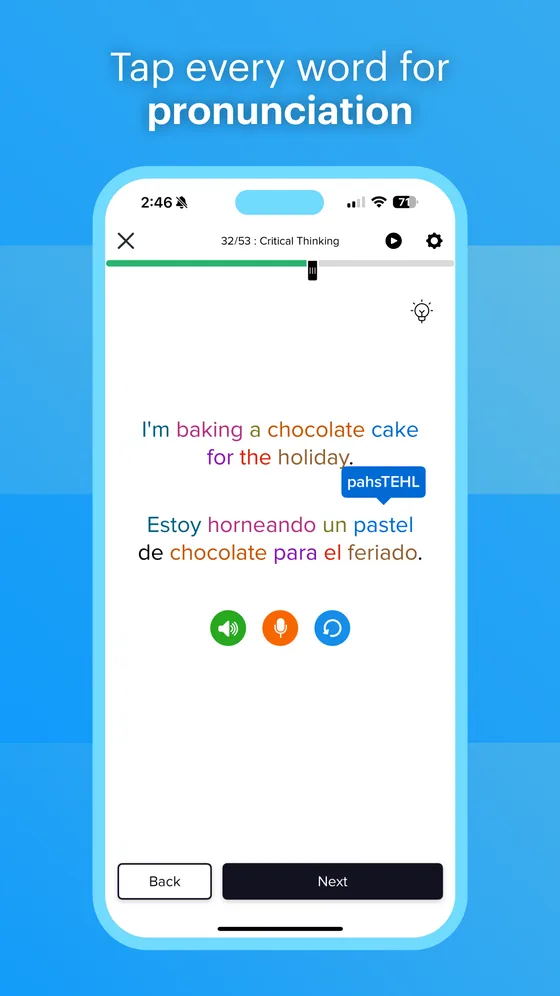
Learners praise this most. Of the 222 recent reviews we coded, about one in ten praised the explanations or culture notes, and as many called Mango better than Duolingo.
The repetition is the trade-off. The same phrases come back again and again, which most reviewers like and a few find slow.
One more caveat: Mango's headline study tested Spanish, not Chinese. Its 2019 efficacy study followed 95 adult beginners of Spanish for two months, and Mango's own page says so.
Characters come first, and pinyin comes when you tap
Mango teaches Mandarin in Simplified characters, the script of mainland China. Its course link ends in "cmn-Hans", the code for Simplified Mandarin, and we found no Traditional option. Mango's Cantonese course uses Traditional characters.
Characters are on screen from the first lesson. A learner on the US App Store in January 2026 noted that Mango uses characters for Chinese straight away. A 2020 Mandarin learner's blog praised it for teaching pinyin and characters at the same time.
Pinyin, the spelling of Chinese sounds in Latin letters, is a tap away. Mango's Mandarin page says you can hover over a word for its phonetics, or click it to hear it said slowly. Some learners want more: reviewers in 2019 and 2023 asked Mango to keep pinyin on screen.
That suits learners who want to read characters early. If you're new to pinyin, though, learn it first, so a tap is a reminder, not your only way in. Our guide to reading Chinese shows a path from pinyin to characters.
A tap may also show each character's dictionary tone, not always the tone you'd say. In January 2024, a Mandarin learner on the App Store reported exactly this, and asked Mango to show the spoken tones instead.
Here's why that matters. In 你好, "hello", two third tones meet, so the first one rises: you say ní hǎo. By that learner's report, a tap shows you the written nǐ.
Those spoken changes are called tone sandhi, and they're everywhere in real speech. You'll want a separate way to learn them.
Speaking practice means matching a waveform
Mango gets you speaking from the first lesson, but nothing in the course judges what you say. Its speaking tool is voice comparison: you record a line, then see your recording as a waveform under the native speaker's and play both back.
Here's that tool in Mango's own App Store image, shown with a Spanish line:
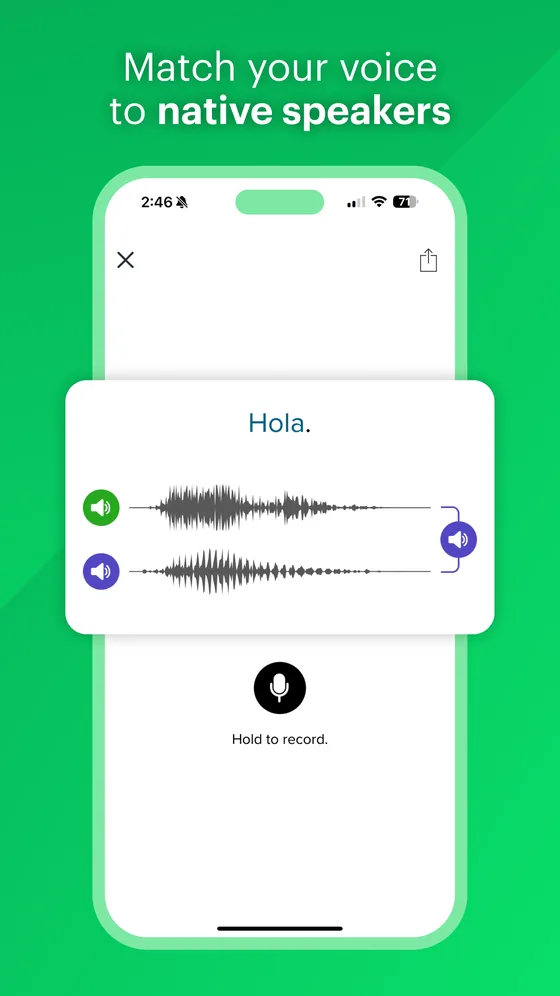
That's a deliberate choice. In a 2019 paper that Mango still links from its research page, it argued that speech-recognition scoring makes too many mistakes. So it gives learners waveforms to compare, and leaves the judging to them.
For Mandarin, that choice costs you. A waveform shows how loud you were over time, not whether your pitch rose or fell. A tone is pitch.
So 买, "to buy", and 卖, "to sell", can look much alike, even though one dips and the other falls. You're left to judge by ear, which is the hard part for an English speaker.
A pitch line shows what a waveform can't. In one study, learners who saw their own pitch curves next to a native speaker's improved their tones over nine weeks.
Learners notice the gap. One reviewer in June 2024 wished Mango "checked the recording automatically instead of having to do it on your own". Others asked for speech recognition, or for an AI conversation mode.
There are signs that's changing. Mango's terms, updated in August 2026, now cover "AI Features" in some services.
One App Store reviewer was asked to rate an "AI conversation partner", and another asked for "conversation AI" in Koine Greek. Mango's pages describe neither, so we couldn't confirm that Mandarin has one, or what it does with tones.
Our advice: use voice comparison for rhythm and speed, and get your tones checked somewhere that shows or hears pitch. Our guide to learning tones explains what works.
Mango's extras mostly skip Mandarin
Mango sells more than its course. For learners who finish Unit 5, its proficiency page points to live coaching, Mango Reader and specialty courses as the way to go further. For Mandarin, most of those aren't there.
Here's what we found for each extra:
Mango extra · In Mandarin · What it does
Mango Live
No
30-minute video lessons with a native-speaking coach
Interactive Reading Passages
No
Longer texts just above your level, with tap-to-translate
Mango Reader
Yes
Translates words on any web page as you read
Placement test
Yes
Finds your starting point in the course
Specialty units
Yes
Short courses on one theme
Classroom Guides
Schools only
Printable student workbooks
Sources: Mango Live's FAQ, Mango's feature pages and K-12 course list, and Mango Reader's App Store listing, 6 November 2026.
Mango Live covers eight languages, from Arabic to Spanish, and Chinese isn't one. Reading passages exist in five languages, none of them Chinese.
What Mandarin does get is useful but small. Mango Reader's iPhone app lists Mandarin among its 14 languages. The two specialty units are Feng Shui and the Chinese zodiac. Mango also publishes 60 free grammar articles for Mandarin.
So past Unit 5, Mango has little more to offer in Mandarin. Line up graded reading, listening and someone to talk to before you get there.
How do you get Mango free with a library card?
Check your public library's website for "Mango Languages" under online resources or e-learning. If it's there, you usually sign up in the Mango app or website with your library card number and PIN.
Mango says thousands of libraries, schools and colleges offer it. To see how common that really is, we checked the public libraries of the 25 biggest US cities. Here's what we found:
Source: each library's own website, checked 6 November 2026. In New York, Brooklyn and the New York Public Library list Mango; Queens doesn't. Method and the full list below.
Where Mango wasn't listed, the library usually had a rival. Transparent Language was the commonest, in Charlotte, Jacksonville, Las Vegas, Nashville and Queens. Phoenix and San Diego offer Rosetta Stone, while Dallas and Fort Worth list only free apps, such as Duolingo.
Libraries also switch. Charlotte's library replaced Mango with Transparent Language in 2021, and San Diego's lists Mango among its discontinued databases.
A few tips if yours doesn't carry it:
- Look at big libraries in your state. Houston's free MYLink card is open to any Texas resident, and its Mango sign-up asks only for a card number and PIN.
- Check your state's rules. In 2023, an Ohio library said any Ohio public library card works for its Mango.
- Ask your school, college or employer. Mango sells to all three, and reviewers mention getting it free through work or university.
- Share it. Mango's library page says a cardholder can share access with up to five family members.
Library access isn't quite the full product. Mango's pricing page says libraries get placement tests, but not the unit assessments that come with personal plans.
You won't be alone in the Mandarin course. At Washington's DC Public Library, Mandarin was seventh on its list of top Mango courses for 2025.
Outside the US, it's patchier. We found Mango at Toronto Public Library and at libraries in Ireland and Australia, but no UK public library that offers it.
Without a library, Mango costs $10 to $14 a month
Mango has two personal plans, and both cover all its languages. On its website and in the US App Store, the prices match:
Individual
- What you get
- Every course, one profile
- Price
- $13.99 a month or $119.99 a year
Family
- What you get
- Every course, up to five profiles, parental controls
- Price
- $19.99 a month or $149.99 a year
Source: Mango's pricing page and its US App Store listing, 6 November 2026. Mango Live costs extra, per lesson.
If you'll stay a while, pay for the year. Here's what each way of paying costs a month:
Source: mangolanguages.com/pricing and the US App Store. The yearly rows are $119.99 and $149.99 divided by 12.
Prices differ by country. Here's the Individual plan in the App Store elsewhere:
| Country | A month | A year |
|---|---|---|
| United Kingdom | £12.99 | £119.99 |
| Canada | C$19.99 | C$149.99 |
| Australia | A$22.99 | A$199.99 |
| Ireland | €14.99 | €129.99 |
Source: Mango's App Store listings in each country, 6 November 2026.
Before you pay, know the terms:
- The free part is short. Mango's pricing page offers the first lesson of any language free. Several reviewers say the paywall came after their third lesson.
- The trial is 14 days. That's what both store listings say, and it renews into a paid plan unless you cancel.
- Refunds are narrow. Mango's cancellation policy keeps your access to the end of the period, with no refunds or credits for the rest. If you paid through Apple or Google, ask them.
- There's no lifetime plan. You pay by the month or the year.
Older reviews quote older prices. Several top results still give $7.99 a month, the price of a one-language plan Mango no longer lists.
Learners rate it highly, bugs and paywall aside
Mango is well liked. It averages 4.8 stars from about 44,000 ratings on the US App Store.
On Google Play it also averages 4.8, and it has more than a million downloads there.
Those ratings cover every language, though. So we read every App Store review since January 2024 in six English-speaking stores, 222 in all, and sorted them by theme:
Source: our coding of Apple's public review feeds for the US, Canada, Australia, the UK, India and Singapore, read 6 November 2026. Method below.
The praise is steady. Fans like the grammar and culture notes, the native speakers, the lack of games and streaks, and the hands-free mode.
The complaints come in two kinds. In 2026, several reviewers said the app froze on its loading screen, some after an update. And about a dozen new users hit the paywall within a few lessons, and several hadn't expected one.
Mandarin learners' own reviews are few, and mostly about what the screen shows. Besides the pinyin and tone reports above, one learner in March 2024 said audio stopped playing in the Chinese course's tests.
Reddit blocks the tools we use to read pages, so this rests on store reviews and Mango's own pages.
Mango or Pimsleur for Mandarin?
Both are audio-first beginner courses you may be able to borrow: Mango as an app through your library, Pimsleur as audio through the Libby app. Mango is the longer course, and it teaches characters. Pimsleur drills speaking harder.
Pimsleur's Mandarin course is 150 half-hour audio lessons, about 80 hours, and it makes you say each answer before you hear it. You read pinyin, with characters only in its last level.
Mango's course is longer, at roughly 120 to 250 hours by its own figures. It shows characters from the start, explains grammar on screen and has a review system built in.
On feedback, Pimsleur goes a step further. Its Premium plans add Voice Coach, which scores the phrases you say, though Pimsleur doesn't say whether it checks tones. The library audio edition doesn't include it.
Pick Pimsleur if you want to be pushed to speak from the first minute. Pick Mango if you want to read as well, and if your library has it, start there.
Who should use Mango, and who shouldn't
We'd pick Mango if:
- Your library offers it. A structured beginner course for free is hard to beat.
- You're starting from zero. The lessons are gentle, and the notes explain why things are said the way they are.
- You learn by listening. Native audio, slow playback and hands-free mode suit commutes and chores.
- You want characters early. Mango shows Simplified characters from the first lesson.
- You're learning another language too. Every plan covers more than 70.
We'd skip it, or pair it with something else, if:
- You want your tones checked. Comparing waveforms won't tell you which tone you said.
- You're aiming past the new HSK 3. The course's grammar stops about there, and Mango's extras skip Mandarin.
- You're preparing for the HSK. Mango follows its own scale and offers no exam practice; our free practice tests guide lists some.
- You need a certificate. Mango's homeschool page says its courses aren't accredited.
- You want to talk freely. Mango's dialogues are set, and its live coaching doesn't cover Chinese.
The best alternatives for each goal
No single app does everything. If Mango isn't the right fit, here's what we'd pick for each goal:
A longer Chinese course
- Pick
 HelloChinese
- Price
- $11.99 a month or $69.99 a year
- Why
- A course past the new HSK 4 list, with handwriting; the full story library needs Premium+
A course that scores what you say
- Pick
 SuperChinese
- Price
- $11.99 a month or $59.99 a year
- Why
- Speaking checked on every line, to about HSK 5
Speaking drills for a commute
- Pick
 Pimsleur
- Price
- From $14.95 a month
- Why
- Answer out loud before you hear the answer
A free daily habit
- Pick
 Duolingo
- Price
- Free
- Why
- The whole course is free, though light on tones
Spoken practice that answers back
- Pick
 SayMei
- Price
- $5.99 a month for 200 minutes
- Why
- Mei Lin replies and corrects your tones
A human ear for your tones
- Pick
 An italki tutor
- Price
- About $20 an hour
- Why
- The median Chinese teacher in our tutors guide
Source: each company's US App Store listing or pricing page, and our reviews of each app, October and November 2026.
If you're comparing several course apps, our Duolingo alternatives for Chinese picks the best fix for each gap.
Where SayMei fits, and where it doesn't
SayMei is built for the part Mango leaves to you: speaking with someone who listens. In a lesson, Mei Lin, your AI teacher, asks you questions out loud, waits for your answer and corrects your tones and grammar as you go.
SayMei Premium is $5.99 a month for 200 minutes with her. Our free tools, such as the Tone Checker, show your pitch line, and our beginner workbooks are free with a SayMei account.
We'll be plain about where SayMei loses to Mango:
- No library deal. Mango is free with a card at many public libraries, and SayMei isn't.
- One language. Mango covers more than 70, so one plan suits a family learning several.
- No offline lessons. SayMei runs in your web browser, on any phone or computer, but not without a connection. Mango downloads lessons and plays them hands-free.
- Less teaching on screen. Mango's 559 lessons walk you through grammar and words on screen; SayMei's lessons are spoken conversations, each on one pattern.
Many learners would do best with both: Mango from the library for structure, and someone to talk to every day.
What to do next
- Check your library first. Search its online resources for Mango before you pay anything.
- Learn pinyin before Unit 1. A tap is a good reminder, but a poor way to learn the sounds.
- Get your tones checked elsewhere. Use a pitch display, a tutor or a teacher who listens.
- Plan for after Unit 5. Line up graded reading and conversation before the course runs out.
- Pay yearly if you pay. Monthly plans add up fast.
If you're weighing Mango against an app with more speaking practice, start with our SuperChinese review.
FAQ
Is Mango Languages free?
It's free if your library, school or employer pays for it. Many US public libraries do: in 17 of the 25 biggest US cities, the public library lists it. You sign in with your card number and PIN.
Without one, Mango's pricing page offers the first lesson of any language free, and its store listings a 14-day trial. After that, a plan costs $13.99 a month in the US.
How much does Mango Languages cost without a library card?
The Individual plan costs $13.99 a month or $119.99 a year on Mango's website and the US App Store.
The Family plan, with up to five profiles, costs $19.99 a month or $149.99 a year. Both include every language.
Live lessons with a coach cost extra, and Mango doesn't refund the rest of a month or year if you cancel.
What HSK level does Mango's Mandarin course reach?
About the new HSK 2, with a good start on HSK 3. Mango likens its last unit to B1, but we placed all 111 grammar goals in its Mandarin guide on the new HSK syllabus. Four in five are HSK 1 or 2 points, and none goes beyond HSK 4. Mango publishes no word list, and its course isn't built around the exam.
Does Mango Languages correct your pronunciation?
Not automatically. Mango's voice comparison lets you record a line and see your recording as a waveform under the native speaker's, then play both back. Nothing scores you. For Mandarin that matters, because a waveform shows loudness, not the pitch that makes a tone. Mango's terms now mention AI features, but we couldn't confirm any speaking feedback for Mandarin.
Is Mango Languages better than Duolingo for Chinese?
For explanations, often yes: in the App Store reviews we coded, 24 called Mango better than Duolingo, many for its grammar and culture notes or its lack of games. Duolingo's Chinese course is free from start to finish, though. Neither checks your tones well. If your library offers Mango, it's a stronger structured start; if not, Duolingo costs nothing, and our review of Duolingo for Chinese explains its gaps.
Does Mango Languages teach Chinese characters?
It shows them from the first lesson, in Simplified characters, the script of mainland China. Going by Mango's pages and learners' reports, pinyin appears when you tap or hover over a word, not over every line. Mango's pages mention no handwriting or stroke-order practice. If you want Traditional characters, Mango's Mandarin course doesn't offer them, though its Cantonese course uses them.
How long does it take to finish Mango's Mandarin course?
Roughly 120 to 250 hours, by Mango's own estimate of the time each chapter takes.
At two hours a week, Mango says a full course takes 20 to 30 months.
That's less time than the new HSK 3 usually takes, so expect to add reading, listening and speaking practice along the way. Our guide to how long Mandarin takes has hours for every level.
Does Mango Languages teach Cantonese?
Yes, but only a little. Mango's Cantonese course is a single unit of 56 lessons, in Traditional characters, against 559 for Mandarin.
Reviewers who learn Cantonese like it, but say they finish it quickly. Mango also has a short Shanghainese course. For a longer Cantonese course, you'll need another app or a tutor.
Sources
Checked 6 November 2026 unless noted. No accounts were created and nothing was bought.
Mango Languages
- Chinese (Mandarin) course page and K-12 course list: features, lesson counts, specialty units
- Proficiency levels and the 2023 proficiency scale: Mango's units against ACTFL and the CEFR
- Mandarin Grammar Goals Guide and the guides' scope: all 111 grammar goals
- How Mango works, Interactive Reading Passages and Mango Reader; Mango Reader on the App Store
- Mango Live FAQ: languages, lesson length, refunds
- Pricing, homeschool page (time estimates, accreditation) and cancellation policy
- Terms of service (updated 3 August 2026) and Mango's article on its use of AI (updated 13 October 2026)
- Find Mango and Mango for Libraries
- Research page, Mango's 2019 paper on its method and a 2025 study summary
- Mango on the US App Store (ratings, in-app prices, version history; also the UK, Canadian, Australian and Irish storefronts) and on Google Play
Libraries
- The public library websites of the 25 most populous US cities, by the Census Bureau's 2025 estimates as listed on Wikipedia; full list in Methods
- Houston Public Library's MYLink card; Charlotte Mecklenburg Library's 2021 change; DC Public Library's 2025 year in review; Mentor Public Library, Ohio (July 2023); Toronto Public Library's Mango guide
HSK and research
- 2025 HSK syllabus, grammar outline and word lists; our HSK 3.0 guide
- Course hours by level: our guide to how long Mandarin takes
- Chun, D. M., Jiang, Y., Meyr, J. & Yang, R. (2015). Acquisition of L2 Mandarin Chinese tones with learner-created tone visualizations. Journal of Second Language Pronunciation 1(1). doi:10.1075/jslp.1.1.04chu
Other
- Learner reviews: Apple's public App Store review feeds for the US, Canada, Australia, the UK, India and Singapore
- A Mandarin learner's 2020 blog review; The Mezzofanti Guild's review, for older prices
- SayMei: pricing; our reviews of Pimsleur, HelloChinese and SuperChinese
Methods
We read Mango's website, FAQs, research papers, terms and store listings on 6 November 2026. We didn't subscribe, sign in or take lessons, so a feature is either what Mango says or what learners report, and we say which.
- The grammar map takes the 111 goals in Mango's Mandarin Grammar Goals Guide and gives each the lowest level at which the 2025 HSK syllabus's grammar outline lists its point. A few goals name a word rather than a pattern, such as 最好, "had better"; those take the word's level on the syllabus word list. Nine goals could be read at a neighbouring level, and none of those readings changes the picture. Mango says the guide covers the whole course, but lessons may use grammar it doesn't list.
- Course hours multiply Mango's own estimate of 3 to 6 hours a chapter by its 41 Mandarin chapters. The HSK hours come from our how-long guide, which uses Taiwan's TOCFL course-hour table.
- The library check covers the 25 most populous US cities by the Census Bureau's July 2025 estimates. For each, we looked for Mango on the city's public library website, on its online-resources pages. New York has three library systems: Brooklyn and the New York Public Library list Mango, and Queens lists Transparent Language and Rocket Languages. The others listing Mango: Los Angeles, Chicago, Houston, Philadelphia, San Antonio, through Bexar County's BiblioTech card, Austin, San José, Columbus, Indianapolis, San Francisco, Seattle, Denver, Oklahoma City, Washington DC, El Paso and Boston. Listing another language app instead: Phoenix, San Diego, Jacksonville, Charlotte, Nashville and Las Vegas. Dallas and Fort Worth list only free apps, such as Duolingo, and neither one's full list of databases includes Mango. Philadelphia's site blocks automated readers. There we went by its pages as search engines show them and by an article the library published in May 2026.
- The review count covers every App Store review from 1 January 2024 to 27 October 2026 in Apple's public feeds for eight English-speaking countries; six had reviews in that window. We read all 222 and sorted each into themes by hand. A review can carry several themes.
- Prices are Mango's US website and App Store prices, and App Store prices in four other countries. Sales and local taxes can change them.
- The screenshots are Mango's own App Store images, shown unedited for review. Both show Spanish; Mango's listings show no Chinese.
- The Mandarin examples were checked against the CC-CEDICT dictionary.
If you spot a mistake, tell us: we fix errors.