Characters · Total beginner
Chinese Calligraphy for Beginners: Brush Strokes, 20 Characters and What They Say
You find all eight basic strokes inside 永, brush twenty first characters from 一 to 王, and choose a word like 平安 for a small scroll. Made for learners starting from zero, with every line on the free audio.
- Level:
- Total beginner · HSK 1
- Format:
- Workbook · PDF · 15 pages · US Letter (prints on A4)
- Price:
- Free · free with a saymei account · updated Nov 4, 2026
Listening audio: play every track free, no account needed.
Download the free PDF: create a free SayMei account on this page, and we'll email you a copy too.
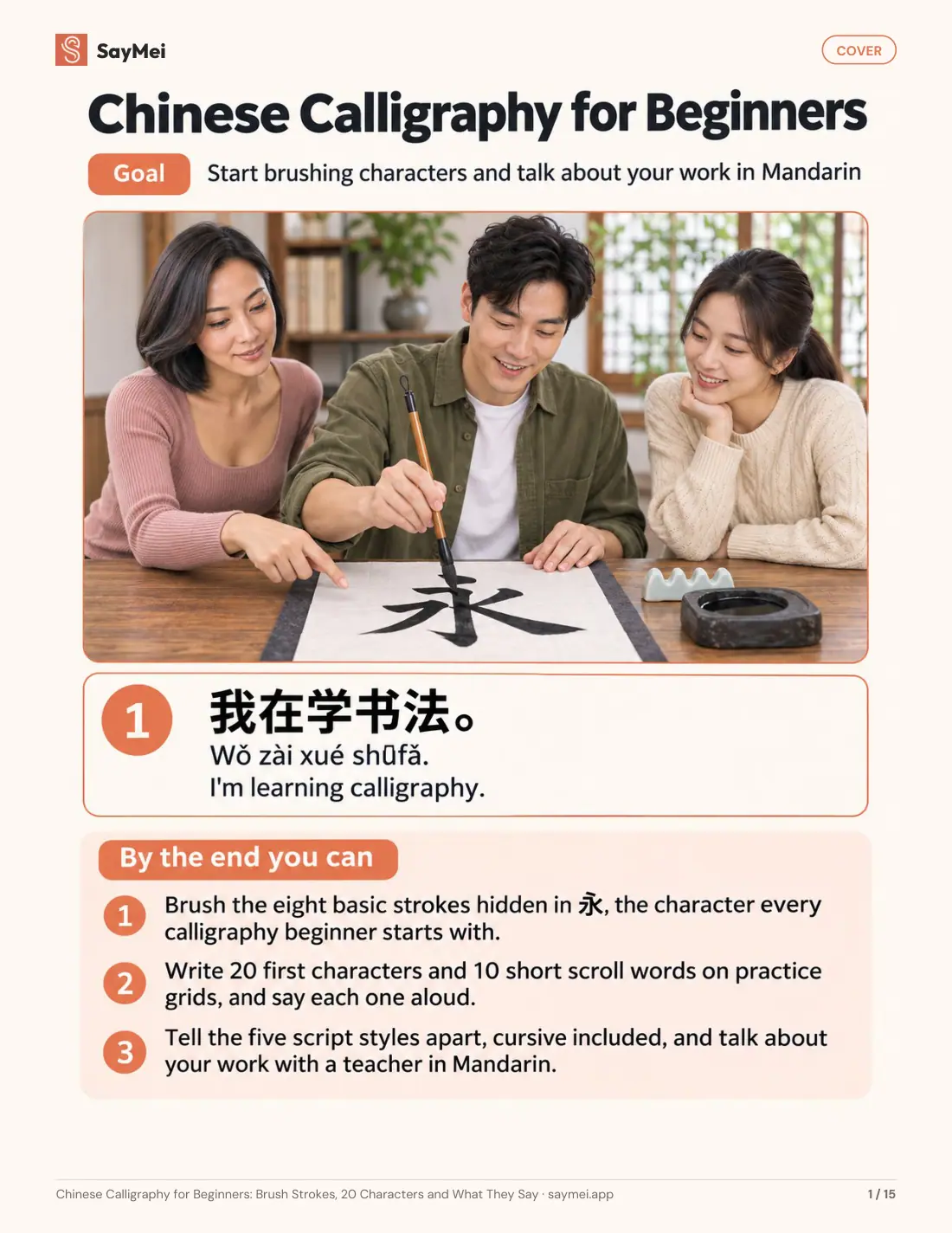
我在学书法。 · Wǒ zài xué shūfǎ. · I'm learning calligraphy.
By the end you can
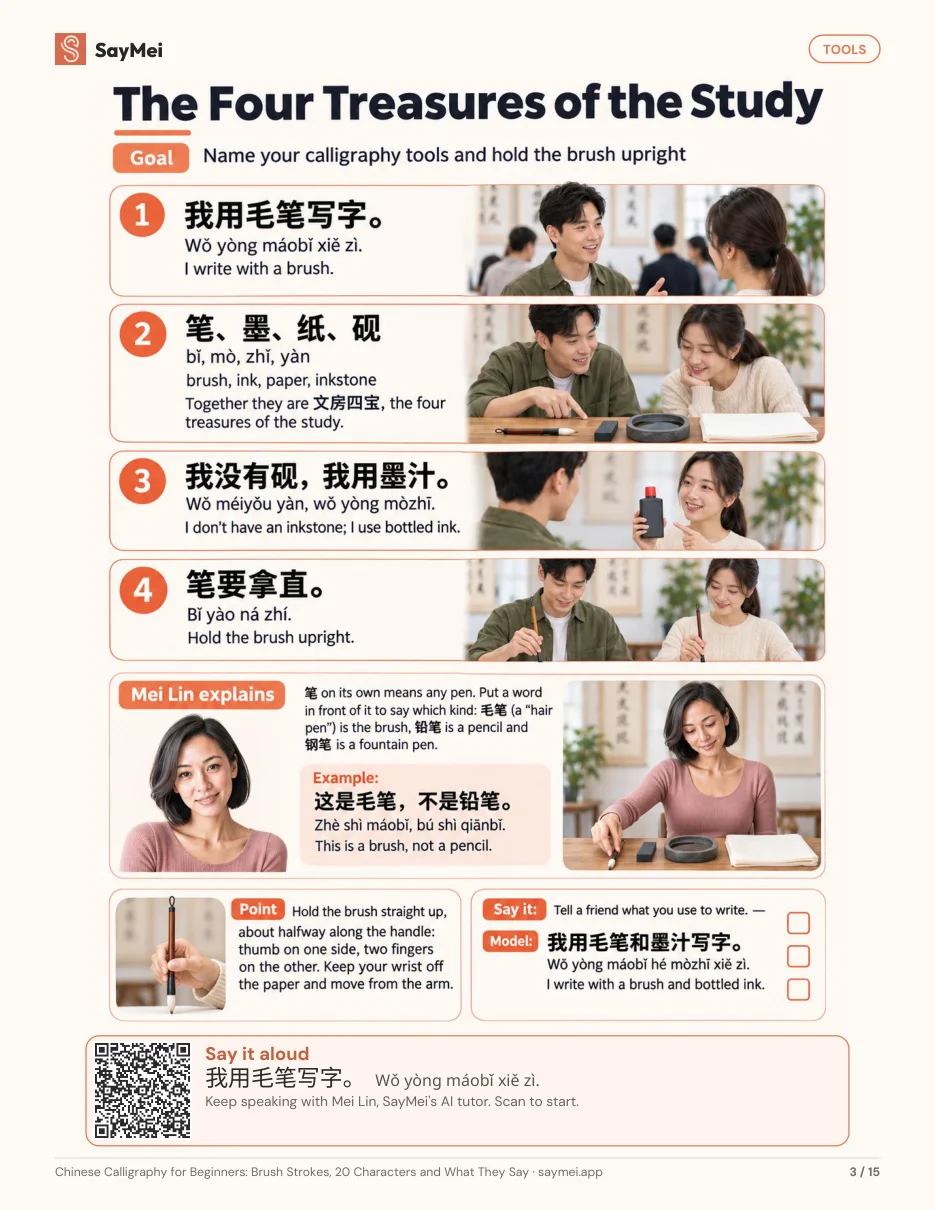
- Name your calligraphy tools and hold the brush the right way. Learn the four treasures of the study, 笔、墨、纸、砚, tell 毛笔 from 铅笔 and 钢笔, and hold the brush upright with your wrist off the paper.
我用毛笔写字。 · Wǒ yòng máobǐ xiě zì. · I write with a brush. - Name and brush the eight basic strokes hidden in 永. 永 has only five strokes, yet all eight basic moves are inside it: 点, 横, 竖, 钩, 提, 撇, 短撇 and 捺. Brush each one, then the whole character.
横要平,竖要直。 · Héng yào píng, shù yào zhí. · Horizontals stay level, verticals stay straight. - Brush ten first characters and watch the key stroke in each. From 一 to 水, with one tip for each: the top line of 二 is shorter, 撇 and 捺 open wide in 大, and the 竖 of 水 ends in a small hook.
这个字怎么读? · Zhège zì zěnme dú? · How do you read this character? - Brush ten more characters and build words with them. From 日 to 王, then join two characters you can now write into words like 火山 (volcano), 中心 (centre) and 人口 (population).
我会写这个字。 · Wǒ huì xiě zhège zì. · I can write this character. - Choose a word for a scroll or card and say what it means. Ten short words and when people hang them: 平安 for a traveller, 天天向上 over a student's desk, 家和万事兴 for a family's living room.
我写了平安两个字,送给我的朋友。 · Wǒ xiěle píng'ān liǎng gè zì, sòng gěi wǒ de péngyou. · I wrote the two characters 平安 for my friend. - Tell the five script styles apart, from seal to cursive. Spot regular, running, cursive, clerical and seal script by their shape, and know why beginners start with 楷书, where every stroke shows.
楷书最好认。 · Kǎishū zuì hǎo rèn. · Regular script is the easiest to read. - Ask for help and talk about your work at a calligraphy class. Ask how to write a character, ask how you did, understand the teacher's comments on your 横 and 竖, and say which style you want to try next.
我写得怎么样? · Wǒ xiě de zěnmeyàng? · How did I do?
What’s inside
- Tools: Brush, ink, paper and inkstone, the words for different pens, and how to hold the brush upright. The Four Treasures of the Study
- Eight Strokes: The eight basic strokes inside 永 and their names, then grids to brush each stroke and the whole character. The Eight Strokes Inside 永 · Brush the Strokes of 永
- First Characters: 一, 二, 三, 十, 人, 大, 天, 木, 山 and 水, each with the stroke to watch, then grids to brush and say them. Ten First Characters to Brush · Brush and Say Ten Characters
- More Characters: 日, 月, 心, 中, 上, 下, 口, 火, 土 and 王, then build words from characters you know. Ten More Characters to Brush · Brush and Say Ten More
- Words to Write: Ten scroll and card words like 平安 and 天天向上, when people hang each one, and a small scroll to plan and brush. Ten Words for a Scroll or Card · Plan a Small Scroll
- Styles: Seal, clerical, regular, running and cursive script: how to tell them apart and say which you like. Five Styles, From Seal to Cursive
- Review: A conversation at a calligraphy class: asking how to write a character and talking about your work. At a Calligraphy Class
How to use this book
The book goes in order and each part ends with something to say aloud. Play a line on the free audio, pause, say it back, then brush it. Print the grids or trace through thin practice paper. At one part a week, that's about a month.
- First session: Your tools. Page 3. Gather a brush and ink, or start with a felt-tip pen or a water-writing cloth, and practise holding it upright.
- Week 1: The eight strokes. Pages 4 and 5. Brush each stroke three times, then 永 three times, and say how your 横 and 竖 look.
- Week 2: Ten first characters. Pages 6 and 7. Brush each character twice, then say it and a word with it, like 山,大山.
- Week 3: Ten more characters. Pages 8 and 9. Brush the next ten, then join characters you know into new words.
- Week 4: Your first scroll. Pages 10 and 11. Pick a scroll word, brush it three times, choose your best and say who it's for.
- Last session: Styles and the class. Pages 12 and 13. Name the style of a sign or scroll near you, then act out the class conversation.
Who it’s for
Adult beginners curious about Chinese calligraphy who want to brush their first characters and talk about them in Mandarin: before a first class, with a new brush set at home, or to make a small scroll as a gift.
Before you start: Nothing. The book starts from the tools and the first stroke, and every Chinese line has pinyin and English. It teaches the shape of each stroke; for the order of strokes, see Chinese Stroke Order Rules.
Frequently asked questions
Do I need a brush and ink to start?
Not for the first weeks: a felt-tip pen or a water-writing cloth works. Print the pages to brush on the empty grids, or lay thin practice paper on top and trace through. When you buy a set, bottled ink (墨汁) does the job if you don't have an inkstone.
Which characters will I brush?
永 for the eight strokes, then twenty characters: 一 二 三 十 人 大 天 木 山 水, and 日 月 心 中 上 下 口 火 土 王. Then you pick a word for a small scroll, like 平安, 春天 or 天天向上.
How long does it take?
About a month at one part a week: your tools, the eight strokes, ten characters, ten more, your first scroll, and last the five styles and a calligraphy class. Each part ends with something to say aloud.
Is there audio?
Yes, free on the book's audio page: one track for each part, from the tools to the class conversation. Every Chinese line is read with a pause to say it back, and the short listening task on page 7 is on it too.
Does it teach stroke order?
It teaches the shape of each stroke and the key stroke to watch in each character. For the order of strokes, use Chinese Stroke Order Chart and Rules alongside it.
Which style of calligraphy does it use?
Page 12 shows the five styles, regular, running, cursive, clerical and seal, and how to spot each one by its shape. You brush in 楷书, regular script, where every stroke shows, which is why beginners start there.
Do I need a SayMei account?
Yes, to download the PDF, and the account is free: sign up with Google, Apple or your email address. With it we email you a copy of the workbook, keep every workbook you download on your account on all your devices, save your place in the free online practice, and you can practise speaking with Mei Lin, SayMei's AI tutor.
How do I print it?
The PDF is US Letter size. On A4 paper, choose "Fit to page" (or "Scale to fit") in the print dialog so nothing is cut off. Print the whole workbook or only the pages you need; colour looks best, and black and white works too.
Keep going
Printable Chinese Character Flashcards: 48 Starter Characters · How to Type in Chinese: Set Up a Pinyin Keyboard and Send Your First Messages · Chinese Stroke Order Chart and Rules · Chinese Flashcards: 200 Most Common Words to Print and Cut · Browse all 294 workbooks
Version 2026-11 · Updated Nov 4, 2026 · Report a correction