Culture · Intermediate
Everyday Chengyu: Meaning, Context & Misuse Practice
You use 20 idioms you'll really hear, like 马马虎虎 and 一模一样, see each one in a short story and fix the mistakes learners make most. For intermediate learners who read simple sentences in characters.
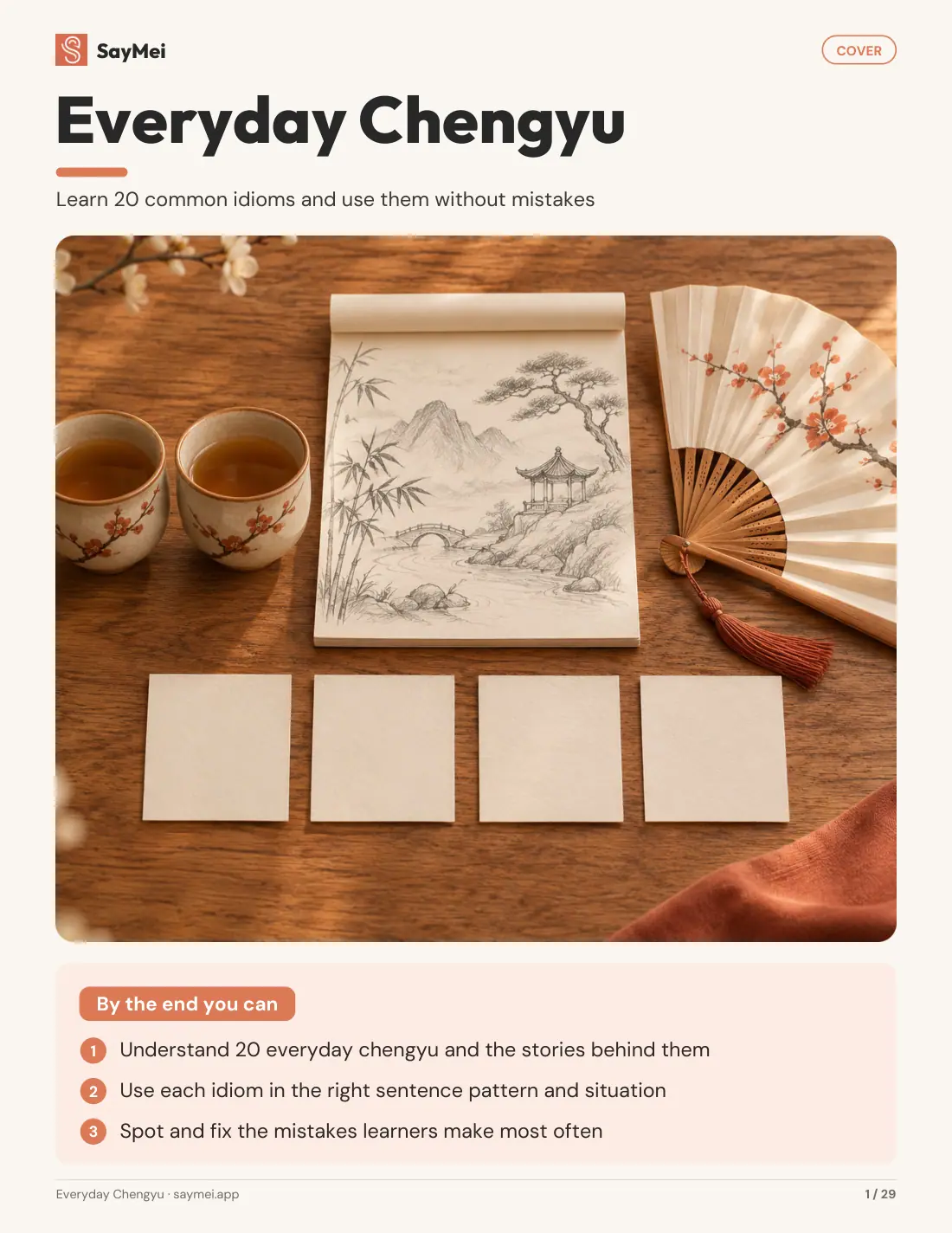
- Level:
- Intermediate · HSK 3
- Format:
- Workbook · PDF · 30 pages · US Letter (prints on A4)
- Price:
- Free · free with a saymei account · updated Oct 8, 2026
Download the free PDF: create a free SayMei account on this page, and we'll email you a copy too.
熟能生巧 · shúnéng-shēngqiǎo · Practice makes perfect.
By the end you can
- Use 20 chengyu you will really hear, four per unit. Five units take you from 马马虎虎 and 熟能生巧 to 一模一样 and 津津有味. Each idiom comes with its meaning, its pinyin in two halves and an example sentence.
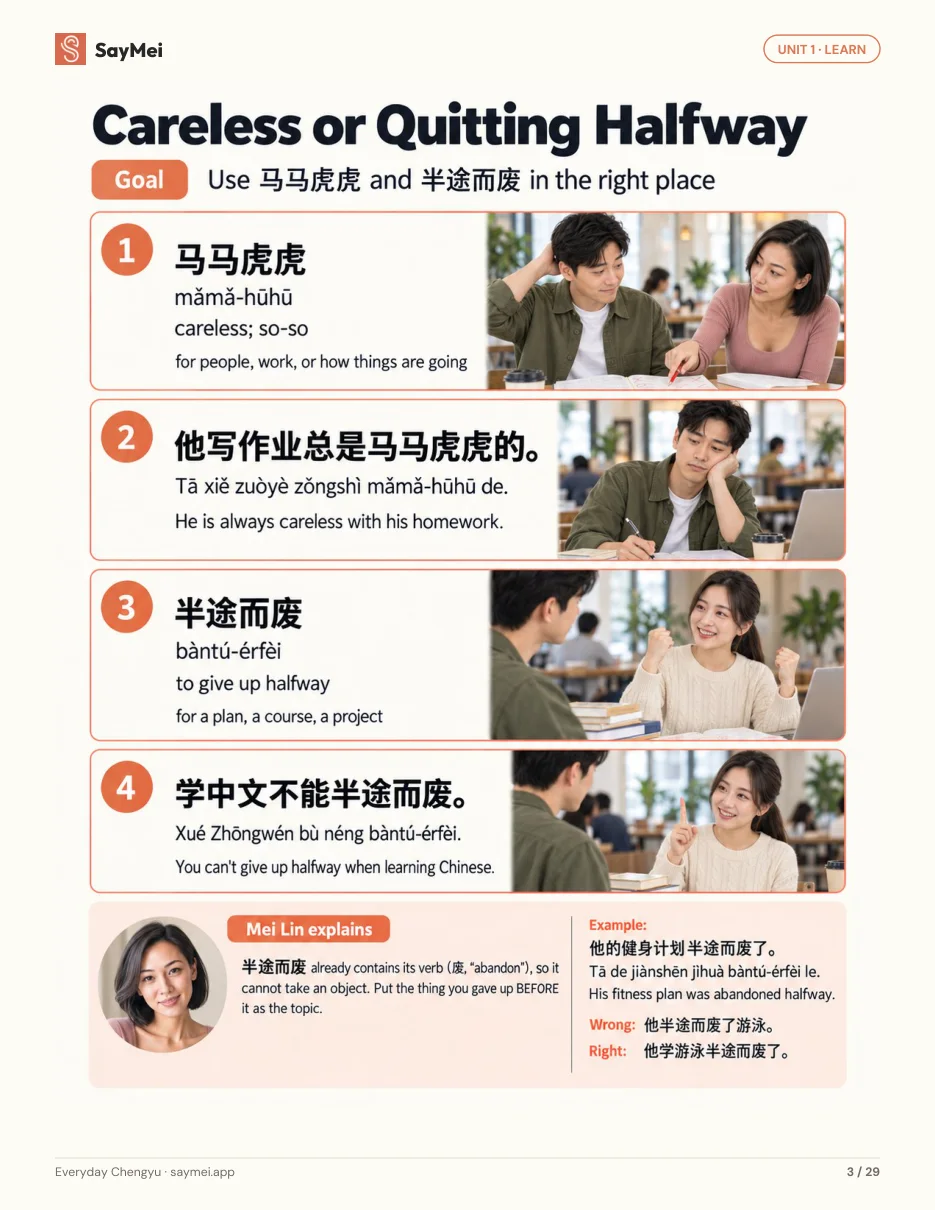
- Talk about effort and giving up. Call work careless with 马马虎虎, warn against quitting with 半途而废, and encourage someone with 熟能生巧. 半途而废 already contains its verb, so it takes no object.
学中文不能半途而废。 · Xué Zhōngwén bù néng bàntú-érfèi. · You can't give up halfway when learning Chinese. - Use story idioms without being rude. 画蛇添足 and 守株待兔 are for criticism, never praise. Say 对牛弹琴 about yourself, not the listener, and add 为时不晚 after 亡羊补牢 to sound hopeful.
跟我讲足球规则就是对牛弹琴,我完全不懂。 · Gēn wǒ jiǎng zúqiú guīzé jiù shì duìniú-tánqín, wǒ wánquán bù dǒng. · Explaining football rules to me is pointless. I don't get it at all. - Describe feelings and fitting in abroad. Put the person after 对 with 一见钟情, the nerves after 心里 with 七上八下, and use 自言自语 and 入乡随俗 about yourself adapting to a new place.
在中国吃饭,大家一起分菜,入乡随俗嘛。 · Zài Zhōngguó chīfàn, dàjiā yìqǐ fēn cài, rùxiāng-suísú ma. · In China everyone shares the dishes: when in Rome. - Describe focus, mess and effort. Contrast 一心一意 with 三心二意, describe a room with 乱七八糟 and effort with 千方百计. Chengyu already carry a strong degree, so drop 很 before them.
他的桌子乱七八糟,找不到钥匙。 · Tā de zhuōzi luànqī-bāzāo, zhǎo bú dào yàoshi. · His desk is a mess; he can't find his keys. - Talk about time, likeness and reactions. Open a sentence with 不知不觉, compare with 跟……一模一样 (say mú, not mó), and describe how someone acts with 莫名其妙地 or 看得津津有味.
不知不觉,我学中文已经三年了。 · Bùzhī-bùjué, wǒ xué Zhōngwén yǐjīng sān nián le. · Before I knew it, I'd been learning Chinese for three years. - See each idiom at work in a short story. Five stories with Lin Hao and Chen Xiaoyu use a whole unit's idioms in context, from a calligraphy class to a business dinner in Chengdu and a café mix-up.
- Spot and fix the mistakes learners make most. Practice pages built from real learner errors ask you to fill gaps, correct wrong sentences, choose the situation that fits and say a line to a partner.
What’s inside
- Unit 1: Learn: Careless or Quitting Halfway · Learn: Practice and Double Wins
- Story 1: Lin Hao Learns Calligraphy
- Unit 1: Practice: Unit 1 Practice
- Unit 2: Learn: Snake Feet and Waiting Rabbits · Learn: Cows and Broken Pens
- Story 2: Xiaoyu's Big Presentation
- Unit 2: Practice: Unit 2 Practice
- Review: Review: Units 1 and 2
- Unit 3: Learn: Love at First Sight, Nerves · Learn: Talking to Yourself Abroad
- Story 3: Lin Hao's Trip to Chengdu
- Unit 3: Practice: Unit 3 Practice
- Unit 4: Learn: One Heart or Three Hearts · Learn: Messy Rooms, Every Effort
- Story 4: Xiaoyu Works from Home
- Unit 4: Practice: Unit 4 Practice
- Unit 5: Learn: Time Flies, Exact Twins · Learn: Baffled and Delighted
- Story 5: The Mixed-Up Bag
- Unit 5: Practice: Unit 5 Practice
- Reference: All 20 Chengyu (1–10) · All 20 Chengyu (11–20)
- Review: Final Review: 20 Chengyu
How to use this book
Five units, each with two Learn pages, a story and a Practice page. One unit a week at a gentle pace, or a few pages a day if you want to finish sooner.
- Each unit: Learn the four idioms. Read both Learn pages and their pattern box, which shows the grammar rule that stops you misusing each idiom. Say every example aloud.
- Each unit: Read the story. Find each new idiom in the story and notice what comes before and after it.
- Each unit: Practise and check. Do the Practice page, including the Correct the mistake tasks. Try every task before you look at the key at the back.
- After Unit 2: First review. Read the review conversation on page 11, which uses eight idioms, then do its role-play: encourage a friend who wants to quit Chinese class.
- At the end: Final review. Use the reference list on pages 24 and 25, then pick the correct pattern in the final review and describe your own Chinese learning with three idioms.
Who it’s for
Intermediate learners who meet chengyu in shows, books and conversation and want to use the common ones correctly, without sounding stiff or rude.
Before you start: Solid everyday Chinese: you can read simple sentences in characters. Every example also has pinyin and English, and each story lists its key words.
Frequently asked questions
Which chengyu does it teach?
Twenty common ones: 马马虎虎, 半途而废, 熟能生巧, 一举两得, 画蛇添足, 守株待兔, 对牛弹琴, 亡羊补牢, 一见钟情, 七上八下, 自言自语, 入乡随俗, 一心一意, 三心二意, 乱七八糟, 千方百计, 不知不觉, 一模一样, 莫名其妙 and 津津有味.
How is each unit built?
Five units of four idioms. Each has two Learn pages with meanings, pinyin in two halves and example sentences, a short story with Lin Hao and Chen Xiaoyu that uses all four, and a Practice page built from real learner errors.
Which mistakes does it help me avoid?
Adding an object to 半途而废, which already contains its verb, using 画蛇添足 as praise, or putting 很 before a chengyu, which already carries a strong degree. The Correct the mistake tasks on each Practice page have you fix sentences like these.
Does it explain the stories behind the idioms?
Unit 2 covers four story idioms: 画蛇添足, 守株待兔, 对牛弹琴 and 亡羊补牢. Its Learn pages give literal meanings, like playing the zither to a cow, and its Practice page has you match each idiom to its story.
How long does it take?
One unit a week at a gentle pace, or a few pages a day if you want to finish sooner. A review after Unit 2 and a final review bring the idioms back, and the answers are in the key at the back.
Is it too hard if I'm a beginner?
It's written for intermediate learners who read simple sentences in characters, though every example also has pinyin and English. If you're earlier on, Chinese Sayings for Beginners has 40 everyday expressions and easy chengyu.
Do I need a SayMei account?
Yes, to download the PDF, and the account is free: sign up with Google, Apple or your email address. With it we email you a copy of the workbook, keep every workbook you download on your account on all your devices, save your place in the free online practice, and you can practise speaking with Mei Lin, SayMei's AI tutor.
How do I print it?
The PDF is US Letter size. On A4 paper, choose "Fit to page" (or "Scale to fit") in the print dialog so nothing is cut off. Print the whole workbook or only the pages you need; colour looks best, and black and white works too.
Keep going
Chinese Myths and Legends in Easy Chinese: 8 Stories to Read, Hear and Retell · 100 Common Chinese Idioms (Chengyu): Printable List with Pinyin, Meanings and Examples · Learn Chinese with C-Dramas: 100 Phrases You Hear in Every Drama · 100 Chinese Proverbs and Sayings with Pinyin, Meanings and Audio · Browse all 379 workbooks
In these collections: Intermediate Chinese Workbooks · Chinese Festival Workbooks · HSK 3 Chinese Workbooks
Version 2026-10 · Updated Oct 8, 2026 · Report a correction