Pronunciation · Beginner
Mandarin Tones Chart: The 4 Chinese Tones, Tone Pairs and Tone Change Rules (Printable PDF with Audio)
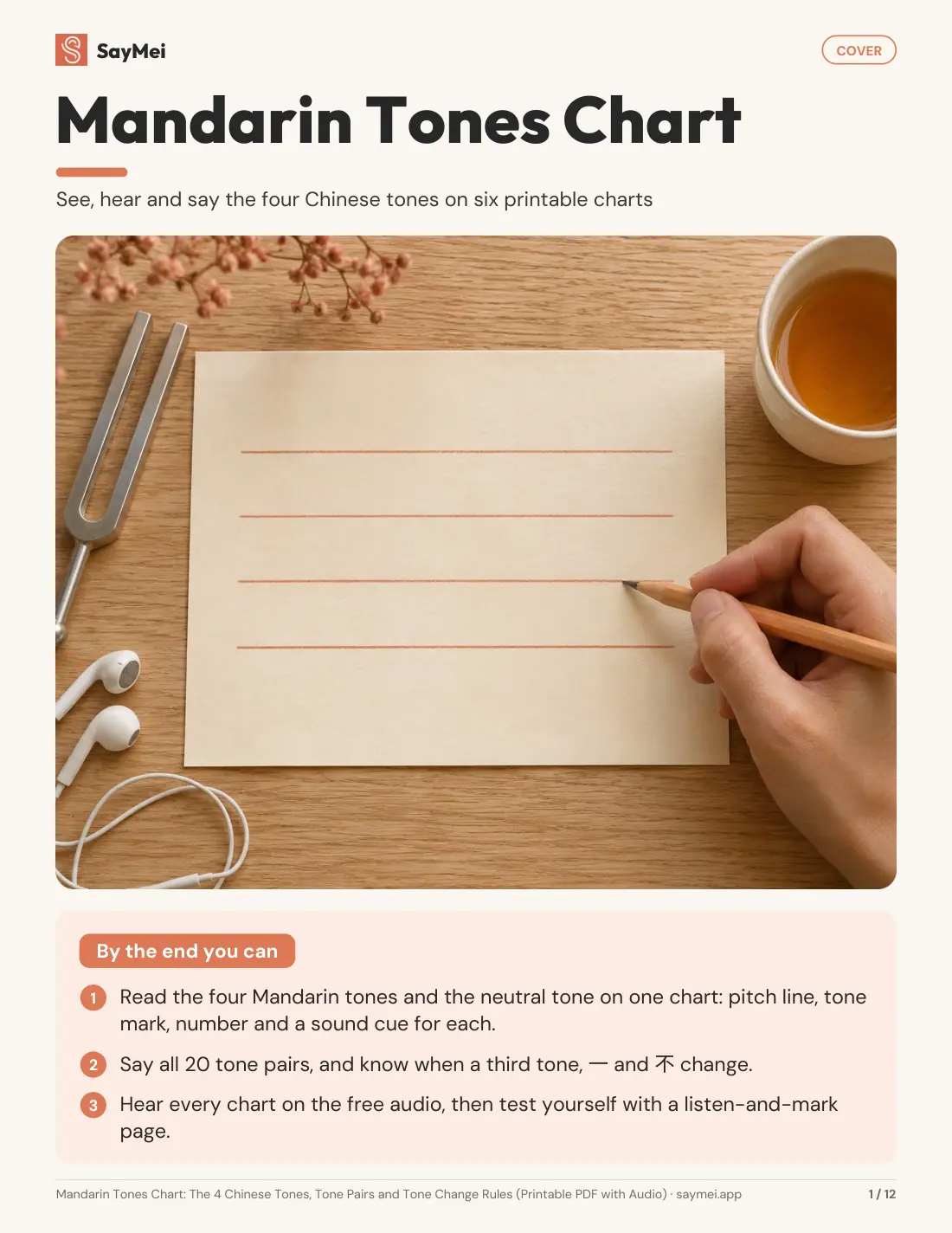
Six printable charts put the four Mandarin tones, the neutral tone, all 20 tone pairs and the tone change rules one to a page, with pitch lines, free audio for every chart and a two-page self-check.
- Level:
- Beginner · HSK 1
- Format:
- Reference guide · PDF · 12 pages · US Letter (prints on A4)
- Price:
- Free · free with a saymei account · updated Nov 17, 2026
Listening audio: play every track free, no account needed.
Download the free PDF: create a free SayMei account on this page, and we'll email you a copy too.
中文有四个声调。 · Zhōngwén yǒu sì gè shēngdiào. · Mandarin has four tones.
By the end you can
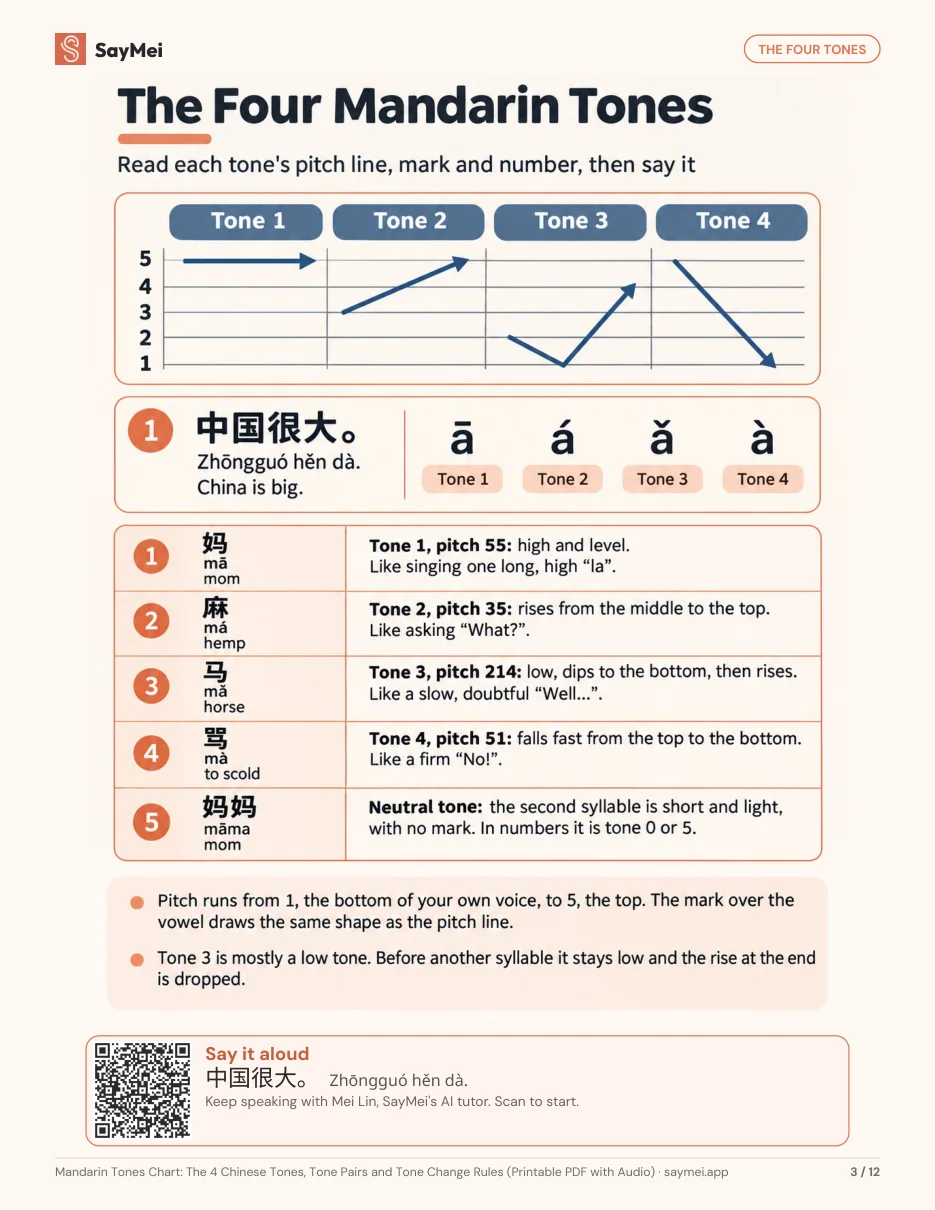
- Read the four tones from one chart. Each tone has its pitch line on a scale of 1 to 5, its mark, its number and a sound cue: 55, 35, 214 and 51, shown on mā, má, mǎ and mà, with the neutral tone in 妈妈.
中国很大。 · Zhōngguó hěn dà. · China is big. (Tones 1, 2, 3 and 4 in a row.) - Hear how the tone alone changes the word. Three more four-tone sets, tāng, shū and jī, and two word pairs that sit one tone apart: 买 and 卖, 汉语 and 韩语.
你要汤还是糖? · Nǐ yào tāng háishi táng? · Do you want soup or sugar? - Say the neutral tone at the right height. A light syllable takes its height from the tone before it: about pitch 2 after tone 1, 3 after tone 2, 4 after tone 3 and 1 after tone 4, shown with 杯子, 房子, 饺子 and 筷子.
你们喜欢饺子吗? · Nǐmen xǐhuan jiǎozi ma? · Do you all like dumplings? - Say one everyday word for each of the 20 tone pairs. One grid, four first tones by five endings, with a word in every cell, from 医生 (1-1) and 熊猫 (2-1) to 雨伞 (3-3) and 月亮 (4-0), and a cue for each row.
这个词怎么念? · Zhège cí zěnme niàn? · How do you say this word? - Know when a third tone, 不 and 一 change. One page holds every rule: two third tones in a row, the low half third tone, 不 as bú before tone 4, and 一 as yí before tone 4 and yì before tones 1, 2 and 3.
你好,我不是老师。 · Nǐ hǎo, wǒ bú shì lǎoshī. · Hello, I'm not a teacher. - Put the tone mark on the right vowel. Five numbered rules: a first, then e, then o, and in iu and ui the last vowel, with notes on i, on ü and on typing tone numbers such as ni3 hao3.
拼音怎么写? · Pīnyīn zěnme xiě? · How do you write the pinyin? - Check your ear and the rules. Two self-check pages: write the tone marks you hear on syllables and words, circle the word you hear, place marks, and apply the changes of 不, 一 and the third tone. The answers are at the back.
是三声吗? · Shì sān shēng ma? · Is it the third tone?
What’s inside
- The Four Tones: The Four Mandarin Tones
- Tone Sets: One Sound, Four Tones
- The Neutral Tone: The Neutral Tone Chart
- Tone Pairs Chart: The 20 Tone Pairs Chart
- Tone Change Rules: Tone Change Rules on One Page
- Tone Mark Placement: Where the Tone Mark Goes
- Self-Check: Listen: Listen and Mark the Tones · Rules: Check the Rules
How to use this book
Each chart stands alone, so you can print one and pin it up. To work through the set, take two charts a day with the free audio: listen, trace the pitch line with your hand, hum the tone, then say the word.
- Day 1: The four tones and the tone sets. Pages 3 and 4. Say mā, má, mǎ, mà after the audio until each one matches its pitch line, then the three other sets.
- Day 2: The neutral tone and the 20 tone pairs. Pages 5 and 6. Read the pairs chart across each row, then down each column, saying every word back in the pause.
- Day 3: Tone changes and tone marks. Pages 7 and 8. Say each example the way the chart tells you, then cover the pinyin and say it again.
- Day 4: Self-check. Pages 9 and 10 with the last audio track. Mark your answers with the key at the back and go back to any chart you missed.
Who it’s for
Beginners who are starting Mandarin, learners whose tones slip in real words, and teachers or parents who want a Mandarin tones chart to print and pin up.
Before you start: You need no Chinese to start. Every example has characters, pinyin and English, and the free audio lets you hear each chart.
Your path
The books that come before and after this one.
Frequently asked questions
What are the four tones in Mandarin?
Tone 1 is high and level, tone 2 rises, tone 3 is low and dips, and tone 4 falls. A fifth sound, the neutral tone, is short and light and has no mark. Page 3 shows all of them on one chart, on the syllable ma.
What do the numbers 55, 35, 214 and 51 mean?
They show pitch on a scale from 1, the bottom of your own voice, to 5, the top. 55 starts high and stays high, 35 rises from the middle to the top, 214 dips to the bottom and then rises, and 51 falls from the top to the bottom.
What is a tone pair?
The two tones of a two-syllable word, written like 2-4 for tone 2 and then tone 4. Counting neutral endings there are 20 pairs, and page 6 gives one everyday word for each.
Why is 你好 written nǐ hǎo but said ní hǎo?
When two third tones meet, the first one rises like a second tone, but pinyin keeps both marks. Page 7 puts this rule, the half third tone and the changes of 不 and 一 on one chart.
Where is the audio, and what does it read?
On this book's page on saymei.app. There is one track for each chart, with a pause after every line to say it back. Single syllables are read in their sets, such as mā, má, mǎ, mà, so you hear each tone next to the others.
Do I need a SayMei account?
Yes, to download the PDF, and the account is free: sign up with Google, Apple or your email address. With it we email you a copy of the workbook, keep every workbook you download on your account on all your devices, save your place in the free online practice, and you can practise speaking with Mei Lin, SayMei's AI tutor.
How do I print it?
The PDF is US Letter size. On A4 paper, choose "Fit to page" (or "Scale to fit") in the print dialog so nothing is cut off. Print the whole workbook or only the pages you need; colour looks best, and black and white works too.
Keep going
Chinese Tone Pairs Practice: All 20 Tone Pairs, with Audio · Complete Pinyin Table PDF: Every Mandarin Syllable with All Four Tones (Printable) · Mandarin Tongue Twisters: 20 Rhymes for Clearer Pronunciation · Chinese Homophones: 100 Words That Sound Alike, with Pinyin, Meanings and Audio · Browse all 379 workbooks
In these collections: Chinese Cheat Sheets and Charts · Pinyin and Tones Workbooks · HSK 1 Chinese Workbooks
Version 2026-11 · Updated Nov 17, 2026 · Report a correction