Characters · Total beginner
Neat Chinese Handwriting: A Pen Writing Practice Workbook for Beginners
You centre each character in the 田字格, keep the left part of 你 and 明 narrow, and finish by writing your address and a birthday card. Made for learners starting from zero, with every word on the free audio.
- Level:
- Total beginner · HSK 1
- Format:
- Workbook · PDF · 17 pages · US Letter (prints on A4)
- Price:
- Free · free with a saymei account · updated Nov 4, 2026
Listening audio: play every track free, no account needed.
Download the free PDF: create a free SayMei account on this page, and we'll email you a copy too.
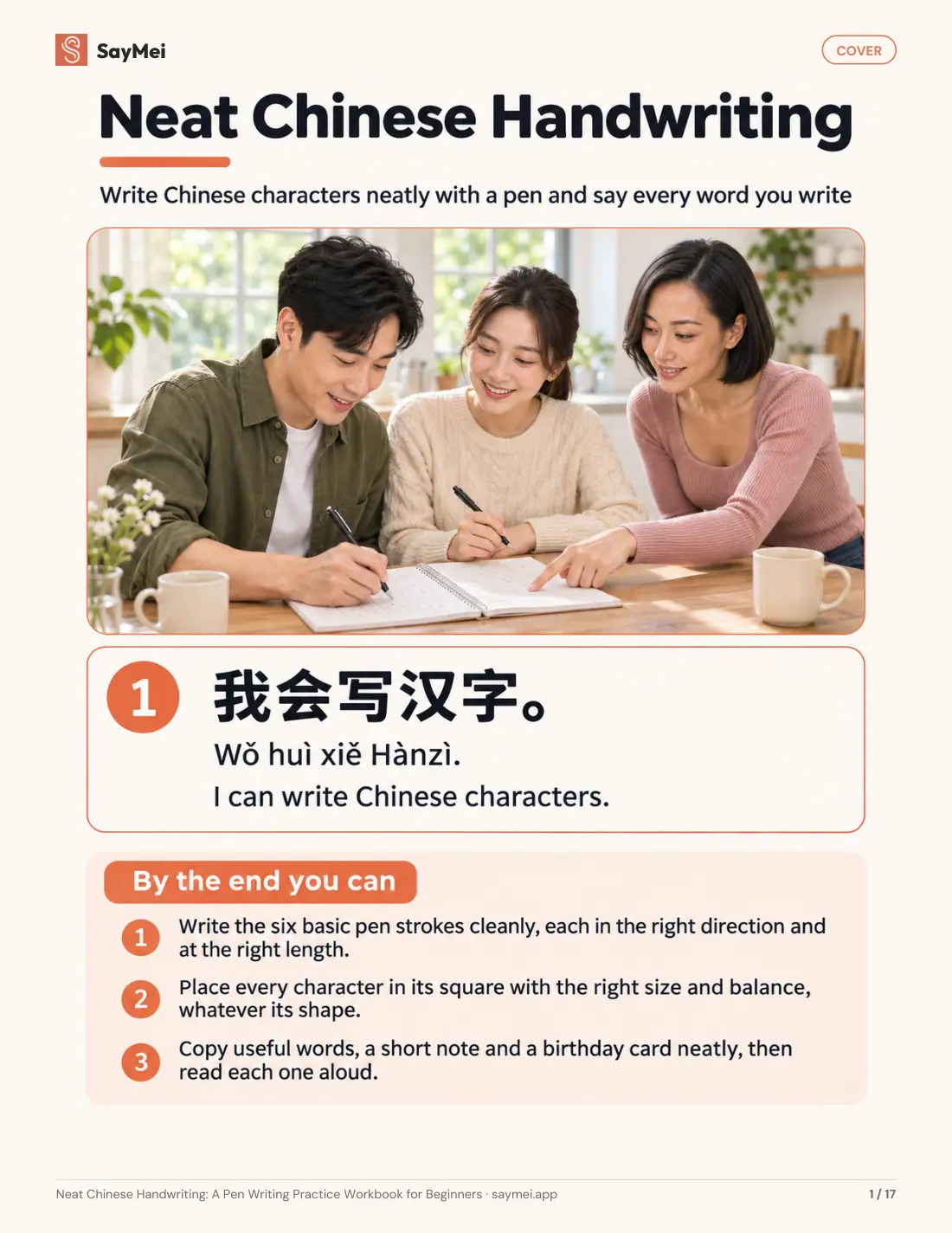
我会写汉字。 · Wǒ huì xiě Hànzì. · I can write Chinese characters.
By the end you can
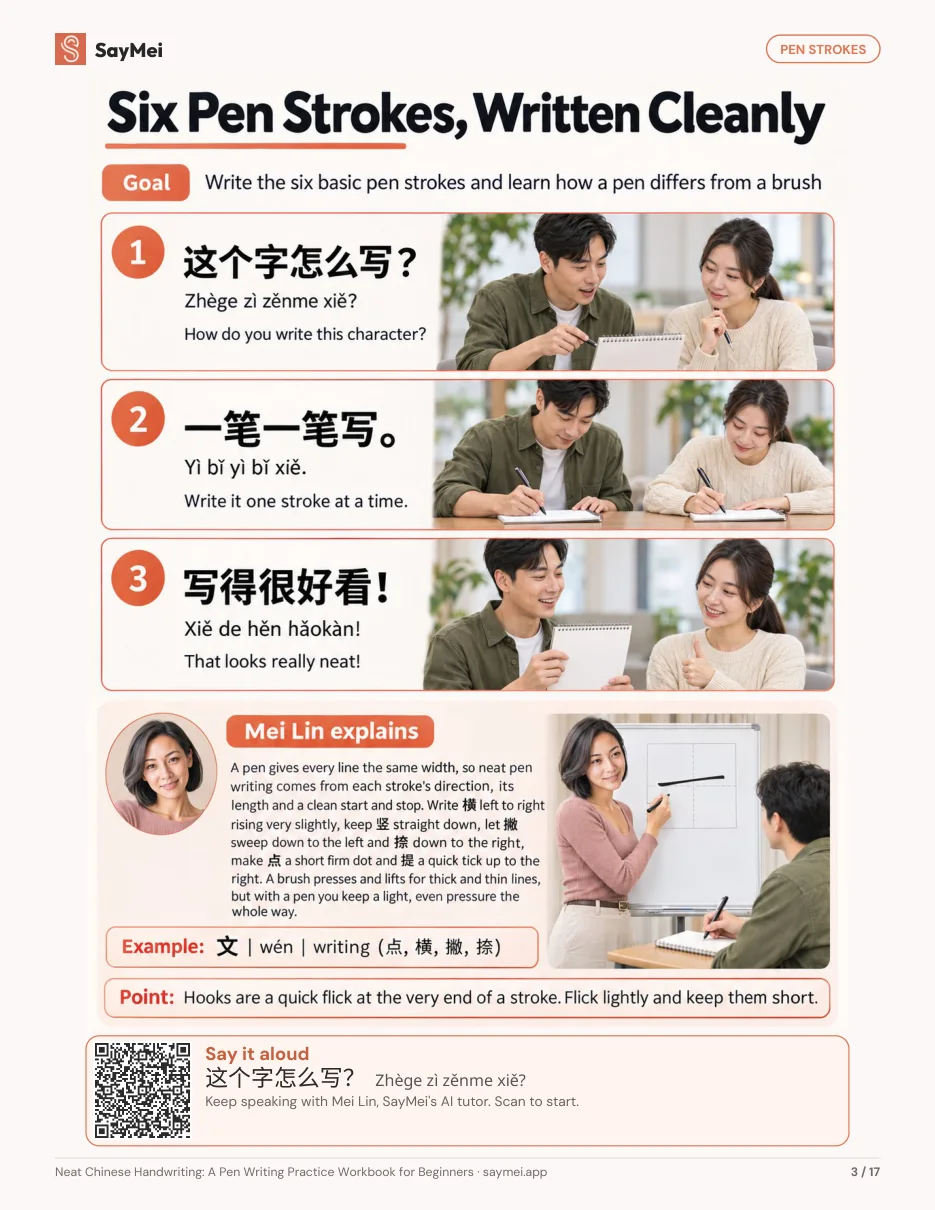
- Write the six basic pen strokes cleanly. 横 rising very slightly, 竖 straight down, 撇 and 捺 sweeping out, 点 short and firm, 提 a quick tick. With a pen, neatness comes from direction, length and a clean start and stop.
一笔一笔写。 · Yì bǐ yì bǐ xiě. · Write it one stroke at a time. - Name the strokes, count them and find the first one. Drill each stroke in the grid, count the strokes in 口 and 中, and spot the first stroke of 人 and 六.
这是横,这是竖。 · Zhè shì héng, zhè shì shù. · This is a horizontal stroke, and this is a vertical stroke. - Centre each character in the 田字格 and keep sizes even. Put the middle of each character on the centre point and fill about four fifths of the square. Simple ones like 口 sit a little smaller.
字要写在中间。 · Zì yào xiě zài zhōngjiān. · Write the character in the middle. - Balance left-right characters like 你, 吃 and 明. Keep the left part narrow and a little high, then say a word with each of the ten characters you wrote.
你好,我在学汉语。 · Nǐ hǎo, wǒ zài xué Hànyǔ. · Hi, I'm learning Chinese. - Let the wider part set the width in top-bottom characters. A roof like 宀 covers the part below; a small top like 日 sits over a wider base. Ten characters from 字 to 爸.
我想喝茶。 · Wǒ xiǎng hē chá. · I'd like some tea. - Write framed characters with a small, centred inside. Keep the frame a little narrower than the square, and see which frames are open: 问 at the bottom, 医 on the right.
我想去中国。 · Wǒ xiǎng qù Zhōngguó. · I want to go to China. - Copy ten useful two-character words at an even height. 你好, 谢谢, 朋友, 老师 and more, with an even gap and a little more room for the character with more strokes.
我喜欢中文。 · Wǒ xǐhuan Zhōngwén. · I like Chinese. - Write a note, your name and your address in Chinese order. Give each punctuation mark its own square, put the family name first, and write an address from big to small: country, city, road.
我叫林浩,我住在上海。 · Wǒ jiào Lín Hào, wǒ zhù zài Shànghǎi. · My name is Lin Hao, and I live in Shanghai.
What’s inside
- Pen Strokes: Six Pen Strokes, Written Cleanly · Stroke Drills in the Grid
- The Grid: Centre and Size in the 田字格 · Ten Simple Characters, Centred
- Shapes: Ten Left-Right Characters · Ten Top-Bottom Characters · Ten Enclosed Characters
- Words and Lines: Copy Ten Useful Words · A Note, Your Name and Address
- Review: A Birthday Card for Mei Lin
- Plan: Your 14-Day Handwriting Plan
How to use this book
Work in order: strokes, the grid, three character shapes, then words and lines. Ten to fifteen slow minutes a day is enough. Play a word on the free audio, write it, then say it back in the pause. Page 13 is a 14-day plan to tick off.
- Days 1–2: Pen strokes. Fill a row of each stroke on page 4 and name the strokes aloud.
- Day 3: The grid. Write the ten simple characters on page 6, centred and evenly sized. Keep this page to compare later.
- Days 4–6: Three shapes. Left-right, top-bottom and enclosed characters, pages 7 to 9, one page a day. Say a word with each.
- Day 7: Look back. Read all your pages aloud once and circle your three neatest characters.
- Days 8–11: Words and a note. Copy the ten useful words on page 10 with the audio, then Lin Hao's note and your own name and address on page 11.
- Days 12–14: A card, then compare. Write the birthday card on page 12 for someone real and read it aloud. On Day 14 write page 6 again and compare it with Day 3.
Who it’s for
Adult beginners who want their everyday pen handwriting in Chinese to look neat and even, for notes, cards, forms and class work.
Before you start: Nothing but the pen you write with every day: a fine gel or ballpoint, about 0.5 mm, or a pencil if you feel unsure. Every word has pinyin and English, and the free audio reads each one.
Frequently asked questions
What's inside?
Six pen strokes and drills in the grid, centring and sizing in the 田字格, then ten characters of each shape: simple, left-right, top-bottom and enclosed. After that you copy ten useful words, write a note with your name and address, and a birthday card. Page 13 is a 14-day plan to tick off.
Should I use a pen or a pencil?
The pen you write with every day. A fine gel or ballpoint pen of about 0.5 mm works best, and you can start in pencil if you feel unsure. A pen gives every line the same width, so the book teaches neatness through each stroke's direction, length and clean start and stop, with a light, even pressure.
How big should each character be in the grid?
Put the middle of the character on the point where the dotted lines cross, and let most characters fill about four fifths of the square, with a little white space on every side. Simple characters with few strokes, like 口, sit a little smaller so they look the same size as busier ones.
How long does it take?
Two weeks on the plan on page 13, at ten to fifteen slow minutes a day. On Day 14 you write page 6 again and compare it with your page from Day 3.
Is there audio?
Yes. The free audio reads every word in the book with a pause after it. Play a word, write it, then say it back in the pause.
Does the book teach stroke order or brush calligraphy?
It covers what neat pen writing needs: the six basic strokes, the first stroke and stroke count of simple characters, and balance by shape. Stroke-order rules in depth are in Chinese Stroke Order Chart and Rules, and brush writing is in Chinese Calligraphy for Beginners: Brush Strokes, 20 Characters and What They Say.
Do I need a SayMei account?
Yes, to download the PDF, and the account is free: sign up with Google, Apple or your email address. With it we email you a copy of the workbook, keep every workbook you download on your account on all your devices, save your place in the free online practice, and you can practise speaking with Mei Lin, SayMei's AI tutor.
How do I print it?
The PDF is US Letter size. On A4 paper, choose "Fit to page" (or "Scale to fit") in the print dialog so nothing is cut off. Print the whole workbook or only the pages you need; colour looks best, and black and white works too.
Keep going
Printable Chinese Character Flashcards: 48 Starter Characters · How to Type in Chinese: Set Up a Pinyin Keyboard and Send Your First Messages · Chinese Stroke Order Chart and Rules · Chinese Flashcards: 200 Most Common Words to Print and Cut · Browse all 294 workbooks
Version 2026-11 · Updated Nov 4, 2026 · Report a correction