Grammar · Beginner to pre-intermediate
The SayMei Chinese Grammar Practice Book
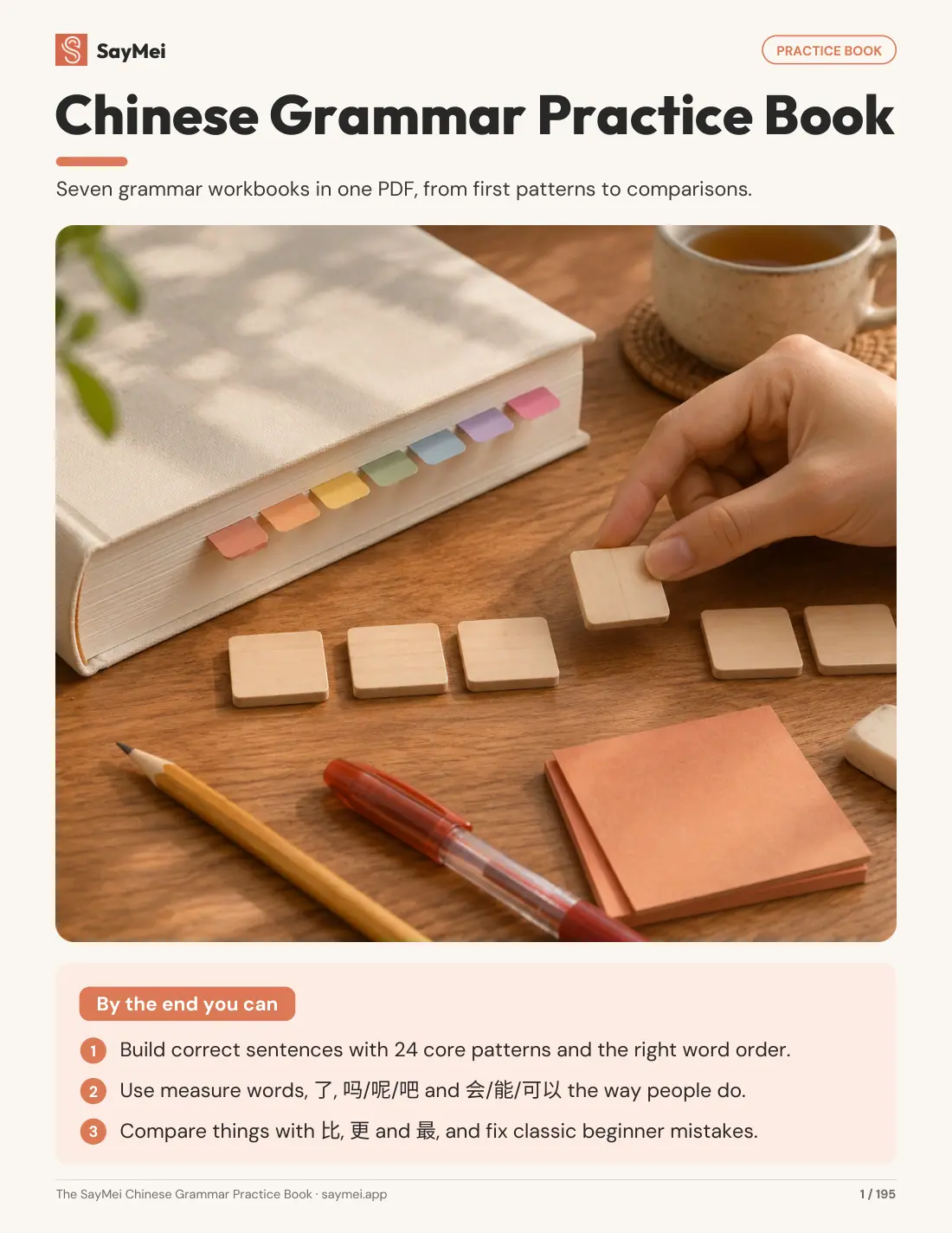
You work through seven grammar workbooks in one PDF, from 24 core patterns to measure words, the two jobs of 了 and comparisons with 比. For beginners and pre-intermediate learners, and for teachers with a class.
- Level:
- Beginner · HSK 1–2
- Format:
- Practice book · PDF · 196 pages · US Letter (prints on A4)
- Price:
- Free · free with a saymei account · updated Oct 27, 2026
Download the free PDF: create a free SayMei account on this page, and we'll email you a copy too.
我们一起练习语法吧! · Wǒmen yìqǐ liànxí yǔfǎ ba! · Let's practise grammar together!
By the end you can
- Build everyday sentences with 24 core patterns. One pattern a page, from 是 and 很 to 因为…所以 and 吧, each with the classic beginner mistake to avoid and practice after every two.
我哥哥比我高。 · Wǒ gēge bǐ wǒ gāo. · My brother is taller than me. - Choose 不 or 没 for "not". Use 不 for habits and plans and 没 for what didn't happen, and drop 了 after 没.
我昨天没喝咖啡。 · Wǒ zuótiān méi hē kāfēi. · I didn't drink coffee yesterday. - Put words in the right order, then grow the sentence. Put time and 在 + place before the verb, keep question words where the answer goes, and add how and why one block at a time.
我今天上班。 · Wǒ jīntiān shàngbān. · I'm working today. - Count drinks, books, clothes and pets with the right measure word. Use 杯, 碗, 本, 张, 件, 双, 只 and more in cafés, shops and at home, and say 两 before a measure word, never 二.
两本书 · liǎng běn shū · two books - Use 了 for what happened and for what has changed. Put 了 after the verb for one finished event, at the end of a sentence for a new situation, and use 没 or 不……了 to say no.
我买了两本书。 · Wǒ mǎi le liǎng běn shū. · I bought two books. - Sound natural with 吗, 呢, 吧 and 啊. Ask yes-or-no with 吗, bounce a question back with 你呢, suggest and guess with 吧, and agree warmly with 好啊.
我们一起去吧。 · Wǒmen yìqǐ qù ba. · Let's go together. - Pick the right "can": 会, 能 or 可以. Use 会 for a skill you learned, 能 for what today's situation allows, and 可以 to ask for or give permission.
我会游泳,但是今天不能游。 · Wǒ huì yóuyǒng, dànshì jīntiān bù néng yóu. · I can swim, but I can't swim today. - Compare things with 比, 更, 最, 没有 and 一样. Say how big a difference is with 一点 or 得多, then say "even more", "the most", "not as … as" and "the same".
地铁比公交车快得多。 · Dìtiě bǐ gōngjiāochē kuài de duō. · The subway is much faster than the bus.
What’s inside
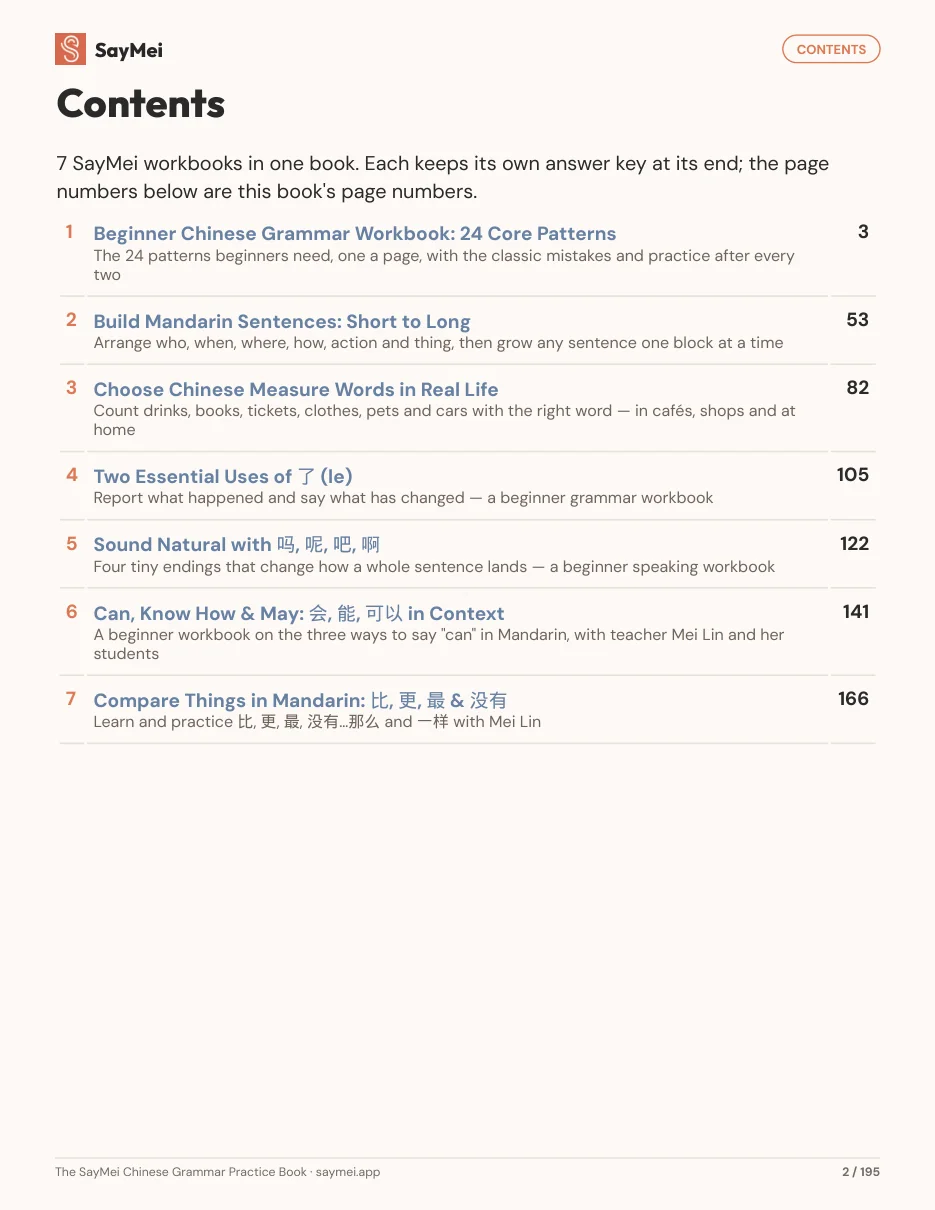
- Workbook 1: The 24 core patterns, one a page, with a practice page after every two and a review conversation after every eight. Beginner Chinese Grammar Workbook: 24 Core Patterns
- Workbook 2: Word order as blocks: who, when, where, how, action and thing. Two short stories and a weekend plan put every block to work. Build Mandarin Sentences: Short to Long
- Workbook 3: Measure words for people, drinks, clothes, pets, cars and shops, 两 or 二, a shopping story and a noodle-shop conversation. Choose Chinese Measure Words in Real Life
- Workbook 4: The two jobs of 了, how to say no without misplacing it, a diary story and a conversation that uses both. Two Essential Uses of 了 (le)
- Workbook 5: What 吗, 呢, 吧 and 啊 ask the listener to do, including the four jobs of 吧, ending with a weekend-plans conversation. Sound Natural with 吗, 呢, 吧, 啊
- Workbook 6: 会 for skills, 能 for situations, 可以 for permission, then favours and rules, two stories and cut-out review cards. Can, Know How & May: 会, 能, 可以 in Context
- Workbook 7: 比 with exact differences, 更 and 还, 最, 没有 (那么), 一样 and comparing actions with 得, with two stories about choosing. Compare Things in Mandarin: 比, 更, 最 & 没有
How to use this book
Seven workbooks in one PDF. Start with the 24 core patterns, then take the others one at a time. Each Learn page has four example lines to say aloud before you do the practice.
- Weeks 1–3: The 24 core patterns. Workbook 1: two patterns, then a practice page. Do the review conversation after each set of eight.
- Week 4: Word order. Workbook 2: build sentences one block at a time, then rebuild the long sentences in Xiaoyu's Rainy Day.
- Week 5: Measure words and 了. Workbooks 3 and 4: count things in a café and a shop, then tell the two jobs of 了 apart.
- Week 6: Sentence endings and "can". Workbooks 5 and 6: the small endings that change the tone of a sentence, and 会, 能 and 可以.
- Week 7: Comparisons. Workbook 7: 比, 更, 最, 没有 and 一样, ending with a conversation about where to eat.
- Any time: Look it up. The at-a-glance pages at the end of Workbooks 1, 6 and 7 put each pattern and its mistake to avoid in one place.
Who it’s for
Beginners and pre-intermediate learners who know some words and want to build correct sentences, and teachers who want one grammar book to work through with a class.
Before you start: Reading pinyin helps. Every example has characters, pinyin and English, and Workbook 1 starts from 是 and 很.
Frequently asked questions
What's in it?
Seven grammar workbooks in one 196-page PDF: the 24 core patterns, word order, measure words, 了, the endings 吗, 呢, 吧 and 啊, 会, 能 and 可以, and comparisons with 比, 更, 最 and 没有. Each workbook is also in the library on its own if you only want one topic.
Which workbook should I start with?
Workbook 1. It covers the 24 patterns beginners need, starting from 是 and 很, including one page each on 了, 会/能/可以 and 比. Workbooks 4, 6 and 7 then give each of those a whole book.
How long does it take?
The plan runs about seven weeks: three on the 24 core patterns, then word order in week 4, measure words and 了 in week 5, the sentence endings and 会, 能 and 可以 in week 6, and comparisons in week 7.
Is it all drills?
No. Each workbook also has short stories to read, like Lin Hao buying a phone or Xiaoyu's new café job, and a conversation that uses what it teaches.
Does it work for a class?
Yes. It's made for teachers who want one grammar book to work through with a class, as well as for self-study. The at-a-glance pages at the end of Workbooks 1, 6 and 7 put each pattern and its mistake to avoid in one place.
What should I use next?
Intermediate Chinese Grammar Workbook: 20 Patterns for Longer Sentences moves on to complements, 把 and 被, and linked pairs like 虽然…但是.
Do I need a SayMei account?
Yes, to download the PDF, and the account is free: sign up with Google, Apple or your email address. With it we email you a copy of the workbook, keep every workbook you download on your account on all your devices, save your place in the free online practice, and you can practise speaking with Mei Lin, SayMei's AI tutor.
How do I print it?
The PDF is US Letter size. On A4 paper, choose "Fit to page" (or "Scale to fit") in the print dialog so nothing is cut off. Print the whole workbook or only the pages you need; colour looks best, and black and white works too.
Keep going
Chinese Sentence Structure: Build Sentences from Short to Long · Chinese Measure Words List: The Ones You Need, in Real Sentences · Chinese Verbs List: 100 Common Verbs with Examples · Chinese Grammar Worksheets: Printable Practice with Answer Key · Browse all 379 workbooks
In these collections: Free Chinese Textbooks and Course Books (PDF) · Chinese Grammar Workbooks · HSK 2 Chinese Workbooks · HSK 1 Chinese Workbooks
Version 2026-10 · Updated Oct 27, 2026 · Report a correction