LingQ review for Chinese: is massive input worth the setup and monthly price?
LingQ Chinese review checked Nov 2026: 20-word free cap, $119.99–$719.76 pricing quirk, LingQ 7.0, pinyin & splitting bugs, plus Du Chinese vs Migaku.

LingQ promises fluency through huge amounts of reading and listening, yet its free plan caps you at twenty saved words. For Mandarin, we checked whether its reader and import tools still earn the bill.
This review helps Mandarin learners weigh LingQ against Du Chinese, Migaku, Pleco and free readers. In November 2026 we checked LingQ's live prices, archived pages, Terms, forums, Chrome extension and 358 English App Store reviews.
Key takeaways
- The free plan works like a short demo. Twenty saved LingQs and five imported lessons run out inside your first Chinese text.
- Word splitting and pinyin still trip readers. Unspaced Chinese breaks auto-splitting, and mobile users lack an easy in-app split fix.
- Importing beats rivals on sheer reach. Pull YouTube, Netflix, podcasts, ebooks and web posts into one tracker, though the Chrome add-on sits at 3.2 stars.
- Skip the two-year Premium Plus button. On LingQ's live site, two years of Premium Plus costs $719.76, far above paying yearly twice.
- LingQ 7.0 shipped in late November 2026. A rebuilt Reader adds video modes, scrolling and inline meanings, while raising the floor to iOS 18.
- Speaking and tones need a second tool. Lynx chats inside lessons, yet LingQ grades neither Mandarin tones nor character strokes.
Strong for self-directed input, rough on Chinese polish
LingQ Languages Ltd. runs out of West Vancouver, Canada, led by CEO Mark Kaufmann and polyglot co-founder Steve Kaufmann. Its About page builds the app around reading and listening to huge volumes of real content while tracking every word you meet.
That loop feels smooth in spaced European languages like French or Spanish. Mandarin brings tougher snags: unspaced characters, tones, two character scripts and no sound clues on new hanzi. We checked LingQ's site, Terms, forums and store pages to score each job:
What you need · Verdict · What LingQ gives you
Importing native Chinese
Strong
YouTube, Netflix, ebooks, podcasts and web posts with 600–3,600 min/mo audio text
Word tracking
Strong
Blue-to-yellow-to-white word counts across 53 languages and devices
Reading unspaced hanzi
Partly
Auto-splitting breaks compounds; no easy mobile split fix; pinyin bugs cited
Built-in Chinese library
Partly
62 Mini Stories plus 381 public courses, mostly uneven user uploads
Traditional and Zhuyin
Partly
Separate Traditional slot, yet audio imports flip to Simplified; no native Zhuyin
Beginners and HSK 3.0
Partly
20-LingQ free cap ends fast; no structured beginner path or official HSK 3.0 course
Speaking, tones and writing
Missing
Lynx text chat only; zero Mandarin tone grading or stroke-order writing
Sources: LingQ Chinese page, pricing, courses catalogue, Terms, forum and US App Store, checked 25 November 2026.
If you already read basic hanzi and want one hub for real Chinese media, we think LingQ earns its keep. If you want clean graded stories, a clear course or tone coaching, another tool fits far better.
How much does LingQ really cost in 2026?
LingQ splits into three plans on its live signup page: Free, Premium and Premium Plus +. Free opens all 53 languages on LingQ's languages directory, yet stops you at twenty saved LingQs and five imported lessons.
In Mandarin, twenty saved words vanish halfway through your first Mini Story. Treat Free as a brief reader tour, not a study plan.
Standard LingQ Premium removes word and import caps across every language. On the US website, Premium runs $14.99 monthly or $119.99 billed yearly, with a lower two-year rate below.
Standard Premium also adds ten hours of monthly audio-to-text imports, InWorld voices, monthly Lynx credits, offline lessons, Karaoke Mode and full-sentence translations. Apple's US App Store keeps a six-month Premium tier at $80.99 plus two unlabelled annual store tiers.
Premium Plus + costs $29.99 monthly or $269.99 billed yearly. It lifts audio-to-text limits sixfold, adds ElevenLabs voices, multiplies Lynx credits by five and unlocks AI lesson simplification.
Watch the two-year button on Premium Plus + closely. On LingQ's live web checkout, two years bills $719.76 with zero discount.
Buying the annual plan twice costs $539.98 instead. That saves nearly $180 for the exact same two years.
Two off-menu options also matter. During late November 2026, LingQ's Black Friday banner advertised up to half off, with its live promo script applying an extra 15% code on annual plans.
LingQ also keeps a hidden single-language Lifetime plan off its signup page and Apple's store. On LingQ's forum, staff confirmed US-dollar billing in June 2024, and buyers reported paying $229 in August 2025.
That fee rose from $199 in October 2020. Lifetime covers standard Premium only, not Premium Plus +, for one language slot. Since LingQ separates Simplified and Traditional Chinese, one Lifetime pass covers one script only.
We pulled 66 archived copies of lingq.com/en/signup/ from the Internet Archive.
Prices held steady for years before jumping in June 2024, then Premium Plus switched into an AI tier in August 2025:
Jun 2021 – Mar 2024
- Premium 1 mo
- $12.99
- Premium 6 mo
- $71.94
- Premium 12 mo
- $107.88
- Premium 24 mo
- $191.76
- Premium Plus 12 mo
- $431.88 (tutor points)
Jun 2024
- Premium 1 mo
- $14.99
- Premium 6 mo
- Dropped on web
- Premium 12 mo
- $119.88
- Premium 24 mo
- $215.76
- Premium Plus 12 mo
- $443.88 (tutor points)
Aug 2024 – Jul 2025
- Premium 1 mo
- $14.99
- Premium 6 mo
- Dropped on web
- Premium 12 mo
- $119.99
- Premium 24 mo
- $215.76
- Premium Plus 12 mo
- $443.88 (tutor points)
Sep 2025 – Mar 2026
- Premium 1 mo
- $14.99
- Premium 6 mo
- Dropped on web
- Premium 12 mo
- $119.99
- Premium 24 mo
- $215.76
- Premium Plus 12 mo
- $269.99 (AI tier)
Nov 2026 (live)
- Premium 1 mo
- $14.99
- Premium 6 mo
- $80.99 (iOS only)
- Premium 12 mo
- $119.99
- Premium 24 mo
- $215.76
- Premium Plus 12 mo
- $269.99 (24 mo: $719.76)
Sources: Wayback Machine snapshots of lingq.com/en/signup/ from June 2021, June 2024 and September 2025, plus live signup page and US App Store, 25 November 2026.
That August 2025 change broke old reviews. Older posts describe tutor points inside Plus; now Plus pays for ElevenLabs voices, Lynx and heavy audio imports, while standard Premium and Lifetime cap audio-to-text at ten hours a month.
Compare every LingQ tier against Du Chinese, Migaku and SayMei for your study span and reading style:
Compare what LingQ and its Mandarin reading rivals actually cost
Pick how long you'll study, which LingQ tier you're weighing and how you want to read: you get the cheapest LingQ billing option plus exact US totals against Du Chinese, Migaku and SayMei.
How long you'll use it
LingQ tier
Reading style
For 1 year of LingQ Premium, cheapest is 12-month plan (web or App Store): $119.99
About $10 a month. Paying monthly would cost $179.88.
For importing arbitrary Mandarin web articles, ebooks, podcasts and YouTube videos into one word-tracking library, LingQ Premium ($119.99/yr) leads on breadth, though Migaku ($96/yr web) adds Viki, tone colours and Zhuyin for $24 less a year.
Every way to pay for 1 year of LingQ Premium
- 12-month plan (web or App Store), once$119.99$10.00/mo across all 53 languages; web signups carry a 30-day initial refund
- 6-month plan (US App Store), twice$161.98$13.50/mo on iOS; dropped from lingq.com/en/signup/ in June 2024
- Monthly (web or App Store), 12 times$179.88Cancel any month; beats 12-month billing for 8 months or fewer
- 24-month plan (web), once$215.76$8.99/mo across all 53 languages; lowest recurring rate
- Single-language Lifetime (unlisted), once$229Forum-reported $229 USD for 1 language only (Simplified or Traditional); standard Premium, not Plus
LingQ vs Mandarin reading rivals for 1 year
LingQ Premium (cheapest)
- Total (1 year)
- $119.99
- Import native web & YouTube
- Strong
- Best plan & catch
- 12-month plan (web or App Store)
- Total (1 year)
- $119.99
- Import native web & YouTube
- Missing
- Best plan & catch
- Regular yearly ($119.99; Black Friday $59.99). 3,814 voice-acted graded stories with HSK 3.0 labels; no custom web/YouTube imports
- Total (1 year)
- $96
- Import native web & YouTube
- Strong
- Best plan & catch
- Web yearly ($96). Netflix, YouTube, Disney+ & Viki overlays with tone colours and Zhuyin; no speaking
- Total (1 year)
- Free
- Import native web & YouTube
- Partly
- Best plan & catch
- Free. 18 dramas + 341 YouTube videos with hanzi, pinyin & English; curated shelf only
- Total (1 year)
- $35.88
- Import native web & YouTube
- Missing
- Best plan & catch
- 12 × $2.99. 169 graded HSK 1–3 books in Simplified or Traditional; stops at HSK 3
- Total (1 year)
- $71.88
- Import native web & YouTube
- Partly
- Best plan & catch
- 12 × $5.99. 200 live Mei Lin speaking min/mo with tone coaching + Stories, SayMei TV, 3,500+ Dialogues & offline FSRS
Prices checked 25 November 2026 in US dollars on lingq.com/en/signup/, the US App Store, duchinese.net, migaku.com and saymei.app/pricing. A recurring plan longer than your window counts in full; LingQ's Black Friday code (bf2026) cuts annual checkout further during November sales.
Sources: lingq.com/en/signup/, LingQ US App Store (id379385811), LingQ forum single-language Lifetime reports ($229 USD), SayMei's Du Chinese and Migaku reviews, and saymei.app/pricing, checked 25 November 2026.
Here is how LingQ's monthly US rate stacks up against its main Mandarin reading rivals:
Sources: LingQ signup and US App Store, 25 November 2026; SayMei's Du Chinese, Migaku, Chairman's Bao guides and SayMei pricing, November 2026. Du Chinese's November 2026 Black Friday yearly sale dropped to $5.00 a month ($59.99 a year).
Standard LingQ Premium lands in the middle of the field, matching regular yearly Du Chinese and sitting just above web Migaku. Unless you convert more than ten hours of raw Chinese audio a month, we'd skip Premium Plus +.
Refunds, cancel steps and a strict data rule
LingQ's web rules are fair on first-month refunds and strict when you leave. Check LingQ's Terms of Service before paying.
Section B gives new web buyers a 30-day full refund on their first Premium payment. Later renewals are non-refundable, and Apple or Google handle mobile-store refunds.
Cancelling carries two sharp traps in Section C. Emailing or calling support won't cancel your bill; web users must open Settings, click Account, pick Change Plan and downgrade to Free.
Section C also warns that all user content is deleted for good when paid time ends. On LingQ's forum, staff told departing users to pick a $2 monthly Vacation plan to freeze data, though current Vacation pricing isn't listed on signup.
Before paying, we'd keep four habits:
- Buy on the website. Keep the 30-day refund window and two-year pricing.
- Start on standard Premium. Check whether ten monthly audio-import hours fit first.
- Skip two-year Premium Plus. Annual billing saves nearly $180 over two years.
- Export your word list before cancelling. Screenshot the confirmation and check next month's bill.
LingQ 7.0 rebuilt the Reader in late November 2026
Most LingQ reviews online still describe older versions. In late November 2026, CEO Mark Kaufmann launched LingQ 7.0 on the company forum, with mobile updates rolling out right after.
LingQ spent a full year rebuilding its Reader and Library. The changes hit four long-standing reader gripes:
- Control over blue words: Choose whether unread blue words turn known per page, wait until the lesson ends, or stay blue.
- Video views and scrolling: Pick new video lesson layouts and read straight down in scroll mode.
- Inline hints and phrases: Read short meanings right inside the line and spot multi-word expressions faster.
- Higher iPhone floor: The new iOS release requires iOS 18 or newer, cutting off older iPhones.
Early replies in that launch thread split fast. Several long-time readers liked the cleaner flow for books, while Android and desktop veterans noted extra taps and a bug pasting unwanted meanings onto saved LingQs.
Treat late November 2026 as a settling-in period. LingQ ships weekly fixes, yet major redesigns here often feel bumpy for a few weeks first.
Unspaced Chinese still trips the word splitter and pinyin
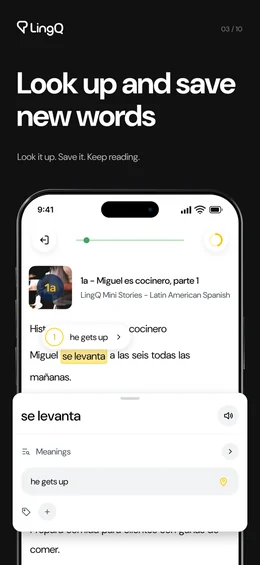
LingQ's loop is simple. Every new word glows blue; tap it to pick a meaning and turn it yellow, then move it up four levels until it turns white as known.
Here is how the rebuilt LingQ 7.0 Reader shows a yellow phrase and lookup drawer:
In Spanish or French, spaces mark where each word begins and ends. Written Chinese has no spaces, so LingQ guesses word breaks automatically.
That splitter is Mandarin learners' top daily snag. Take "developing country", 发展中国家: a clumsy split pulls out "China", 中国, and wrecks both ends.
When a learner flagged YouTube splitting bugs on LingQ's forum in May 2025, short lines like "walking toward us with a smile", 面带微笑地走向我们 miàndài wēixiào de zǒuxiàng wǒmen, broke into wrong chunks. Staff confirmed in December 2025 that mixed-language captions still trigger bad splits.
Phone users feel this worst. A US App Store reviewer in July 2026 praised YouTube lessons yet noted LingQ "often misidentifies word boundaries, and there doesn't seem to be a way to correct this on the app." On desktop, fixing splits means editing spaces by hand in Sentence View.
Three more Mandarin quirks recur in 2026 reports:
- Pinyin leaks and errors: A July 2026 US reviewer saw caption pinyin saved as Chinese words, while UK and Canadian users noted inexact pinyin.
- Traditional audio flips to Simplified: LingQ separates Simplified characters, 简体字, from Traditional characters, 繁体字, yet a July 2026 forum post showed Traditional audio imports still turning into Simplified text.
- No built-in Zhuyin toggle: Taiwan Mandarin learners using Zhuyin, 注音, need third-party browser add-ons, unlike Migaku.
Past HSK 3 or 4, your own eye catches bad splits fast. For beginners who trust every blue highlight, splitting bugs slow reading down.
Importing YouTube, Netflix and ebooks beats rivals on reach
If word splitting is LingQ's weak spot, importing keeps fans paying for years. Almost no rival drops ebooks, Chinese podcasts, web articles and YouTube talks into one word counter.
Here is how LingQ's mobile player pairs a YouTube video with tracked blue and yellow lyrics:
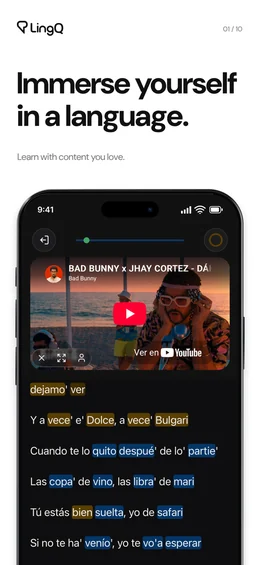
The official LingQ Importer Chrome extension reaches 80,000 users, with companion versions for Firefox, Edge and Safari. That browser reach beats Chrome-only tools like FluentU and Migaku.
Look at the Chrome score, though. On Google's store in November 2026, LingQ Importer sat at 3.2 stars across fifty-seven ratings. Streaming sites tweak caption tracks often, so Netflix and YouTube imports break until LingQ patches the add-on.
Built-in Whisper audio-to-text helps most with Mandarin podcasts and uncaptioned videos. Standard Premium converts up to ten hours of audio a month, while Premium Plus + lifts that cap sixfold. As our Chinese dual subtitles guide found, most official YouTube Chinese dramas ship without soft subtitles, so raw drama imports burn through monthly minutes quickly.
Here is how LingQ's import reach compares with four main Mandarin tools:
LingQ
- Built-in Chinese shelf
- 381 public courses; mixed quality
- Custom media imports
- YouTube, Netflix, web, ebooks, podcasts
- Chinese splitting and script
- Auto-split quirks; Simplified and Traditional separate
- Mobile study
- Full iOS and Android apps
Du Chinese
- Built-in Chinese shelf
- 3,814 teacher-written readings
- Custom media imports
- None
- Chinese splitting and script
- Human-edited splits; Simplified and Traditional
- Mobile study
- Full apps with offline audio
Migaku
- Built-in Chinese shelf
- Small shelf + 1,500-word course
- Custom media imports
- Netflix, YouTube, Disney+, Viki, ebooks
- Chinese splitting and script
- Tone colours, pinyin and Zhuyin; occasional glitches
- Mobile study
- YouTube and reader on mobile
Pleco
- Built-in Chinese shelf
- None built in
- Custom media imports
- Local text, PDF and EPUB via Basic Bundle
- Chinese splitting and script
- Fast offline dictionaries; manual lookups
- Mobile study
- iOS and Android offline reader
SayMei TV
- Built-in Chinese shelf
- 18 dramas + 341 YouTube videos
- Custom media imports
- None
- Chinese splitting and script
- Pre-timed hanzi, pinyin and English
- Mobile study
- Any phone browser plus apps
Sources: LingQ Importer and signup page, 25 November 2026; SayMei's Du Chinese, Migaku, Pleco guides and SayMei TV, November 2026.
If you mix Chinese podcasts, web articles and ebooks across a phone and laptop, LingQ's importer has few peers. If you mostly watch Netflix or Rakuten Viki dramas in Chrome, Migaku gives cleaner tone colours and fewer splitting headaches for less money.
Mini Stories lead an uneven crowd-built Chinese shelf
LingQ's Chinese landing page promotes thousands of hours of audio lessons with matching transcripts. We checked its public Chinese courses catalogue to see what sits on the shelf.
The catalogue spans sixteen pages, listing 381 public Chinese courses in all.
At the top sits LingQ Mini Stories, Steve Kaufmann's starter series: 62 short lessons at Beginner 2 covering 1,462 words.
Below Mini Stories, the shelf looks nothing like teacher-edited apps such as Du Chinese or The Chairman's Bao. Page one mixes user-shared HSK textbooks, pop songs, folk tales, economics clips and podcasts.
That open library brings real range alongside clear downsides. You get quirky topics and real creator audio that graded apps rarely publish. Yet audio clarity, pacing and transcript accuracy swing wildly from course to course, and difficulty labels depend on whoever uploaded the file.
LingQ also posts a free Chinese Grammar Guide and a short level check on its website. Both act as light reference sheets rather than guided drills.
If you enjoy curating your own Chinese feed, LingQ's open shelf feels freeing. If you want to open an app and trust that the next story matches your level with crisp human audio, Du Chinese or SayMei Stories saves hours of sifting.
Can a complete beginner or HSK student use LingQ?
Steve Kaufmann often starts brand-new languages straight inside Mini Stories. For Mandarin, starting from zero on LingQ alone is much rougher than in Spanish or Italian.
Reading research shows why. Our guide to reading Chinese notes that smooth solo reading needs about 95% to 98% known words.
Even at HSK 4, learners know roughly four in five film-dialogue words and barely over half of a news story.
Start with zero hanzi on LingQ, and every box on screen turns bright blue. You can't sound out new characters like European cognates, and LingQ gives no pinyin course, tone-pair drills or stroke-order writing.
Even happy subscribers admit this. A five-star US reviewer in August 2026 praised LingQ's HSK 1 material yet noted using it beside four other apps: two pinyin tools, HelloChinese and a character app.
HSK test takers hit a clear gap too. With China's updated HSK 3.0 exam starting regular sittings in December 2026, LingQ offers no official HSK 3.0 course, no HSK 7 to 9 tags and no mock tests. User-shared HSK textbook lessons follow older lists, leaving big word gaps under the new syllabus in our HSK 3.0 guide.
We'd start total beginners on HelloChinese, SayMei Stories or a structured course until you read a few hundred characters easily. Bring LingQ in once reading stops feeling like decoding every single character.
Lynx AI adds lesson chat, not Mandarin tone coaching
For years, LingQ's biggest gap was speaking: endless reading and listening, with no output unless you hired outside tutors. Since mid-2025, LingQ has placed Lynx AI, its built-in chat coach, right inside lessons.
Here is how Lynx AI looks in LingQ's US App Store listing:
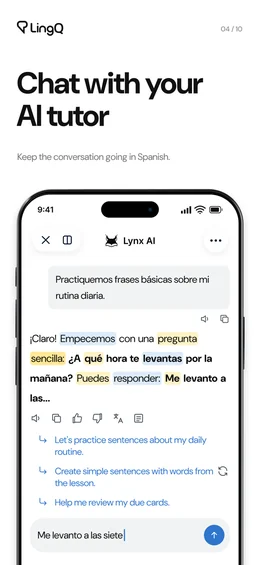
Lynx lets you ask grammar questions, turn saved words into sample lines, or chat about a story while tapping blue and yellow words inside each reply. Premium Plus + multiplies monthly Lynx credits by five and adds one-click lesson simplification.
What Lynx doesn't give Mandarin learners is spoken tone grading. On LingQ's community forum, learners in September 2025 and April 2026 used phone keyboard dictation to talk to Lynx while keeping ChatGPT open for live voice practice.
LingQ publishes zero test data on Mandarin tone checks. In Chinese, a flat tone swaps meanings outright: sugar, 糖, turns into soup, 汤. A review of fifteen studies in ReCALL found speech tools improve clear sounds well, yet help tone pitch only modestly.
Text-to-speech voices divide learners too. Standard Premium uses basic TTS and InWorld voices, keeping ElevenLabs voices inside Premium Plus +. A five-star US reviewer in July 2026 called standard voices too unnatural for shadowing, and another flagged odd stuttering pauses in the automated reader.
Pair LingQ with real voice work from day one. Train pitch patterns in our Chinese tones guide, check single tones on our free Tone Checker, or speak weekly with a tutor.
Offline audio works, yet mainland China needs a VPN
Unlike streaming-only tools such as FluentU, LingQ Premium saves lessons and audio offline on iPhone and Android. You can download Mini Stories or podcasts before flights and review saved words without mobile data.
Two snags still catch travellers off guard. First, importing media, converting audio to text, chatting with Lynx and pulling fresh dictionary hints or pinyin all need a live connection.
Second, LingQ struggles inside mainland China without a VPN. Long-running forum threads cite connection timeouts across China. A UK App Store user gave one star in May 2026 after Apple sign-in froze inside China, writing that a Chinese app "should at least work in the country it's aimed at."
If you travel offline, download playlists ahead of time and check pinyin before boarding. If you live in mainland China and hate fighting VPN drops, offline tools like Pleco or The Chairman's Bao run far more smoothly.
High store stars hide sharp gripes in written reviews
Unlike FluentU, whose recent ratings collapsed, LingQ holds strong scores on both phone stores. Here is where its three main public stores stood on 25 November 2026:
US App Store
- Rating
- 4.74
- Count
- 10,540
- Note
- Version 7.0.0, updated 25 Nov 2026; requires iOS 18.0+
Google Play
- Rating
- 4.47
- Count
- 51,288
- Note
- 1M+ downloads; updated 25 Nov 2026; IAPs $4.99–$269.99
Chrome Web Store
- Rating
- 3.20
- Count
- 57
- Note
- LingQ Importer v2.3.52; 80,000 users; updated 16 Aug 2026
Sources: Apple iTunes lookup, Google Play and Chrome Web Store, 25 November 2026. Google Play displays 4.5 rounded from 4.4657.
To hear what active buyers actually say, we read the 100 most recent written US App Store reviews from June through November 2026.
They averaged 4.08 stars, with about three in four giving four or five stars. We hand-coded every review by theme:
Source: hand count of the 100 most recent written reviews in Apple's US RSS feed, 20 June to 23 November 2026, checked 25 November 2026. Reviews can raise multiple themes. How we coded them.
Even fans strike the same note: they stay because nothing else replaces LingQ's import-and-track loop, yet they tolerate sync bugs, rough mobile editing and robotic TTS voices.
Next, we filtered all 358 English App Store reviews from the US, UK, Canada and Australia for Chinese, Mandarin or Cantonese.
Fifteen reviews matched from December 2024 onward, averaging 4.13 stars across eleven positive posts, three three-star posts and one one-star post:
- Big character gains: An August 2026 Canadian user learned thousands of Chinese characters via YouTube imports, and a September 2026 US buyer praised skipping heavy Anki setup.
- Splitting and pinyin snags: A July 2026 US reviewer cited broken splits and caption pinyin leaking into vocab; a November 2026 UK user said Simplified Chinese trailed French.
- Audio and China blocks: A July 2026 US user flagged wrong Cantonese audio on "so", 咁, plus an editor that undid edits, and a May 2026 UK user in China couldn't log in.
- Slow early climb: A December 2025 UK learner spent months wrestling with LingQ's crowded interface before finding a rhythm.
Public r/ChineseLanguage threads checked on 25 November 2026 echo that split. Self-directed readers past HSK 3 love LingQ; learners wanting early polish pick Du Chinese.
LingQ vs Du Chinese vs Migaku for Mandarin
Most Mandarin readers weighing LingQ narrow their choice to two rivals: a teacher-edited graded reader or a streaming-first browser toolkit.
LingQ vs Du Chinese
LingQ and Du Chinese charge the exact same regular US list prices: $14.99 monthly or $119.99 yearly. Inside, they serve opposite stages.
Du Chinese offers over 3,800 teacher-written stories and articles across six strict character levels, voiced by human actors, with HSK 3.0 labels and zero word-splitting bugs. Yet you can't import a single web page, ebook or YouTube video, though Du Chinese drops to $59.99 yearly on Black Friday.
Choose Du Chinese from HSK 1 through early HSK 5 when you want effortless daily reading without tinkering. Move to LingQ once you want real Chinese podcasts, ebooks, blogs and YouTube channels inside one tracker.
LingQ vs Migaku
Migaku targets learners studying directly on streaming sites and web pages. At $96 a year on the web, Migaku beats LingQ Premium by $24 yearly and adds Chinese polish LingQ lacks: tone colours, native Zhuyin alongside pinyin, a 1,500-word starter course and Rakuten Viki support.
LingQ wins on sheer breadth. Migaku skips podcasts, Firefox and Safari, offers a shorter ten-day web refund and lacks LingQ's audio-to-text pipeline and Lynx chat. Pick Migaku for Netflix, YouTube and Viki dramas with tone colours; pick LingQ for podcasts, ebooks, multi-browser reading and multi-language study.
Who should buy LingQ, and better Mandarin alternatives
We'd pick LingQ Premium if:
- You sit at HSK 3 or higher and read most days. You'll get full value from unlimited imports, audio-to-text and word tracking.
- You mix podcasts, ebooks, web posts and YouTube. No Chinese rival pulls all four into one mobile-and-web hub as cleanly.
- You study several languages together. One yearly plan opens 53 languages, stretching the fee far beyond Chinese-only apps.
We'd skip LingQ, or pair it with another app, if:
- You are starting from zero. Learn pinyin, tones and your first few hundred characters in a structured course first.
- You want plug-and-play graded stories. Teacher-written stories save you from fixing splits and sorting uneven uploads.
- You need live Mandarin speaking, tone feedback or handwriting. LingQ grades neither your tones nor your character strokes.
Here is what we'd pick instead for each Mandarin goal:
Teacher-written graded stories to advanced
- Pick
- Du Chinese
- US price
- $14.99/mo or $119.99/yr
- Why it beats LingQ here
- 3,814 voice-acted stories, HSK 3.0 labels, zero splitting bugs
Daily graded Chinese news
- US price
- $11/mo or $88/yr
- Why it beats LingQ here
- 11,155+ human-voiced news lessons; works in mainland China
Netflix, YouTube and Viki mining
- Pick
- Migaku
- US price
- $10/mo or $96/yr (web)
- Why it beats LingQ here
- Tone colours, native Zhuyin, Viki support and starter course
Cheap graded stories for HSK 1–3
- Pick
- SayMei Stories
- US price
- $2.99/mo
- Why it beats LingQ here
- 169 books in 1,161 chapters, Simplified and Traditional
Free dramas and YouTube videos on a phone
- Pick
- SayMei TV
- US price
- Free
- Why it beats LingQ here
- 18 dramas and 341 everyday videos with hanzi, pinyin and English
Offline ebook reader with top dictionaries
- Pick
- Pleco
- US price
- Free; $24.99 web bundle
- Why it beats LingQ here
- One-off fee, works offline in China, zero recurring subscription
Free Chinese web novels
- Pick
- Readibu
- US price
- Free (paid extras)
- Why it beats LingQ here
- Pop-up dictionary built directly for native Chinese web fiction
Live spoken lessons with tone correction
- Pick
- SayMei Premium
- US price
- $5.99/mo
- Why it beats LingQ here
- 200 live minutes/mo with Mei Lin plus Stories and Flashcards
Human conversation and exam coaching
- Pick
- An italki tutor
- US price
- About $20/hour
- Why it beats LingQ here
- Real human conversation and tailored pronunciation coaching
Sources: SayMei's live competitor guides, SayMei pricing and SayMei TV, checked 25 November 2026.
If handwriting matters alongside reading, check our Chinese flashcard apps guide or Skritter review. For free Mandarin channels ready to import into LingQ, browse our ranked Chinese YouTube channels for learners.
Where SayMei fits, and where it doesn't
SayMei is our app, built strictly for Mandarin. One account works on saymei.app and in our iPhone and Android apps. SayMei is also an app for iPhone and Android: get the app.
Three parts fit ahead of or beside LingQ:
- SayMei Stories costs $2.99 a month. Read 169 graded books for HSK 1 to 3 in Simplified or Traditional with pinyin, English and tappable words, including eight whole books free.
- SayMei TV is free. Watch 18 official YouTube dramas and 341 everyday videos with hanzi, pinyin and English, and save words with a free account.
- SayMei Premium costs $5.99 a month. Get 200 live spoken minutes monthly with Mei Lin for tone coaching, plus Stories, over 3,500 Dialogues, offline due flashcards, Tones and Characters.
Free SayMei accounts also include 402 printable PDF workbooks and HSK 1 to 9 lists under the November 2025 HSK 3.0 syllabus.
Where LingQ beats us, and where SayMei stops short:
- Custom imports and native novels. SayMei has no browser add-on, YouTube or Netflix importer or ebook reader, and Stories stop at HSK 3.
- Multi-language study. SayMei teaches Mandarin only, while one LingQ Premium plan covers 53 languages.
- Offline and store limits. Live Mei Lin lessons need internet, so only due flashcards work offline beside paper PDFs. We don't build an offline dictionary or OCR like Pleco, we aren't a tutor marketplace, and our iPhone app isn't yet on the App Store in the EU, mainland China, Morocco or Afghanistan.
SayMei's seven-day trials for Stories Unlimited and Premium also need a card and auto-renew unless cancelled. Start with SayMei for clean HSK 1 to 3 reading and tone coaching, then add LingQ when you're ready to import native Chinese podcasts and novels.
What to do next
- Try Mini Stories on a free account first. Feel how LingQ tracks Chinese words before you hit the saved-word cap.
- Buy on the website, not in the app. Keep your web refund window and avoid the broken two-year Plus button.
- Stick to standard Premium unless transcribing heavily. It gives unlimited imports and offline audio for half the price of Plus.
- Add live speaking alongside reading. Pair input with tone feedback or a human teacher so silent reading turns into clear speech.
Still comparing reading tools? Read our Du Chinese review next to pit graded stories against LingQ's open importer.
FAQ
Is LingQ good for learning Chinese in 2026?
Yes, if you're at HSK 3 or above and want to import your own Chinese articles, ebooks, podcasts and YouTube videos into one tracker. In November 2026, LingQ's US App Store score sits at 4.74 stars and Chinese reviews average 4.13. Beginners, however, face word-splitting bugs, uneven user texts and no tone grading.
How much does LingQ cost in 2026, and is Lifetime still offered?
In November 2026, LingQ Premium costs $14.99 monthly, $119.99 yearly or $215.76 every two years on the web, with a six-month store option on iPhone. Premium Plus + costs $29.99 monthly or $269.99 yearly, while two-year web checkout bills $719.76 with zero discount. Forum buyers report unlisted single-language Lifetime access at $229.
What is the 20-LingQ limit on LingQ's free plan?
LingQ's free plan lets you browse its 53-language library, yet caps you at twenty saved LingQs and five imported lessons. In Mandarin, beginners burn through twenty new words inside their first Mini Story. Once full, you can't save new words without paying for Premium or deleting old ones, turning Free into a brief demo.
Why do Chinese learners complain about LingQ's word splitting and pinyin?
Written Chinese has no spaces between words, so LingQ uses an automatic splitter to chop characters into clickable chunks. On YouTube imports and novels, it often breaks compound words wrongly, pulls caption pinyin into vocab lists and misses tones. LingQ staff noted YouTube splitting issues in December 2025, and mobile lacks an easy fix.
Is LingQ better than Du Chinese for Mandarin?
They fit different stages of reading. Both cost $14.99 monthly or $119.99 yearly at regular 2026 US list prices. Du Chinese wins from HSK 1 to early HSK 5 with 3,814 voice-acted, teacher-written stories, HSK 3.0 labels and zero splitting errors. LingQ wins once you want to import real Chinese podcasts, web articles, ebooks and YouTube clips.
Does LingQ support Traditional Chinese, Zhuyin and Cantonese?
Yes for scripts and Cantonese, with caveats. LingQ lists Simplified Chinese, Traditional Chinese and Cantonese as three separate languages among its 53 options, so one single-language Lifetime licence covers just one script. Taiwan-script users reported in July 2026 that audio-to-text imports still convert Traditional speech into Simplified text, and Zhuyin needs third-party browser add-ons.
Can you use LingQ offline or in mainland China?
LingQ Premium lets you download lessons and audio for offline reading and listening on iPhone and Android, though importing, audio-to-text, Lynx chat and some pinyin lookups still need internet. In mainland China, both forum reports and a May 2026 UK App Store reviewer confirm LingQ fails to load or finish login without a VPN.
How do you cancel LingQ, get a refund and keep your data?
First-time web Premium signups carry a 30-day full refund under Section B of LingQ's Terms; Apple and Google handle mobile refunds. To cancel on the web, open Settings, Account, Change Plan and downgrade to Free, because emails don't stop billing. Export your word list first, since Terms Section C warn cancelling deletes user content.
Sources
Checked 25 November 2026 unless noted. No paid trial was started and nothing was bought.
- LingQ official pages: About LingQ, Languages directory (53 languages), Learn Chinese, Chinese courses directory (16 pages, 381 courses, 62 Mini Stories), Chinese Grammar Guide, pricing and feature table (including live bf2026 notice JSON), LingQ Importer Chrome page and Terms of Service (Sections B and C)
- Wayback Machine snapshots (lingq.com/en/signup/): June 2021, June 2024, August 2024 and September 2025
- LingQ official forum threads: LingQ 7.0 launch by CEO Mark Kaufmann (24 Nov 2026), 7.0 Android feedback (25 Nov 2026), Premium Plus synthetic voices and $229 Lifetime (Aug 2025), 600-minute transcription cap (Jul 2025), Lifetime USD confirmation (Jun 2024), Lifetime $199 historical note (Oct 2020), Vacation plan downgrade (Mar 2021), YouTube Chinese word segmentation (May–Dec 2025), Traditional Chinese transcription converting to Simplified (Jul 2026), Lynx speaking dictation (Apr 2026) and China VPN access (Jul 2021)
- Stores and review feeds: US App Store (4.74, 10,540 ratings, v7.0.0, iOS 18.0+), US Apple RSS feed (plus UK, Canada and Australia feeds), Google Play (4.47, 51,288 ratings, 1M+ downloads, updated 25 Nov 2026) and Chrome Web Store (3.2, 57 ratings, 80,000 users, v2.3.52)
- Competitors and research: SayMei live October–November 2026 reviews (Du Chinese, Migaku, The Chairman's Bao, Pleco, Best Chinese Graded Readers), SayMei pricing, SayMei Stories and TV; Ngo, T. T.-N., Chen, H. H.-J. & Lai, K. K.-W. (2024), ReCALL 36(1), doi:10.1017/s0958344023000113; public r/ChineseLanguage threads checked on 25 November 2026
Methods
We checked LingQ's public website, Chinese course directory, Terms of Service, forum staff posts and app-store listings on 25 November 2026 without starting a paid subscription.
- Pricing history: 66 monthly Internet Archive snapshots of lingq.com/en/signup/ (January 2020 to October 2026) compared against live web checkout and US App Store in-app purchases on 25 November 2026.
- Chinese library audit: Direct fetch of pages 1, 2 and 16 of LingQ's public Chinese course directory (25 courses per page across pages 1 to 15 plus 6 on page 16, totalling 381 listed courses), plus live Mini Stories card metadata (62 lessons, 1,462 words).
- App Store review audit: We collected 358 English reviews from Apple's public RSS feeds across the US (100), UK (50), Canada (158) and Australia (50). We hand-coded all 100 most recent US reviews (20 June to 23 November 2026) across seven themes and pulled every review across all four stores mentioning Chinese, Mandarin or Cantonese (15 reviews, December 2024 to November 2026).
- Competitors and Mandarin: Rival prices match SayMei's October–November 2026 guides; hanzi and pinyin tone marks were verified against CC-CEDICT.
If you spot an error or price change, tell us: we update and fix mistakes.