Chineasy review: pretty character cards, but can it teach Mandarin?
Chineasy review checked Nov 2026: four conflicting price lists ($4.99 to $16.99/mo), Talk Chineasy split, 137 iOS reviews, and HelloChinese vs Skritter math.

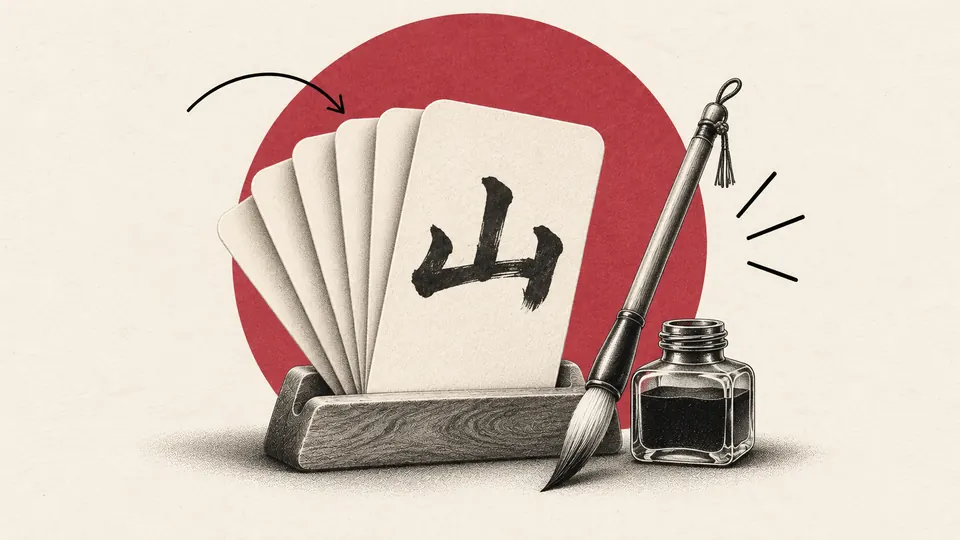
Chineasy turns Chinese characters into bright graphic art, and now renews at $69.99 a year. We checked whether those picture cards can teach you Mandarin.
This review helps beginners and parents weigh Chineasy against HelloChinese, Skritter or free radical tools. We checked Chineasy's site, shop, FAQ, archived prices and 137 App Store reviews in November 2026.
Key takeaways
- Four live pages list four different prices. Its FAQ, store blurbs and web shop show monthly rates from $4.99 to $16.99.
- Renewal matches a full course. At $69.99 yearly after year one, Chineasy costs the same as HelloChinese Premium.
- Picture cards hit a fast wall. Over 70% of school Chinese characters pair a meaning part with a sound part, not a drawing.
- Free study stops around level eight. Eleven of the latest US App Store reviews hit that paywall within minutes.
- Speaking sits in a second paid app. Talk Chineasy adds another yearly bill, and two in three recent reviews gave one or two stars.
- Beginners still love the main app's art. Over three in four recent US written reviews gave four or five stars.
Clever art, thin grammar and a split speaking app
Chineasy began in 2013 as a viral TED Talk and book by ShaoLan Hsueh with illustrator Noma Bar. The mobile app launched in February 2018 and reached the 2022 Apple Design Award finals.
We checked Chineasy's site, FAQ, terms and US store pages on 25 November 2026 to score each job:
What you need · Verdict · What Chineasy gives you
Losing character fear
Strong
Bright picture cards, short levels and calm daily pacing
Scripts and offline use
Strong
Simplified and Traditional toggle plus offline levels after sign-in
Word recall and review
Partly
500+ to 600+ short levels and Speed Review SRS, though noun-heavy
Writing by hand
Partly
Stroke playback and outline tracing without strict SRS grading
Grammar and reading
Partly
Cultural essays and stories, with no real grammar path
HSK 3.0 exam match
Missing
No HSK 2.0 or November 2025 HSK 3.0 syllabus match listed
Speaking and tones
Missing
Split into paid Talk Chineasy, with no published tone benchmark
Sources: Chineasy app page, FAQ, US App Store, Google Play and Talk Chineasy, 25 November 2026.
For a playful first week with characters, Chineasy delivers. For one plan covering grammar, HSK reading and live speech, you will outgrow it fast.
How much does Chineasy really cost in 2026?
Chineasy's pricing is among the messiest we've checked for Mandarin. On 25 November 2026, four live Chineasy pages showed four conflicting price lists.
On the live web shop, intro discounts step up on renewal: monthly climbs to $16.99 after month one, while yearly rises to $69.99 after year one. The standard subscription page lists those renewal rates, and a lifetime pass costs $139.99.
We checked past web-shop copies on the Internet Archive and traced the clash. Every stale price still live today is a fossil left behind from an older price rise:
| Where you look on 25 Nov 2026 | Monthly | Yearly | Lifetime | Archived match |
|---|---|---|---|---|
| Chineasy FAQ | $4.99 | $39.99 | Not listed | Jan 2021 |
| Google Play text | $9.99 | $39.99 | Not listed | Jan 2023 |
| US App Store text | $12.99 | $49.99 | $149.99 | May 2024 |
| US App Store live IAPs | $16.99 / $12.99 | $69.99 / $49.99 | $139.99 | Live Apple SKUs |
| Chineasy web shop | $11.99, then $16.99 | $49.99, then $69.99 | $139.99 | Live Nov 2026 |
Sources: live checks of FAQ, Google Play, US App Store and web shop on 25 November 2026, plus Internet Archive snapshots. Google Play's billing box shows $12.99 to $139.99 per item.
Apple's store shows that clash on one page. The blurb still quotes May 2024 rates while live In-App Purchases include newer renewal SKUs alongside older tiers.
Chineasy's FAQ shows the same neglect. It still cites iOS 11 and Android Oreo from 2018, even though today's iPhone build requires iOS 15.6.
Note one device limit too: Chineasy has no browser learning app. Its lifetime page confirms that paying on the web unlocks only the phone apps via the same login.
Adding Talk Chineasy, its separate speaking app from September 2024, doubles the yearly bill. Standard yearly access to both apps reaches $139.98 a year, or $309.98 for both lifetimes.
Use our tool to compare Chineasy alone or with Talk Chineasy against beginner and character rivals:
Compare what Chineasy and its Mandarin character rivals actually cost
Pick how long you'll study, whether you are weighing Talk Chineasy too and your main goal: you get the cheapest Chineasy plan and exact US totals against HelloChinese, Skritter and SayMei.
How long you'll use it
Chineasy setup
Main learning goal
For 1 year of Chineasy, cheapest is Web yearly ($49.99 first yr, then $69.99): $49.99
About $4.17 a month. Paying monthly would cost $198.88.
For visual mnemonics on your first few hundred characters, Chineasy shines on a short web monthly stint or via the $29.99 Chineasy Everyday book; SayMei Radicals teaches real components with stories free with an account.
Every way to pay for 1 year of Chineasy
- Web yearly ($49.99 first yr, then $69.99), year 1$49.99Beats monthly from month 4 onward and still undercuts Lifetime at 2 years
- Lifetime pass ($139.99 one-off), once$139.99Crossed out from $199 on chineasy.com/shop/; pays off only past 2 full years
- Web monthly ($11.99 first mo, then $16.99), 12 months$198.88Cheapest for 1 to 3 months; cancel any month before renewal
Chineasy vs Mandarin rivals for 1 year
Chineasy (cheapest)
- Total (1 year)
- $49.99
- Visual mnemonics
- Strong
- Best plan & catch
- Web yearly ($49.99 first yr, then $69.99)
- Total (1 year)
- $69.99
- Visual mnemonics
- Partly
- Best plan & catch
- Yearly ($69.99). 2,500+ words, 430+ grammar points, handwriting & pinyin; speaking is repeat-after-me
- Total (1 year)
- $99.99
- Visual mnemonics
- Partly
- Best plan & catch
- Yearly ($99.99). Strict stroke-by-stroke SRS with 2025 HSK 3.0 decks; no grammar or speaking
- Total (1 year)
- Free
- Visual mnemonics
- Strong
- Best plan & catch
- Free with account. Component stories up to HSK 6 + stroke-order SRS for all 1,200 HSK 3.0 writing characters
- Total (1 year)
- $71.88
- Visual mnemonics
- Strong
- Best plan & catch
- 12 × $5.99. 200 live Mei Lin speaking min/mo + Characters, Radicals, 169 Stories & offline FSRS
Prices checked 25 November 2026 in US dollars on chineasy.com/shop/, the US App Store, HelloChinese, Skritter and saymei.app/pricing. A yearly plan longer than your window counts in full.
Sources: chineasy.com/shop/, Chineasy US App Store (id1318941705), Talk Chineasy US App Store (id6473402700), SayMei's HelloChinese and Skritter reviews, and saymei.app/pricing, checked 25 November 2026.
Here is how Chineasy's monthly cost compares with its main Mandarin rivals:
Sources: Chineasy shop, US App Store, Talk Chineasy, SayMei's HelloChinese and Skritter reviews, and SayMei pricing, 25 November 2026.
Check the lifetime math first. Paying $139.99 upfront beats the web yearly plan only past two full years, since years one and two total $119.98. Most learners outgrow picture drills before year three.
Free tier, renewals and refund rules
Chineasy is free to install, yet the free section ends fast. Its FAQ promises "the first few levels" free without naming a number.
App Store users give the real cutoff. Eleven of the latest US reviews hit a paywall after level eight or nine, roughly ten minutes in. There is no ad-funded tier and no test to skip words you already know.
Plans on iPhone and Android auto-renew unless cancelled at least a day early in Apple ID or Google Play settings. Talk Chineasy widens that window to two full days on its Apple listing.
Refunds are equally strict. Chineasy's FAQ states that store refunds "can't be done from our end" and sends buyers to Apple or Google. Its Terms and Conditions, updated in July 2024 under the laws of England and Wales, publish no explicit web refund window; support sits at hello@chineasy.com.
One extra caution came from a Canadian lifetime buyer in January 2026 who reinstalled after a break and could not restore their purchase. Keep your receipt email and confirm which login you used before deleting the app.
How the picture method works, and where it stalls
Chineasy's core hook is easy to like. ShaoLan Hsueh and Noma Bar drew clean pictures straight over simple characters, then paired blocks to form compound words.
Here is the showpiece card from Chineasy's US App Store listing:
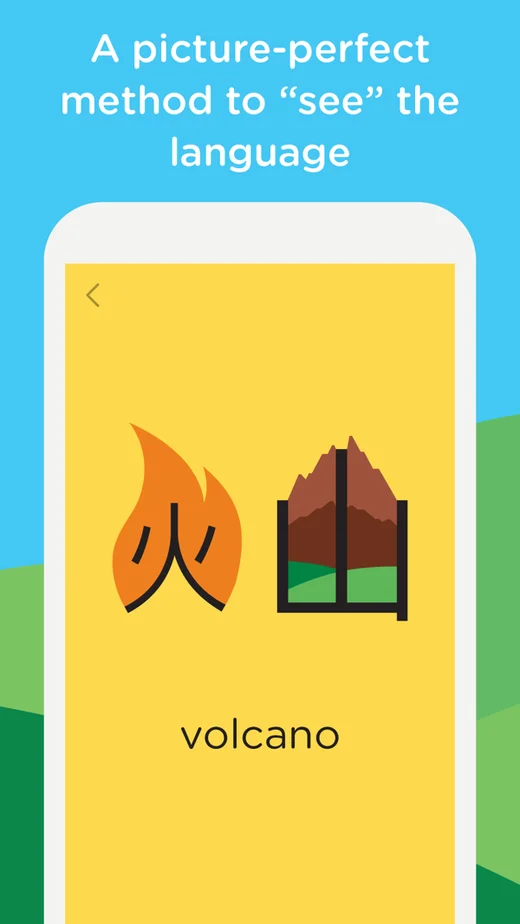
You see why people smile right away. Fire, 火, glows inside an orange flame, and mountain, 山, sits over brown peaks. Put them together and you read volcano, 火山.
That trick shines on a few dozen famous picture shapes: person, 人; tree, 木; forest, 森; sun, 日; moon, 月; and bright, 明. For a nervous beginner, seeing clear shapes instead of tangled lines brings real relief.
Now notice what that volcano card leaves off: pinyin. Chineasy's art ties shapes to English words, yet real Chinese reading runs mostly on sound clues.
In a classic study of Chinese primary-school textbooks, Shu and colleagues found that 72% of school characters are sound-and-meaning compounds, 形声字. Across wider dictionaries, linguist Zhou Youguang and John DeFrancis put that share near 81%.
Each sound-and-meaning character pairs one meaning clue with one sound clue. Look at the family built on green, 青:
- Clear, 清: water on the left, 青 for the sound.
- Please, 请: speech on the left, 青 for the sound.
- Feeling, 情: heart on the left, 青 for the sound.
- Sunny, 晴: sun on the left, 青 for the sound.
Once you pass early picture words, forcing cartoons onto every stroke stops matching how Chinese works. In our Chinese radicals guide, we counted the new HSK 1 to 4 list and found that just 22 radicals file half of all characters, while a sound part gives the right syllable about two times in five.
Memory research shows a second catch with ready-made art. In a 1992 study, students given ready-made character pictures held no recall edge after a week and forgot more than learners using plain drills.
A follow-up study of 92 high-school students showed why. Learners who invented their own cues beat those handed ready-made pictures or plain glosses.
Sinologists flagged a third snag early on. In two March and August critiques on Language Log in 2014, Victor Mair called out Chineasy's folk etymologies. One example explained row, 划, as "weapon + knife", picturing "a warship's rowers slicing through the water", rather than its real sound and radical parts.
Bright colour-coded tiles can also act as a crutch in quizzes. Look at this phrase puzzle from the US App Store:
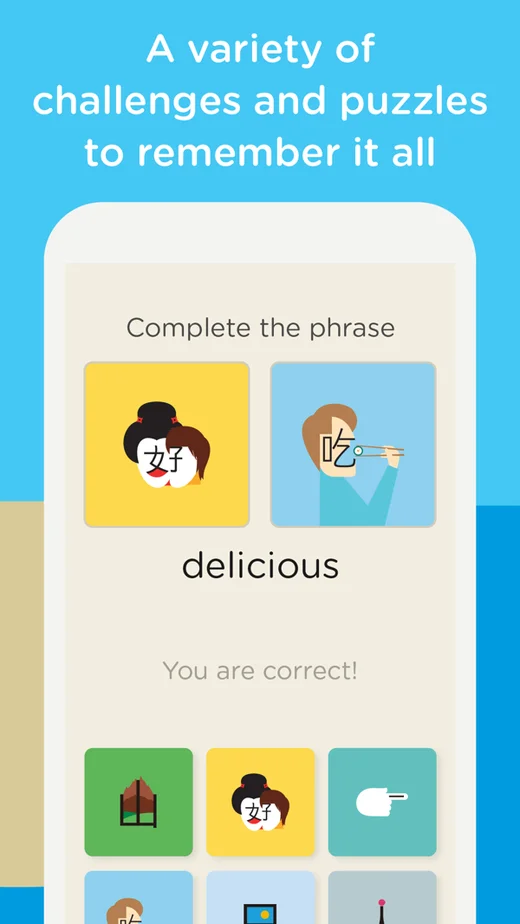
Good, 好, sits on yellow with two faces, and eat, 吃, sits on blue with chopsticks, spelling delicious, 好吃. As learners note in public r/ChineseLanguage threads we checked in November 2026, colourful tiles train your eye on artwork that vanishes on real signs and menus.
Picture cards make a warm front door into Chinese. They are the wrong engine once you pass your first few hundred words.
What the Chineasy app teaches, and where it stops
The main app has grown well past flat flashcards. According to Chineasy's May 2025 feature guide and app comparison, lessons follow a winding map with a blue mascot called Bao:
- Circle levels: teach four to six new words with picture cards and native audio.
- Square levels: quiz words from the past five to seven levels with unlimited tries.
- Octagon levels: review everything across the past fifteen to twenty levels.
- Extra tabs: Speed Review spaced cards, a Writing tab, short Story units and an Explore feed of essays, videos and podcasts.
Many beginners enjoy that calm pace. A US user praised the "non-competitive approach" in July 2026, with no leaderboards or clocks.
Check the course size, though, and Chineasy's own claims drift. Its web shop says over five hundred levels, while Google Play and the FAQ say over six hundred. Word claims swing from a thousand on the FAQ to fifteen hundred on the app page.
We set Chineasy's published character claims next to the November 2025 HSK 3.0 syllabus and our character count study:
Sources: Chineasy About, Chineasy FAQ, CLEC November 2025 HSK 3.0 syllabus, and SayMei's character count study, 25 November 2026.
The bigger limit is which words Chineasy picks. Concrete nouns are easiest to draw, so core verbs and grammar lag behind.
A three-star US reviewer in October 2025 laid this out cleanly. After a hundred lessons, they knew numbers, family terms and weather nouns, yet still lacked want, 要, buy, 买, or happy, 高兴. They added that generated stories used only about 20% taught words and skipped grammar lessons.
HSK students hit another snag. Chineasy publishes no HSK match on its store pages or FAQ. With the first regular HSK 3.0 sitting starting in December 2026, our HSK 3.0 guide explains why exam takers need aligned word lists.
Scripts, offline access and handwriting
Chineasy gets three practical details right, each with a catch.
First, you can toggle Simplified characters, 简体字, and Traditional characters, 繁体字, under the blue Bao icon in Settings. Audio stays Mandarin-only rather than Cantonese, and an Australian user in February 2024 reported missing words after switching scripts. Even Chineasy's own third US App Store preview shows Simplified wind, 风, beside Traditional shell, 貝, on one beach scene.
Second, offline study works well once set up. Chineasy's FAQ says you only need internet to sign in and verify your plan; after that, you can study offline and sync later.
Third, the main app does include a Writing tab, which older reviews often miss. Here is how it looks on the US App Store:
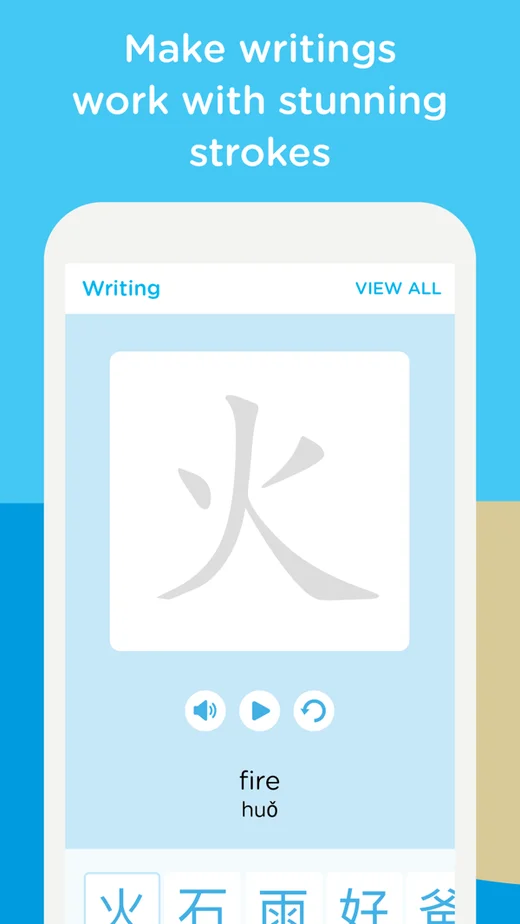
You get stroke playback, audio and a plain outline to trace for characters like fire, 火. There is no stroke grid, no strict stroke-order grading and no spaced writing deck like Skritter. Simple tracing works fine for browsing, yet serious handwriting needs a dedicated trainer.
Speaking, tones and the Talk Chineasy split
For years, users asked Chineasy for real speaking and grammar drills. In September 2024, Chineasy Ltd shipped Talk Chineasy: Speak With Ease as a separate paid app instead of upgrading the original.
Long-time buyers felt burned. One US reviewer wrote in September 2024 that "this developer made a second app with high subscription pricing instead of updating this one." Another paying member in August 2026 called the original app "pretty flash cards" and questioned renewing.
Talk Chineasy bills separately on Apple's US store at $69.99 yearly or $169.99 for life, with monthly and quarterly tiers too. Google Play lists separate Android items alongside it.
Its own web page hints at rushed upkeep. On 25 November 2026, chineasy.com/talkchineasy-app still displayed five lines of unfinished "Lorem ipsum dolor sit amet dolor." filler text inside its pricing cards.
Worse still is how poorly its voice checks perform in user reports. Neither Chineasy nor Talk Chineasy publishes any test of Mandarin tone grading. As a review of fifteen studies in ReCALL showed, speech tools catch consonants and vowels well yet struggle to grade tones cleanly.
We read all 37 written English App Store reviews of Talk Chineasy across the US and UK, averaging 3.11 stars overall. From November 2025 through July 2026, the score dropped to 2.00 stars, with two in three recent reviews giving one or two stars:
- Broken voice checks: Ten of the 37 users said recording or grading failed. Two separate buyers, in the UK in December 2025 and the US in March 2026, asked a native Chinese friend to say mā into the mic and watched the app reject them too.
- Freezes and empty units: Seven users hit infinite loading, freezes, a dead support link or units stuck on "coming soon", including a July 2026 lifetime buyer who regretted paying.
- Awkward AI teacher clips: Five users called the AI teacher videos "uncanny valley" or badly synced.
- Hard paywall: Five flagged forced sign-ups, immediate paywalls or refund friction.
Talk Chineasy shipped a minor bug-fix update in October 2026 after sitting idle for months. Until voice checks work reliably and tone scoring is tested openly, skip paying for a second app. For pitch training, read our Chinese tones guide or test your voice on our free Tone Checker.
What store scores and 137 written reviews show
At a glance, Chineasy looks like a runaway App Store star. Here is where all four public store profiles stood on 25 November 2026:
Chineasy, US App Store
- Rating
- 4.82
- Count
- 9,378
- Latest build
- v4.34.0, 9 Nov 2026
Chineasy, Google Play
- Rating
- 4.16
- Count
- 2,758
- Latest build
- 100K+ downloads, 8 Nov 2026
Talk Chineasy, US App Store
- Rating
- 4.55
- Count
- 193
- Latest build
- v1.2.0, 17 Oct 2026
Talk Chineasy, Google Play
- Rating
- Not shown
- Count
- Not shown
- Latest build
- Updated 7 Oct 2026
Sources: Apple iTunes Lookup API and Google Play metadata, 25 November 2026. Exact averages are 4.824 on US iOS and 4.160 on Google Play.
Notice the spread between iPhone and Android on the main app: 4.82 stars on Apple against 4.16 on Google Play. Reading written reviews explains who thrives and who bounces off.
We pulled and hand-coded the 100 latest written US App Store reviews of the main app. Unlike rivals whose reviews have collapsed, Chineasy's main app holds a solid 4.16 written average, with three quarters giving four or five stars.
Here are the themes those 100 US reviewers raised most often:
Source: hand count of the 100 most recent written US App Store reviews in Apple's US XML feed (14 Jan 2022 to 21 Nov 2026; 69 five-star, 7 four-star, 7 three-star, 5 two-star, 12 one-star). Reviews can raise multiple themes. How we coded them.
Those themes paint a fair picture. Eight of the nine Duolingo comparers preferred Chineasy's visual hints over Duolingo's rote matching. Parents reading with young kids and heritage learners reconnecting with family Chinese praised how friendly it felt. One user in May 2023 joked that years after stopping, they still remembered big cat, 大猫, and small hill, 小山.
Critics bump into three steady walls. Eleven US users named level eight or nine as the cutoff where free study ended. Older updates wiped progress, clipped iPad screens or froze Apple Watch cards on the same dozen words, while a July 2025 user hit an endless login spinner. Learners past beginner basics also ran out of grammar, tone checks and real sentences.
Put both apps side by side and the gap is obvious. Chineasy's original app remains a pleasant visual starter, whereas Talk Chineasy has stumbled hard on reliability.
Physical books and card decks vs the Chineasy app
Many people first meet Chineasy on a bookshop table. Because the picture method shines brightest on the first few hundred characters, a print book can beat paying for the app every year.
Here is how Chineasy's print books and games compare with the app:
Chineasy: The New Way to Read Chinese
- Typical US price
- ~$26.99 list
- What you get
- Hardcover guide to core shapes and compounds
- Best use
- Gift book or casual browse
Chineasy Everyday (256 pages)
- Typical US price
- $29.99 list
- What you get
- Over 400 characters, phrases and cultural notes
- Best use
- Best print pick for depth
Chineasy: 60 Flashcards
- Typical US price
- ~$15 to $20
- What you get
- Boxed physical picture cards with pinyin
- Best use
- Screen-free study with kids
Chineasy Tiles
- Typical US price
- ~$89 list
- What you get
- Tabletop character tile game
- Best use
- Family or classroom play
Chineasy Tiles Lite e-book
- Typical US price
- $20.00
- What you get
- 100-page audio e-book on chineasy.com/shop/
- Best use
- Companion to Tiles or audio
Chineasy App, standard yearly
- Typical US price
- $69.99/yr
- What you get
- 500+ to 600+ levels, audio, SRS and tracing
- Best use
- Daily phone drills on the go
Sources: chineasy.com/shop/, Chineasy About, and HarperCollins / Thames & Hudson listings, 25 November 2026. Used copies often sell well below list price.
We like that trade-off. Chineasy Everyday gives you over 400 illustrated characters for a single $29.99 list price, or less used, with zero renewal fees. You give up audio and spaced quizzes, yet you capture the best part of the method before picture cards stretch thin. For textbooks, see our best books to learn Chinese guide.
Chineasy vs HelloChinese, Skritter and better picks
If you plan to spend $50 to $140 on Mandarin, look closely at what the same money buys elsewhere.
Chineasy vs HelloChinese
At renewal, Chineasy and HelloChinese charge the exact same $69.99 a year. They are not in the same league as a beginner course.
HelloChinese Premium covers over 2,500 words and 430 grammar points, with pinyin drills, handwriting, Teacher Talk grammar notes and Traditional support. Premium+ adds over 1,000 graded stories with audio.
Chineasy wins on playful art. HelloChinese wins on almost every skill needed to read, write and build real Mandarin sentences.
Chineasy vs Skritter
Skritter costs more at $99.99 yearly, yet solves a job Chineasy barely touches. Skritter grades every stroke from memory, schedules writing, tone, pinyin and meaning separately, and supports the new HSK 3.0 lists.
Pick Skritter if handwriting is your focus. Pick free radical tools or a full course if you only need to read and type.
Who should buy Chineasy, and what to pick instead
We would still consider Chineasy if:
- Characters look scary right now. One intro month at $11.99 or a library copy of Chineasy Everyday breaks the ice fast.
- You are learning lightly with a young child. Parents of young kids love the mascot, pictures and calm pace.
- You want cultural browsing beside a real course. As a five-minute extra next to a tutor or textbook, it stays fun.
We would skip a yearly or lifetime plan if:
- You want one main course from zero to HSK 4. HelloChinese costs the same at renewal and teaches real grammar.
- You want character mnemonics past 1,000 words. Component-based systems scale far beyond simple pictographs.
- You want live speaking and tone feedback. Skip a second yearly bill for Talk Chineasy while voice bugs persist.
Here is what we would pick instead for each Mandarin goal:
Free character parts and stories
- Pick
- SayMei Radicals
- US price
- Free with account
- Why it beats Chineasy
- Real components and stories up to HSK 6
Free stroke-by-stroke writing
- Pick
- SayMei Characters
- US price
- Free with account
- Why it beats Chineasy
- Checks strokes with SRS on 2025 HSK lists
Full beginner course and grammar
- Pick
- HelloChinese
- US price
- $11.99/mo or $69.99/yr
- Why it beats Chineasy
- 2,500+ words, 430+ grammar points
Strict handwriting SRS trainer
- Pick
- Skritter
- US price
- $14.99/mo or $99.99/yr
- Why it beats Chineasy
- Deep stroke grading and 2025 HSK 3.0 decks
Offline dictionary and flashcards
- Pick
- Pleco
- US price
- Free; $24.99 web bundle
- Why it beats Chineasy
- 130,000+ words and one-off SRS
Graded stories to advanced level
- Pick
- Du Chinese
- US price
- $14.99/mo or $119.99/yr
- Why it beats Chineasy
- Over 3,700 voiced readings, HSK 3.0 labels
Deep character-movie course
- US price
- $2,000+ Fluency Lab
- Why it beats Chineasy
- 3,050-character system with sound and tone
Live spoken lessons with tone help
- Pick
- SayMei Premium
- US price
- $5.99/mo
- Why it beats Chineasy
- 200 spoken min/mo with Mei Lin plus Stories
Human teacher for weekly chats
- Pick
- An italki tutor
- US price
- About $20/hour
- Why it beats Chineasy
- Live human feedback on speech and exams
Sources: SayMei's live competitor guides and SayMei pricing, 25 November 2026.
To see how characters turn into real reading, read our guide on how to read Chinese or compare Chinese flashcard apps.
Where SayMei fits, and where it doesn't
SayMei is our app, built only for Mandarin. One account works on saymei.app and in our iPhone and Android apps. SayMei is also an app for iPhone and Android: get the app.
Four parts cover what learners hope to get from Chineasy and Talk Chineasy together:
- SayMei Radicals and SayMei Characters are free with an account. Learn real radicals with pictures and stories up to HSK 6, and write every HSK handwriting character in Simplified or Traditional with SRS.
- 402 printable PDF workbooks are free with an account. Our downloads library includes illustrated kids' packs and direct-download HSK writing workbooks.
- SayMei Stories costs $2.99 a month. Read 169 graded books for HSK 1 to 3 in either script, with eight whole books free.
- SayMei Premium costs $5.99 a month. Get 200 live spoken minutes monthly with Mei Lin for tone help, plus Stories, Dialogues, offline FSRS due cards in the apps, Tones and Music.
We will be plain about where Chineasy beats us, and where SayMei stops short:
- Poster-style art and gift books. Chineasy's Noma Bar drawings, hardcovers and tabletop tiles have a visual charm we do not copy.
- Full offline lessons. Chineasy lets you play levels offline after signing in. On SayMei, live Mei Lin lessons need internet, so only due flashcards work offline in our apps beside paper PDFs.
- Scope and store limits. SayMei Stories end at HSK 3, we have no offline dictionary or OCR like Pleco, we are not a human-tutor marketplace, and our iPhone app is not yet on the App Store in the EU, mainland China, Morocco or Afghanistan.
SayMei's seven-day trials for Stories Unlimited and Premium also take a card and auto-renew unless cancelled. For free component-based character training, stroke writing and live speaking in one account, SayMei stretches your budget further.
What to do next
- Play Chineasy's free eight levels first. Test whether the artwork hooks you before adding a card.
- Borrow or buy Chineasy Everyday instead of a lifetime pass. Get the strongest illustrated cards once without paying a yearly fee.
- Move to real radicals and sound parts early. Once you recognise your first hundred characters, focus on the top 40 radicals and common phonetic blocks.
- Pair characters with grammar and live speaking. Combine free writing tools with a full beginner course and spoken tone feedback.
Ready to see how real components unlock HSK characters? Open SayMei Radicals or start speaking with Mei Lin below.
FAQ
Is Chineasy worth it for learning Mandarin in 2026?
Only as a light visual starter or kids' companion, not your main Mandarin course. Chineasy's art makes early characters less scary, yet at $69.99 yearly on renewal in November 2026 it lacks real grammar, HSK exam alignment and built-in live speaking. HelloChinese costs the same yearly and teaches a complete beginner course.
How much does the Chineasy app cost in 2026?
In November 2026, Chineasy's web shop lists intro rates that renew at $16.99 monthly or $69.99 yearly, with a one-off lifetime pass at $139.99. Older prices still linger on its FAQ and mobile store blurbs, yet live billing follows the newer rates and unlocks only the iPhone and Android apps.
How many levels and characters are free in Chineasy?
Chineasy's FAQ says only "the first few levels" are free without naming an exact cutoff. Across recent US App Store reviews we checked in November 2026, eleven learners reported hitting the paywall after level eight or nine out of more than 500 levels. There is no ad-supported tier or placement test.
Does Chineasy teach HSK levels or Mandarin grammar?
No. Chineasy publishes no alignment with old HSK lists or the updated HSK 3.0 syllabus, and its main app focuses on illustrated vocabulary cards, quizzes and short cultural notes rather than step-by-step grammar. Learners aiming at the December 2026 HSK 3.0 exam need a course built around the new syllabus.
What is the difference between Chineasy and Talk Chineasy?
Chineasy is the original visual character and word app, while Talk Chineasy, launched in September 2024, is a separate paid app for speaking, pinyin and video dialogues. Talk Chineasy charges its own yearly or lifetime fee on iOS and Android, and recent 2025 to 2026 reviews frequently report broken voice checks.
Does Chineasy support Traditional Chinese, pinyin and offline study?
Yes, with limits. You can toggle Simplified and Traditional characters under the blue Bao icon in Settings, though audio stays Mandarin-only rather than Cantonese. Pinyin appears inside lessons, though not on every card face. Chineasy's FAQ confirms you can study levels offline after signing in online to verify your plan.
Is the Chineasy book better than the Chineasy app?
For many casual beginners, yes. Chineasy Everyday lists at $29.99 in the US in November 2026 and teaches over four hundred illustrated characters, phrases and cultural notes with no recurring bill. You give up audio and spaced quizzes, yet you get the best part of the method before picture cards lose steam.
How do you cancel Chineasy and request a refund?
Cancel at least a day before renewal in Apple ID settings for iPhone or Google Play Subscriptions for Android; Talk Chineasy requires two full days on iOS. Chineasy's FAQ states it cannot issue refunds for mobile store purchases and directs buyers to Apple or Google support. For web shop orders, email hello@chineasy.com.
Sources
Checked 25 November 2026 unless noted. No accounts were created, no trial was started and nothing was bought.
- Chineasy pages: App landing page, Methodology, About, Shop, Subscription, Lifetime, FAQ, Privacy & Terms (30 Jul 2024), Chineasy vs Talk (3 Oct 2024), 6 Features (26 May 2025), and Talk Chineasy web page
- Archived shop (chineasy.com/shop/): Jan 2021, Jan 2023 and May 2024
- App stores: Chineasy US App Store (4.824, 9,378 ratings, v4.34.0), US RSS, Google Play (4.160, 2,758 reviews, 100K+ downloads), Talk Chineasy US App Store (4.554, 193 ratings, v1.2.0), Talk RSS and Talk Google Play
- Research: Shu et al. (2003), Child Development 74(1), 27–47, doi:10.1111/1467-8624.00519; Wang & Thomas (1992), Language Learning, doi:10.1111/j.1467-1770.1992.tb01340.x; Kuo & Hooper (2004), ETR&D, doi:10.1007/bf02504673; Ngo et al. (2024), ReCALL 36(1), doi:10.1017/s0958344023000113; Victor Mair, Language Log, "Chineasy? Not" (Mar 2014) and "Chineasy2" (Aug 2014)
- Syllabus and rivals: CLEC November 2025 HSK 3.0 syllabus; SayMei competitor reviews, SayMei pricing, and public r/ChineseLanguage threads checked 25 November 2026
Methods
We checked Chineasy's public pages, Terms and store listings on 25 November 2026 without creating an account or starting a paid trial.
- Pricing: Compared live prices on chineasy.com/shop/, chineasy.com/faq/, US App Store description vs live In-App Purchases, and Google Play against Internet Archive snapshots from 2021, 2023 and 2024.
- Chineasy reviews: Hand-coded the 100 most recent written US App Store reviews (XML feed, 14 Jan 2022 to 21 Nov 2026; avg 4.16 stars; multiple themes per review).
- Talk Chineasy reviews: Hand-coded all 37 written English App Store reviews across US (27) and UK (10) from 11 Sep 2024 to 13 Jul 2026 (avg 3.11 overall; 2.00 and 10 of 15 negative from Nov 2025 onward).
- Mandarin data: HSK 3.0 reading counts and radical shares match SayMei's corpus guides; characters and pinyin were checked against CC-CEDICT.
If you spot an error or price change, tell us: we update and fix mistakes.