ChinesePod review: is the classic audio library still worth paying for in 2026?
ChinesePod review checked Nov 2026: $14 Basic retired, $249/yr Premium, decade-old 'new' episodes, 59 iOS reviews (2.3 stars) and better audio rivals.

ChinesePod helped invent Mandarin podcasting two decades ago. Now it has dropped its cheaper Basic plan and asks $29 a month for a mostly recycled archive.
This review helps Mandarin learners weigh ChinesePod against Pimsleur, Glossika, Du Chinese or free podcasts. We checked ChinesePod's site, checkout code, Terms, archived prices, RSS feeds and 59 App Store reviews in November 2026.
Key takeaways
- The $14 Basic plan is gone. Archived pages show ChinesePod dropped Basic between February and July 2026, leaving only Premium.
- "New" uploads are old Shanghai shows. Every November 2026 podcast and YouTube upload we traced came from 2011 to 2013.
- Most angry reviewers still like the lessons. Over half of critical App Store reviews praised the hosts while slamming crashes and billing.
- Fine print caps offline saves. Terms updated in November 2026 cap downloads at one lesson a day inside a two-week window.
- Nothing hears you speak. ChinesePod offers pronunciation videos, yet skips live talk, tone checks and the new HSK 3.0 syllabus.
- Thousands of full shows are free. Official Apple Podcasts feeds and YouTube carry over 2,600 episodes without a card.
A classic archive inside a dated subscription
ChinesePod's best idea has never changed. Two lively hosts unpack real spoken Mandarin in plain English. What changed by November 2026 is the price and software wrapped around those talks.
We checked its site, checkout setup, Terms, podcast feeds and store listings to score each Mandarin job:
What you need · Verdict · What ChinesePod gives you
Everyday listening archive
Strong
Thousands of real-life talks across Shanghai, Taipei and Hong Kong eras
Scripts and character toggle
Strong
Hanzi, pinyin, English, line audio, PDFs, Simplified and Traditional toggle
Price and plan value
Partly
$29/mo or $249/yr after dropping $14 Basic; rivals cost far less
Fresh 2026 lessons
Missing
Podcast and YouTube feeds re-upload 2011–2013 shows; Advanced stopped Feb 2025
Beginner path and HSK
Partly
Standalone episodes with heavy English chat; no HSK 3.0 or HSK 7–9 path
Speaking and tone checks
Missing
22 Say It Right videos; no live talk and no tone score
Mobile app and billing
Missing
2.30 stars iOS, 2.67 stars Android, strict cancel and download rules
Sources: chinesepod.com, pricing, Terms, US App Store and Google Play, checked 25 November 2026.
We see ChinesePod as a great audio library stuck inside clunky billing and weak apps. Check the real maths before you pay.
How much does ChinesePod really cost in 2026?
Most ChinesePod reviews online still list a $14 monthly Basic plan next to Premium. New web buyers can no longer pick that cheaper tier.
We pulled 52 archived copies of chinesepod.com/pricing from the Internet Archive. From April 2020 through February 2026, Basic Learner sat at $14 a month with audio, video, PDF notes, scripts, playlists and dictionary search.
By July 2026, Basic was gone. On the live pricing page, only Premium Learner appears for solo buyers at $29 a month. Dead code on that page still links Basic clicks to checkout, yet chinesepod.com/checkout forces every Basic link straight onto Premium.
Here is every live US price we checked on the web and app stores:
Free plan (web)
- Monthly
- $0
- 3 months
- $0
- Annual
- $0
- Effective monthly
- $0.00
Premium (chinesepod.com)
- Monthly
- $29.00
- 3 months
- $79.00
- Annual
- $249.00
- Effective monthly
- $20.75–$29.00
Premium (US App Store)
- Monthly
- $29.99
- 3 months
- $78.99
- Annual
- $249.99
- Effective monthly
- $20.83–$29.99
Basic Learner (retired 2026)
- Monthly
- $14.00
- 3 months
- Not live
- Annual
- Not live
- Effective monthly
- Gone before Jul 2026
Sources: chinesepod.com/pricing, chinesepod.com/checkout, US App Store and 11 February 2026 Wayback snapshot. Google Play lists in-app items from $28.99 to $249.99.
Two small catches hide inside the checkout code. ChinesePod sells no lifetime plan and lists no general solo student discount. A few partner school domains do unlock deep cuts, such as Maastricht University at over half off yearly plans, while schools and firms ask for quotes.
Watch the break-even maths too. Quarterly beats monthly at three months and six months. Yearly only beats quarterly once you stay ten months or longer, because three quarterly bills still sit below the yearly price.
Pick your study span, tier and goal below to compare totals and hourly audio costs:
ChinesePod cost & listening-hour calculator
Pick how long you'll study, which ChinesePod tier you are comparing (including the retired $14/mo Basic plan) and your study goal: see total cost, cost per listening hour at 30 min/day and exact US totals against Pimsleur, Glossika, Du Chinese and SayMei.
How long you'll study
ChinesePod tier
What matters most
For 1 year of ChinesePod Premium (web), cheapest is 12-Month plan (chinesepod.com): $249
About $20.75 a month ($1.36/hr at 30 min/day) across about 183 listening hours. Paying monthly would cost $348.
For passive audio dialogues at intermediate to advanced level, try ChinesePod's free podcast feeds first; if you want transcripts, Du Chinese ($119.99/yr) and SayMei Premium ($5.99/mo, 3,500+ dialogues) cost half to a quarter as much.
ChinesePod payment paths for 1 year (183 listening hours)
- 12-Month plan (chinesepod.com), once$249 · $1.36/hr$20.75/mo ('Save $99'); beats Quarterly from month 10 onward
- 3-Month plan (chinesepod.com), 4 times$316 · $1.73/hr$26.33/mo ('1 Week Free'); cheapest web path for 3 or 6 months
- Monthly (chinesepod.com), 12 times$348 · $1.91/hrCheapest for 1–2 months; 14-day card trial auto-renews; 30-day web refund window
ChinesePod vs Mandarin audio rivals for 1 year (183 listening hours at 30 min/day)
ChinesePod Premium (cheapest live)
- Total & $/hr (1 year)
- $249 ($1.36/hr)
- Passive audio archive
- Strong
- Best plan & catch
- 12-Month plan (chinesepod.com)
- Total & $/hr (1 year)
- Free
- Passive audio archive
- Partly
- Best plan & catch
- Free. 2,664 podcast episodes on Apple Podcasts & YouTube plus ad-supported web audio; limited notes & downloads
- Total & $/hr (1 year)
- $164.95 ($0.90/hr)
- Passive audio archive
- Partly
- Best plan & catch
- All Access yearly ($164.95). 150 hands-free 30-min audio lessons (~80 hrs total); active spoken recall; pinyin only until Level 5
- Total & $/hr (1 year)
- $129.99 ($0.71/hr)
- Passive audio archive
- Partly
- Best plan & catch
- New app Plus yearly ($129.99; Legacy $199). Native Taiwan & Beijing mass sentence drills; hands-free audio kept on Legacy ($199/yr) only
- Total & $/hr (1 year)
- $119.99 ($0.66/hr)
- Passive audio archive
- Strong
- Best plan & catch
- Yearly ($119.99; sales drop to $89.99). 3,814 graded stories & articles with voice-actor audio, HSK 3.0 labels and offline playback; no speaking
- Total & $/hr (1 year)
- $71.88 ($0.39/hr)
- Passive audio archive
- Strong
- Best plan & catch
- 12 × $5.99. 3,500+ HSK 1–6 dialogues + 200 live Mei Lin speaking min/mo ($1.80/live hr) + 169 Stories & offline FSRS
Prices checked 25 November 2026 in US dollars on chinesepod.com/checkout, the US App Store, pimsleur.com, glossika.com, duchinese.net and saymei.app/pricing. Hourly cost divides total spend by 30 minutes a day (about 15.2 hours a month); a plan longer than your window counts in full.
Sources: chinesepod.com/pricing, chinesepod.com/checkout, ChinesePod US App Store (id1185380819), Wayback 11 Feb 2026 Basic snapshot, SayMei's Pimsleur, Glossika and Du Chinese reviews, and saymei.app/pricing, checked 25 November 2026.
Here is how ChinesePod's monthly rate compares with its main Mandarin audio and reading rivals:
Sources: chinesepod.com/checkout, SayMei's live November 2026 reviews of Glossika, Pimsleur, Yoyo Chinese and Du Chinese, and SayMei pricing.
Even yearly, ChinesePod costs double Du Chinese and more than triple SayMei Premium. Dropping Basic also pushed short-term learners up by $15 a month.
Billing traps, refunds and a hidden download cap
Before you start ChinesePod's two-week trial, read its Terms and Conditions, updated in November 2026. Several rules sit far outside normal app habits and explain why billing fights keep showing up in reviews.
First, the web trial asks for a card upfront on the checkout page and renews at full price unless you cancel early. Web buyers get a 30-day refund window from the order date, with no refund right after that. Apple and Google store plans follow Apple and Google refund rules instead.
Second, read the cancel rule word for word. The Terms say a denied card charge does not end your plan. You stay on the hook for bills until you cancel in one of three listed ways:
- Your web account area at chinesepod.com, though the Terms warn site cancel tools come with no promise they will work.
- Phone support on ChinesePod's New York customer line.
- Registered mail sent to ChinesePod LLC in New York.
Third, watch the Fair Use Policy if you thought of paying for one month to save hundreds of lessons. The Terms cap personal downloads at one lesson a day and keep offline files inside a two-week window, split between past lessons and upcoming ones. You also agree to delete extra files and help if the firm checks your use.
Two other odd lines sit in the same Terms. Minors under 18 are barred from the site and users must enter their legal name from government ID, even though ChinesePod's schools page pitches primary and secondary schools. Prepaid credits also expire after a year with no refund.
If you still test ChinesePod, we'd keep four habits:
- Use Apple or Google billing for safer cancels. Monthly costs a dollar more on Apple, yet Apple handles renewals cleanly and quarterly actually costs a penny less.
- Start on monthly, not yearly. A missed reminder costs $29 instead of $249.
- Save proof when you quit. Screenshot your plan page and keep any note sent to support@chinesepod.com.
- Check your card statement next month. Several store reviewers saw new charges even after deleting their accounts.
Shanghai, Taipei and Hong Kong: why the eras sound different
Listening through ChinesePod feels like time travel across two decades of Mandarin. That is because the show moved studios three times under different teams.
ChinesePod's history starts in Shanghai, where Ken Carroll, Hank Horkoff and Steve Williams founded Praxis Language in 2004 and began publishing lessons the next autumn. Over the next decade, hosts like Jenny Zhu, John Pasden, Dilu, Vera Zhang and Connie Cheng recorded the classic shows that built its name.
Ownership changed in January 2012, when Bigfoot Ventures bought the brand. You can still see Bigfoot Squirrel in the site footer today.
John Pasden left in January 2014 to build AllSet Learning. By early 2015, the original Shanghai hosts stopped recording for ChinesePod.
Studio work shifted to Taipei, Taiwan under Fiona Tian, bringing video sets and softer Taiwan speech. In early 2018, the studio moved again to Hong Kong, adding newer hosts and shorter clips before output slowed hard.
That history gives your ear one clear perk and two quirks:
- Real accent range. Hearing Shanghai banter next to Taipei hosts trains you for both mainland and Taiwan speech, a split we map in our Chinese dialects and accents guide.
- Shifting tone and polish. Classic Shanghai audio feels warm and playful like late-night radio. Newer studio videos feel brisker and more scripted.
- Dated props. Old classics still bring up flip phones, paper train tickets and life before WeChat, even when the spoken patterns stay useful.
We still rate the classic Jenny-and-John archive among the sharpest listening libraries ever cut for adults. Just know you are paying for a museum of past eras, not a lively 2026 studio.
Are new ChinesePod lessons still being made in 2026?
At first glance, ChinesePod looks busy in November 2026. Its homepage boasts over 4,000 lessons, YouTube posts every few days, and Apple Podcasts drops three shows a week.
When we checked those counts and dates at the source, the truth looked very different.
Start with the headline count. While the top banner claims over 4,000 lessons, the six course cards on chinesepod.com add up to 1,799 core lessons. The rest are old side shows like Qing Wen, Media, Dear Amber, movie clips and the Say It Right video set. Even ChinesePod's own pages clash on level counts: the site lists six, Apple's text says five, and its own store screens promise seven.
Here is how those core lessons split across the six site levels:
Source: direct count from the six course cards on chinesepod.com, 25 November 2026.
Now check the "new" uploads. We pulled all three official Apple Podcasts feeds and ChinesePod's YouTube channel, which has about 293,000 subscribers. In late November 2026, both feeds pushed fresh-dated episodes like Quieting the Baby, Shopping for the Wife and Hiring Discrimination.
We traced those exact lesson IDs back to chinesepod.com and the Internet Archive:
25 Nov 2026
- Episode title
- Elementary: Quieting the Baby
- Lesson ID and hosts
- 1946 (John, Dilu)
- Original release
- June 2012 (14 years old)
25 Nov 2026
- Episode title
- Intermediate: Shopping for the Wife
- Lesson ID and hosts
- 1802 (Jenny, John)
- Original release
- Nov 2011 (15 years old)
23 Nov 2026
- Episode title
- Upper-int: Hiring Discrimination
- Lesson ID and hosts
- 2243 (Jenny, John)
- Original release
- Aug 2013 (13 years old)
21 Feb 2025
- Episode title
- Advanced: Us & Them Part 3
- Lesson ID and hosts
- 4600 (last Advanced post)
- Original release
- Feed halted Feb 2025
Sources: official Beginner, Intermediate and Advanced RSS feeds, @ChinesePodTV, chinesepod.com/1946 and Internet Archive first crawls, checked 25 November 2026.
The pattern is plain. Both active feeds simply walk up old Shanghai lesson numbers three times a week, stamping new 2026 dates onto shows cut more than a decade ago. Meanwhile, the Advanced feed halted in February 2025 after just three posts.
The site shows the same quiet stretch. ChinesePod News posted five short pieces in summer 2026 after a seven-year pause since May 2019. Meanwhile, the blog still keeps a July 2020 post near the top. Your subscription buys a historic archive, not fresh weekly studio shows.
Inside a lesson: dialogues, PDFs, scripts and exercises
Put the billing worries aside, and ChinesePod's lesson format still works well. Each show centres on a real short talk instead of dry word lists.
Take Elementary lesson Quieting the Baby. Two tired parents calm a crying infant using plain speech: baby, 宝宝, to make noise, 吵, and very late, 很晚了. The hosts play the talk at full speed, break down each line in English, explain nuance and replay the clip so your ear catches more the second time.
Premium adds five study tabs to each short podcast:
- Dialogue script: Full hanzi, tone-marked pinyin, English and line-by-line native audio replay.
- Vocabulary: Key words with audio, glosses and pop-up look-ups.
- Expansion: Fresh real-life lines using the same word, such as high-speed rail, 高铁, or hold a meeting, 开会.
- Drills: Matching, word order, sorting, multiple choice and dictation checks.
- PDF notes and grammar: Printable sheets and short pattern blocks.
Here is how the dialogue notes screen looks in ChinesePod's own App Store listing:
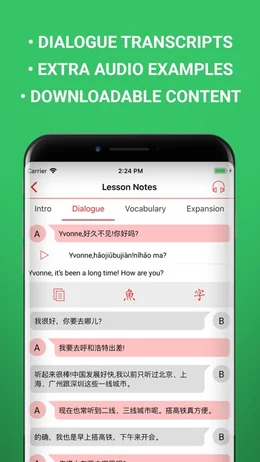
One clear Mandarin win stands out. ChinesePod lets you switch between Simplified characters, 简体字, and Traditional characters, 繁体字, on both the site and the app. Learners focused on Taiwan or Hong Kong can read Traditional across the whole library; our Simplified vs Traditional Chinese guide explains when to make that jump.
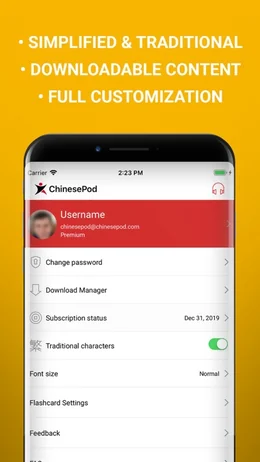
Look too at what costs nothing. The Free web plan streams shows with ads and partial notes. Even better, the three official Apple Podcasts feeds carry over 2,600 free episodes across Beginner, Intermediate and Advanced, mirrored on YouTube. Pay only if synced scripts, PDFs and line-by-line replay truly earn their keep for you.
Can a beginner or HSK student rely on ChinesePod?
ChinesePod pitches a journey from beginner to fluent, yet total beginners and exam takers both hit real gaps early.
Start with beginners. Because ChinesePod grew as an open podcast feed rather than a tight course, most episodes stand alone. Words taught on Monday rarely cycle back on purpose on Wednesday.
In public r/ChineseLanguage threads checked in November 2026, two gripes come up over and over. Lower levels spend half or more of each show on English host banter instead of Mandarin. Then Intermediate jumps abruptly into fast native chat with much less hand-holding. Even a five-star App Store fan noted that words do not repeat across episodes and called it great for listening alone.
Handwriting is thin too. If you want stroke-by-stroke memory, pair podcasts with HelloChinese, Skritter or free SayMei Characters.
HSK learners hit a sharper wall. ChinesePod's store art showcases HSK 1 to 4 vocabulary playlists, such as dozens of lessons grouped for HSK 1 and HSK 2:
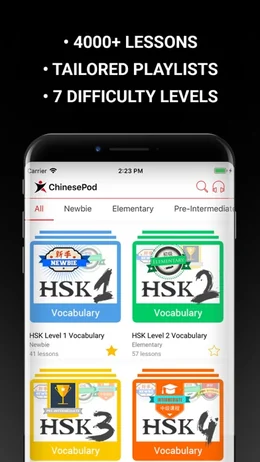
Those playlists pre-date the exam overhaul. The last regular HSK 2.0 test passed in November 2026, and the first regular sitting under the November 2025 HSK 3.0 syllabus arrives in December 2026.
As our HSK 3.0 guide shows, HSK 1 doubled its word count, speaking is mandatory from HSK 3, and HSK 7 to 9 add thousands of new words. We found no HSK 3.0 updates or upper-band lists anywhere on chinesepod.com.
If you start from zero or study for the new HSK, use our free HSK vocabulary lists and a clear core course first. Treat ChinesePod as extra listening, not your main syllabus.
Great for passive listening, missing for active speaking
ChinesePod's biggest limit is simple. You can listen for hundreds of hours and still freeze when someone asks you an unexpected question.
ChinesePod includes Say It Right, a 22-lesson video set on pinyin, tones and tone changes. Clear clips help beginners tell apart sleep, 睡觉, and dumplings, 水饺, or to ask, 问, and to smell, 闻.
Yet watching clips or muttering behind earbuds gives you zero feedback on your voice. ChinesePod has no tone checker, no live talk tool and no bundled speaking practice on any solo plan.
Research shows why listening alone stalls out. In a classic study, Robert DeKeyser and Karl Sokalski showed that listening mainly builds understanding while speaking practice builds output. Merrill Swain and Sharon Lapkin found that forming your own sentence forces you to spot gaps that passive audio hides. Across 28 interaction studies, Shawn Loewen and Masatoshi Sato found that live back-and-forth talk with feedback drives large, lasting speaking gains.
If podcasts fill your commute, add active speaking and pitch checks right away. Our guide to learning Chinese tones maps the routine, our free Tone Checker checks your pitch against 984 clips, and our how to speak Chinese guide compares speaking costs per minute. Listening wakes up your ear; answering back trains your mouth.
Mobile apps, retired Recap and 59 App Store reviews
Software quality is where ChinesePod lets down its biggest fans. Here is where every ChinesePod app and review page stood in late November 2026:
ChinesePod (US App Store)
- Rating
- 2.30
- Count
- 27
- Version and status
- v6.0.2, updated 13 Nov 2026 (iOS 17.2+)
ChinesePod (Google Play)
- Rating
- 2.67
- Count
- 266
- Version and status
- v3.0.45, 100K+ downloads, updated 18 Nov 2026
ChinesePod Decks (iOS)
- Rating
- None
- Count
- 0
- Version and status
- v1.0.2, untouched since 29 May 2021
CharacterCrush (iOS)
- Rating
- 4.25
- Count
- 4
- Version and status
- v1.0, untouched since 8 Dec 2019
ChinesePod Recap
- Rating
- Removed
- Count
- 0
- Version and status
- Gone from US App Store and Play; folded into main app
Trustpilot (chinesepod.com)
- Rating
- None
- Count
- 0
- Version and status
- No active rated Trustpilot profile found
Sources: Apple iTunes lookup, Google Play and developer catalogue lookup for Chinesepod Limited, checked 25 November 2026.
Look at the side-app trail first. ChinesePod once spun out ChinesePod Recap for quick review and ChinesePod Decks for cards. By November 2026, standalone Recap is gone from both US stores, with recaps preloaded inside the main app, while Decks has sat untouched since May 2021 with zero ratings.
Even the main iPhone page shows odd neglect beside new patches. ChinesePod pushed a fresh app update in mid-November 2026 to fix rotation and logout crashes. Yet its live store shots still boast of fifteen years online and show a plan date from December 2019.
To see why scores stay below three stars, we pulled every written App Store review across the US, UK, Canada and Australia from April 2018 through October 2026. Canada and Australia had none. The US and UK held 59 written reviews in all.
Three quarters of all writers gave one or two stars, for an overall score of 1.85 stars. Since January 2023, the score slid further to 1.55 stars, with over four in five leaving one or two stars.
We hand-coded every single review by theme, and one clear split jumped out:
Source: hand-coded count of all 59 written reviews in Apple's US (50) and UK (9) RSS feeds, April 2018 to October 2026. Reviews can raise multiple themes. How we coded them.
Look at those top two bars side by side. Even among the 45 people mad enough to leave one or two stars, 20 still praised the lessons. Learners love the hosts and hate the app and billing around them:
- Paid plans ignored: Eight buyers paid yet stayed locked out. A US user in May 2026 wrote that "the app doesn't even recognize my paid account."
- Crashes and awkward playback: Nearly two in three writers hit crashes, freezes or black screens. A UK user in November 2025 noted you could not view dialogue notes while audio played, and saved shows still tried to stream online.
- Sticky billing and silent support: Seven users reported charges after cancelling or failing to cancel, and sixteen got no reply from support. One UK user in August 2025 had to dispute charges through their bank after deleting the account.
- Reddit says the same: Public r/ChineseLanguage threads checked in November 2026 praise the Shanghai shows while warning buyers about unresponsive web billing help.
One fair caveat applies right now. Every written review we read came before the November 2026 iOS and Android updates, which claim to fix crashes and add background preloading. Wait for fresh reviews to confirm those fixes before signing up for a full year.
ChinesePod vs Pimsleur vs Glossika vs Du Chinese
If audio-first Mandarin is your goal, four strong rivals handle different jobs for much less than ChinesePod Premium.
ChinesePod vs Pimsleur
Pimsleur Mandarin trains active spoken recall rather than passive listening. Every few seconds in a half-hour audio lesson, a narrator asks you to say a line out loud before giving the answer. Finishing all 150 lessons on a monthly plan runs roughly $100 over five months.
Pick Pimsleur from zero if you want hands-free speaking drills for the car or walks. Pick ChinesePod only once you know basics and want character scripts or deeper mid-level talks past Pimsleur's 80-hour cap.
ChinesePod vs Glossika
Glossika Mandarin drops host chat and grammar notes to drill thousands of native lines in separate Taiwan and Beijing tracks. Its new app costs $129.99 a year, while hands-free audio now stays on Glossika Legacy at $199 a year.
Pick Glossika if English host chat slows you down and you want pure native rhythm drills. Pick ChinesePod if you need clear cultural notes and full scripts that Glossika omits.
ChinesePod vs Du Chinese
Du Chinese pairs over 3,800 graded stories with voice-actor audio, tap-to-define words, both scripts and offline play, adding about six new pieces weekly with HSK 3.0 tags. At $119.99 a year, it costs under half of ChinesePod Premium and holds top ratings on Apple's store.
Pick Du Chinese for rock-solid apps, steady new content and reading tied directly to audio. Pick ChinesePod only if you prefer podcast hosts breaking down slang out loud.
Here is how ChinesePod stacks up next to five leading audio, video and reading apps:
ChinesePod Premium
- Library and format
- 1,799 core lessons (4,000+ archive); dialogues
- Active speaking
- None
- Scripts and HSK 3.0
- Both scripts; no HSK 3.0
- US annual price
- $249.00/yr ($29/mo)
Pimsleur Mandarin
- Library and format
- 150 audio lessons (~80 hrs); recall prompts
- Active speaking
- Spoken recall; no live reply
- Scripts and HSK 3.0
- Pinyin to L4; no HSK
- US annual price
- $164.95/yr ($19.95/mo)
Glossika Mandarin
- Library and format
- Native Taiwan & Beijing sentence drills
- Active speaking
- Shadowing; no live reply
- Scripts and HSK 3.0
- Both scripts; CEFR only
- US annual price
- $129.99/yr Plus ($199 Legacy)
Du Chinese
- Library and format
- 3,814 graded stories & articles; voice audio
- Active speaking
- None
- Scripts and HSK 3.0
- Both scripts; HSK 3.0 labels
- US annual price
- $119.99/yr ($14.99/mo)
Yoyo Chinese Learn
- Library and format
- 1,272 structured teacher videos to Advanced
- Active speaking
- Record & compare only
- Scripts and HSK 3.0
- Both scripts; old HSK tags
- US annual price
- $143.88/yr ($19.99/mo)
SayMei Premium
- Library and format
- 3,500+ dialogues + 169 Stories + live tutor
- Active speaking
- 200 live min/mo + tone checks
- Scripts and HSK 3.0
- Both scripts; HSK 3.0 lists
- US annual price
- $71.88/yr ($5.99/mo)
Sources: chinesepod.com/checkout, SayMei's live November 2026 reviews of Pimsleur, Glossika, Du Chinese and Yoyo Chinese, and SayMei pricing.
Every rival below ChinesePod ships fresher lessons, smoother apps or real speaking for $50 to $177 less a year.
Who should still pay for ChinesePod, and better alternatives
Even with those flaws, ChinesePod still fits a small slice of learners. We'd still weigh paying for it if:
- You sit at HSK 3 to HSK 5 and love podcast breakdowns. The classic Shanghai archive teaches casual speech few textbooks cover.
- Your school or firm holds a partner deal. Checkout partner codes slash yearly rates by 60%, bringing the bill under $100.
- You want a short desktop sprint. Paying $29 for a month on the web lets you mine key playlists and PDFs without risking a full year.
We'd skip ChinesePod, or pair it with another app, if:
- You are starting Mandarin from zero. Heavy English chat, loose order and thin character drills slow beginners down compared with HelloChinese or Yoyo Chinese.
- You want live talk, tone feedback or HSK 3.0 prep. ChinesePod checks neither your voice nor the new exam syllabus.
- You want a reliable phone app under $15 a month. With Basic gone and store scores under three stars, cheaper modern apps build smoother daily habits.
Here is what we'd pick instead for each Mandarin goal:
Classic ChinesePod audio free
- Pick
- Official Podcasts & YouTube
- US price
- Free
- Why it beats ChinesePod here
- Over 2,600 archive episodes on Apple Podcasts and YouTube
Free video input in Mandarin
- US price
- Free
- Why it beats ChinesePod here
- Modern clear input with far less English chatter
Hands-free starter speaking
- US price
- $14.95–$20.95/mo
- Why it beats ChinesePod here
- Active spoken recall every few seconds; ~80 hours
Pure native sentence rhythm
- US price
- $129.99/yr (Legacy $199)
- Why it beats ChinesePod here
- Taiwan and Beijing tracks with zero English filler
Graded reading with voice audio
- Pick
- Du Chinese
- US price
- $14.99/mo or $119.99/yr
- Why it beats ChinesePod here
- 3,814 readings, six new weekly, HSK 3.0 labels, 4.85 stars
Clear teacher video courses
- Pick
- Yoyo Chinese
- US price
- $19.99/mo or $143.88/yr
- Why it beats ChinesePod here
- 1,272 step-by-step video lessons from zero to Advanced
Guided beginner course app
- Pick
- HelloChinese
- US price
- $11.99/mo or $69.99/yr
- Why it beats ChinesePod here
- Structured path, handwriting drills and 1,000+ stories
Dialogues plus live tone coaching
- Pick
- SayMei Premium
- US price
- $5.99/mo
- Why it beats ChinesePod here
- 3,500+ HSK 1–6 dialogues plus 200 live Mei Lin min/mo
Human talk and cultural nuance
- Pick
- An italki tutor
- US price
- About $20/hour
- Why it beats ChinesePod here
- Median of 763 Chinese tutors for tailored live help
Sources: SayMei's live November 2026 reviews and SayMei pricing, checked 25 November 2026.
If you want to weigh full course platforms next to podcasts, our online Chinese courses guide compares ten options side by side. If you feel stuck at mid-level listening, our intermediate Chinese plateau guide shows how to turn listening into fluent speech.
Where SayMei fits, and where it doesn't
SayMei is our app, built only for Mandarin. One account works on saymei.app and in our iPhone and Android apps. SayMei is also an app for iPhone and Android: get the app.
Three parts cover what learners want from ChinesePod for far less money:
- SayMei Dialogues holds over 3,500 Mandarin talks. Listen across HSK 1 to 6 with hanzi, pinyin, English and fresh daily additions. Listening practice is free, and a free account adds one daily speaking session.
- SayMei Stories costs $2.99 a month. Read and hear 169 graded HSK 1 to 3 books in Simplified or Traditional, with eight whole books free.
- SayMei Premium costs $5.99 a month. You get 200 live spoken minutes monthly with Mei Lin for real replies and tone checks, plus unlimited Dialogues, Stories, offline due FSRS cards, Tones and Characters. Free accounts also unlock 402 printable PDF workbooks and HSK 1 to 9 HSK 3.0 lists.
We'll be plain about where ChinesePod beats us, and where SayMei stops short:
- Host-led cultural podcast archive. SayMei does not run 20-minute English-hosted cultural chats or hundreds of upper-advanced media talks. ChinesePod's old archive still owns that niche.
- Advanced graded stories. SayMei Stories currently serve HSK 1 to 3 learners rather than upper-advanced fiction.
- Offline audio and store limits. Live Mei Lin lessons need internet, so only due flashcards work offline beside paper PDFs. We don't build an offline dictionary or OCR like Pleco, we aren't a human-tutor marketplace, and our iPhone app isn't yet on the App Store in the EU, mainland China, Morocco or Afghanistan.
SayMei's seven-day trials for Stories Unlimited and Premium also take a card and renew unless cancelled. For HSK 1 to 6 dialogues and live tone coaching, SayMei gives you far more per dollar. For long cultural podcasts at advanced level, keep ChinesePod's free podcast feeds in your queue.
What to do next
- Start with ChinesePod's free feeds. Follow the official Apple Podcasts feeds or YouTube channel before paying a cent.
- Try the Free web plan first. Open a few lessons in a browser to see if you really miss full PDFs and line audio.
- Guard your card if you pay. Use monthly or Apple billing, set a cancel alert before day fourteen, and skip yearly plans until new app reviews arrive.
- Pair listening with live talk. Add daily spoken recall, tone checks and character reading so your mouth keeps pace with your ear.
Try our free Mandarin listening dialogues next, or compare ten full courses in our online Chinese courses guide.
FAQ
Is ChinesePod still worth paying for in 2026?
For most Mandarin learners, probably not at full price in November 2026. ChinesePod's classic Shanghai and Taipei audio archive still trains your ear well at mid and upper levels. Yet dropping the cheaper Basic plan pushed entry to $249 yearly, new uploads are archive reruns, speaking help is missing, and app ratings sit under three stars.
How much does ChinesePod cost in 2026, and what happened to the Basic plan?
ChinesePod's web checkout charges $29 monthly or $249 yearly for Premium, with a quarterly option in between, after a two-week card trial. US App Store plans sit within a dollar of web rates. Archived pricing pages confirm ChinesePod dropped its $14 Basic plan between February and July 2026, and old Basic links now load Premium.
Does ChinesePod still make new lessons in 2026?
Almost all uploads we audited in November 2026 are reruns of old archive shows. While the Beginner and Intermediate podcast feeds and YouTube channel still post three shows a week, tracing those lesson IDs leads back to Shanghai recordings from over a decade ago. The Advanced podcast feed halted in February 2025, though five news posts appeared in summer 2026.
Is ChinesePod free, and what do the free podcasts include?
Yes, a huge chunk is free in November 2026. The Free web plan streams lessons with ads and partial dialogues, word lists and drills. Better yet, ChinesePod's three official Apple Podcasts feeds carry over 2,600 full episodes across Beginner, Intermediate and Advanced, mirrored on YouTube without a card. Full PDF notes and interactive tools stay behind Premium.
Does ChinesePod support Traditional Chinese and Taiwan Mandarin?
Yes, and script support remains one of ChinesePod's bright spots in November 2026. You can switch between Simplified and Traditional characters right on website lesson pages and inside mobile app settings. Because ChinesePod recorded lessons in Taipei from 2015 onward alongside its earlier Shanghai library, listeners also hear both mainland and Taiwan Mandarin phrasing across the archive.
Is ChinesePod good for beginners or HSK 3.0 exam prep?
Only as an extra listening habit, not your main beginner or exam course. Standalone episodes rarely repeat words on a schedule, lower levels lean heavily on English host banter, and handwriting drills are thin. While ChinesePod lists older HSK playlists, we found no HSK 3.0 updates or upper-band material ahead of the December 2026 exam launch.
Why are ChinesePod's app ratings so low, and what happened to Recap?
In November 2026, ChinesePod sat below three stars on both Apple and Android stores. Across 59 written US and UK App Store reviews through October 2026, nearly two in three cited crashes or broken playback, and nearly a third raised billing or silent support. Standalone ChinesePod Recap left both US stores, with recaps folded into the main app.
How do you cancel ChinesePod and get a refund?
Cancel where you subscribed before your two-week trial or billing cycle ends. ChinesePod's November 2026 Terms list cancelling via your chinesepod.com user area, calling their New York phone line, or sending registered mail to New York, and warn a denied card does not stop billing. Web bills carry a 30-day refund window; Apple and Google plans refund through those stores.
Sources
Checked 25 November 2026 unless noted. No accounts were created, no trial was started and nothing was bought.
- ChinesePod pages: Home, Pricing, Checkout, Terms and Conditions (updated 2 November 2026; phone 212-666-8000; 246 West Broadway, New York, NY 10013), Support, Apps, Schools, News, Blog and sample lessons 1946, 1802 and 2243
- Wayback pricing and lesson snapshots: chinesepod.com/pricing on 11 February 2026 (showing $14 Basic), 10 July 2026 (Basic removed), and earliest archive crawls for Quieting the Baby (June 2012), Shopping for the Wife (November 2011) and Hiring Discrimination (August 2013)
- Podcasts, YouTube and history: Official Apple Podcasts RSS feeds for Beginner (1,024 eps), Intermediate (974 eps) and Advanced (666 eps); @ChinesePodTV on YouTube (293K subscribers); ChinesePod corporate and studio timeline on Wikipedia
- App stores and learner reviews: US App Store (2.30, 27 ratings, v6.0.2, 13 November 2026), US App Store RSS feed (plus UK feed), ChinesePod Decks (v1.0.2, 29 May 2021), Google Play (2.67, 266 reviews, 100K+ downloads, v3.0.45, 18 November 2026) and r/ChineseLanguage public discussions
- Research and competitors: DeKeyser, R. & Sokalski, K. (1996), Language Learning 46(4), doi:10.1111/j.1467-1770.1996.tb01354.x; Swain, M. & Lapkin, S. (1995), Applied Linguistics 16(3), doi:10.1093/applin/16.3.371; Loewen, S. & Sato, M. (2018), Language Teaching 51(3), doi:10.1017/s0261444818000125; SayMei's live November 2026 competitor reviews and SayMei pricing
Methods
We checked ChinesePod's public website, checkout script, Terms, support pages, podcast RSS feeds, YouTube channel and store listings on 25 November 2026 without creating an account, starting a trial or buying a subscription.
- Pricing history: 52 monthly Internet Archive snapshots of chinesepod.com/pricing (April 2020 to October 2026) cross-checked against live checkout pricing config and US App Store and Google Play listings on 25 November 2026.
- Publishing cadence audit: All episodes in ChinesePod's three official Anchor RSS feeds (Beginner 1,024, Intermediate 974, Advanced 666) and recent YouTube uploads, tracing November 2026 episode IDs (1946, 1802, 2243) to host credits, dated comments and first Wayback crawls.
- App Store review audit: All 59 written reviews returned by Apple's US (50) and UK (9) RSS feeds from April 2018 through October 2026 (Canada and Australia returned zero written reviews), hand-coded across six themes. Every written review predates the 13 November 2026 v6.0.2 update.
- Cost-per-hour maths and Mandarin: Calculator hourly rates divide total US spend by 30 minutes daily (30.4375 days per month, about 15.2 hours monthly), matching SayMei's Pimsleur and Glossika reviews. Characters and pinyin were verified against CC-CEDICT.
If you spot an error, broken link or price change, tell us: we review and fix mistakes.