Ling App review for Chinese: worth paying for over HelloChinese or Duolingo?
Ling App Chinese review checked Nov 2026: real prices ($89.99/yr vs $69.99 sale), retired Lifetime, speech-to-text tones, 150 iOS reviews and rival math.

Ling App asks $89.99 a year to unlock over 80 languages, from Thai and Tagalog to Cantonese and Mandarin. For Chinese alone, we checked whether that broad mould earns its fee.
This review helps Mandarin learners weigh Ling against HelloChinese, Duolingo, SuperChinese and LingoDeer. We checked Ling's site, Help Center, archived prices and 150 recent Apple App Store reviews in November 2026.
Key takeaways
- Ling itself points Mandarin learners elsewhere. Its February 2026 post recommends LingoDeer for learners studying popular languages like Chinese.
- Prices rose in February 2026, and Lifetime vanished. Regular yearly web billing climbed to $89.99, while the Lifetime tier left public checkout.
- Black Friday saves $20 off everyday web rates, not half. The November 2026 sale rate only ties HelloChinese's normal annual price.
- Speaking grades text, not Mandarin pitch. Ling's FAQ confirms voice clips go to third-party speech-to-text tools, with no tone-accuracy data published.
- Mandarin barely appears in store reviews. Across 150 recent English iOS reviews, none mentioned Mandarin while seven praised Cantonese.
- Refund rules clash across three live Ling pages. In November 2026, Ling's own site promised seven-day, fourteen-day and thirty-day windows at once.
Built for 80 languages, stretched thin for Mandarin
Simya Solutions in Chiang Mai built Ling for a clear niche: gamified courses in overlooked Asian and Eastern European languages. That focus helps learners of Thai, Lao, Tagalog or Cantonese. For Mandarin, it forces Chinese into a shared mould built for dozens of unrelated tongues.
We checked Ling's Chinese Simplified page, Help Center, Terms of Use and store listings to score each Mandarin job:
What you need · Verdict · What Ling App gives you
Scripts and Chinese varieties
Strong
Simplified, Traditional, Cantonese and Taiwanese Hokkien in one plan
Native audio and short drills
Strong
Human native voices, 0.5x to 1.5x speed, pinyin toggle
Offline mobile study
Partly
Paid mobile downloads plus web sync; speaking still needs internet
Character writing and hanzi
Partly
Finger-tracing grid for several scripts; Chinese character count unpublished
Free tier depth
Partly
Store promises two free units; many 2026 users hit paywall after unit one
Speaking and tone checking
Missing
Third-party speech-to-text grading and scripted Dialogs; no tone test
Grammar and HSK structure
Missing
Thin grammar notes; zero HSK 2.0 or HSK 3.0 syllabus alignment
Sources: Ling Simplified Chinese, Ling FAQs, Help Center, US App Store and Google Play, checked 25 November 2026.
We see Ling fitting best when you want Cantonese, Hokkien or a Southeast Asian language beside Mandarin. For Mandarin alone, Chinese-built apps offer deeper structure for less cash.
How much does Ling App really cost in 2026?
Ling raised its everyday web prices in February 2026 and pulled its Lifetime plan off public checkout. On Ling's live pricing page, monthly billing runs $16.99 and yearly runs $89.99, with a six-month option in between.
Watch the crossed-out price on the yearly card. Ling strikes out $149.99 and stamps a "save 50%" badge beside its yearly rate, even though that discount is forty percent.
We pulled archived copies of ling-app.com/pricing/ from the Internet Archive to test that anchor. Regular yearly billing sat at $79.99 until the February hike:
| Date checked | Monthly | Mid-length plan | Yearly shown | Crossed-out anchor |
|---|---|---|---|---|
| Jun–Oct 2025 | $14.99 | $29.99 (3 months) | $79.99 | None |
| Dec 2025–Jan 2026 | $14.99 | $59.99 (6 months) | $79.99 | $119.99 |
| Feb–Nov 2026 (live) | $16.99 | $64.99 (6 months) | $89.99 | $149.99 |
| Black Friday (23–30 Nov 2026) | Not discounted | Not discounted | $69.99 | $149.99 |
| US App Store SKUs (Nov 2026) | $10.99–$16.99 | Not listed | $48.99–$89.99 | None |
Sources: Internet Archive snapshots of ling-app.com/pricing/ from June 2025, December 2025 and February 2026, plus live pricing, Black Friday and US App Store pages, 25 November 2026.
That archive check matters during sales. Ling's Black Friday page runs through late November 2026 and cuts the yearly bill to $69.99 while you stay subscribed.
The banner shouts "50% OFF FOREVER" and warns prices jump back to $149.99 after Cyber Monday. Against the everyday web price, Black Friday saves $20 a year, or about a fifth. Ling also bars thirteen countries from the offer, including Taiwan, Japan, South Korea, India, Vietnam and Brazil.
Older blogs still quote lifetime offers up to $219.99, and Ling's FAQs page still mentions a lifetime tier. Yet we checked live checkout pages and store lists and found Lifetime gone. Ling's June 2026 Macedonian review puts it plainly: "No lifetime subscription option". A Canadian iOS user wrote in September 2026 asking where Lifetime went.
Apple's US listing still carries older yearly SKUs below the live web rate, so check the Apple sheet closely before confirming.
Compare Ling's live plans against five Mandarin rivals by study length and main goal:
Compare Ling App against Mandarin beginner apps by cost and goal
Pick your study window, Ling's regular or Black Friday price and your top priority: you get the cheapest Ling plan alongside exact US totals for HelloChinese, Duolingo, SuperChinese, LingoDeer and SayMei.
How long you'll study
Ling pricing
What matters most
For 1 year of Ling Pro (regular), cheapest is Yearly plan (ling-app.com): $89.99
About $7.50 a month. Paying monthly would cost $203.88.
For structured grammar and HSK alignment, Ling publishes no HSK map and spreads its template across 80+ languages; HelloChinese (430+ grammar points), SuperChinese and LingoDeer are built for Chinese.
Every live way to pay for 1 year of Ling Pro (regular)
- Yearly plan (ling-app.com), once$89.99Includes 7-day trial; $7.50/mo effective; Lifetime was retired from public pricing
- 6-month plan (ling-app.com), twice$129.98No free trial; $10.83/mo effective; beats yearly only for a 4 to 6 month stint
- Monthly (ling-app.com), 12 times$203.88No free trial; raised from $14.99 in Feb 2026 (cheapest for 1 to 3 months)
Ling App vs Mandarin beginner apps for 1 year
Ling Pro (regular) (cheapest)
- Total (1 year)
- $89.99
- Grammar & HSK depth
- Weak
- Best plan & catch
- Yearly plan (ling-app.com). Unlocks 80+ languages incl. Simplified, Traditional, Cantonese & Hokkien; no published HSK map
- Total (1 year)
- $69.99
- Grammar & HSK depth
- Strong
- Best plan & catch
- Yearly ($69.99). 2,500+ words, 430+ grammar points, stroke writing & Traditional toggle; full stories need Premium+
- Total (1 year)
- Free
- Grammar & HSK depth
- Weak
- Best plan & catch
- Free with ads. Full ~6,000-word course free; thin grammar notes, no handwriting, Video Call moving to Super
- Total (1 year)
- $59.99
- Grammar & HSK depth
- Strong
- Best plan & catch
- App Store yearly ($59.99). 8 levels to old HSK 5, scored speaking on every line & $139.99 lifetime; open AI role-plays need CHAO
- Total (1 year)
- $95.99
- Grammar & HSK depth
- Strong
- Best plan & catch
- Yearly ($95.99). Built for Asian languages with upfront grammar notes and stroke tracing; Lifetime retired
- Total (1 year)
- $71.88
- Grammar & HSK depth
- Partly
- Best plan & catch
- 12 × $5.99. 200 live Mei Lin speaking min/mo, 169 Stories, offline due cards & free-with-account Characters
Prices checked 25 November 2026 in US dollars on ling-app.com/pricing/, ling-app.com/bfcm/, the US App Store and SayMei's live competitor reviews. Ling's older Lifetime plan ($149.99 to $219.99 in legacy posts) is no longer listed on ling-app.com/pricing/ or the US App Store; a plan longer than your window counts in full.
Sources: ling-app.com/pricing/, ling-app.com/bfcm/, US App Store (id1403783779), SayMei's HelloChinese, Duolingo, SuperChinese and LingoDeer reviews, and saymei.app/pricing, checked 25 November 2026.
One plan opens every language on Ling at no extra charge, though Ling's FAQs confirm accounts cannot be shared across a family.
Here is how Ling's monthly cost compares with five mainstream Mandarin apps:
Sources: Ling pricing and Black Friday, plus SayMei's live HelloChinese, SuperChinese, LingoDeer, Duolingo and SayMei pricing pages, checked 25 November 2026.
At regular web prices, Ling runs $20 above HelloChinese and $30 above SuperChinese PLUS each year. Even the sale price only ties HelloChinese's normal rate.
Three refund windows and a trial that bills yearly
Check the fine print before tapping any free-trial button on Ling. First, Ling's Terms of Use confirm the seven-day free trial covers annual plans only. Monthly and six-month plans bill right away, and cancelling less than a day before day seven triggers the full yearly charge.
Second, Ling's live pages clash on refunds. In November 2026, three live Ling domains showed three different windows at once:
- Seven days on the pricing page. The FAQ on ling-app.com/pricing/ gives seven days for Google Play and web bills, cut from thirty days in late 2025.
- Fourteen days on the sale page. Ling's Black Friday page promises fourteen days starting on your first paid charge.
- Thirty days in the Help Center. The guide on help.ling-app.com, dated September 2025, still promises thirty days from payment.
iPhone buyers sit outside all three windows because Apple controls every App Store refund. Ling's Terms of Use, updated in May 2025, also note Simya may share your in-app usage stats with Apple during a refund review.
Web cancel steps clash too. Deleting the app never stops billing, yet different Ling pages tell web users to email support@ling-app.com, cancel inside Ling Web settings, or use the mobile app. If you trial Ling, screenshot checkout, set a day-five alarm, and buy on web or Android if you want a vendor refund rule.
How much of Ling App is actually free?
Ling is free to install, yet its free tier works like a brief demo rather than a free course. Both the US App Store and Google Play listings promise two free units in any language, with ads and limited dialogues.
Real users often hit the paywall sooner. In a public Google Play reply, Ling's own team cited "the first free unit" as the sample, and fifteen of the 150 recent Apple reviews we checked complained about steep pricing or locked lessons right after unit one.
One Canadian learner in July 2026 played under half an hour before hitting a hard wall. A UK reviewer wrote in September 2026: "It's not actually free. It's marketed to be like Duolingo, except it's not even close."
Compare that with Duolingo, where the full Mandarin path stays free with ads. Use Ling's free unit purely to test the layout and mic before adding a card.
Inside the 50-unit template: audio, pinyin and scripts
Ling's daily loop feels familiar if you have tried Duolingo. According to Ling's own review, each course uses a shared template of 50 themed units, holding five to nine short lessons per unit and over 200 lessons total.
Short sessions mix picture matching, listening picks, word-bank sorting, gap-fill chats, flashcards and unit tests. You collect Banana Points, keep streaks with Streak Savers and review starred words later.
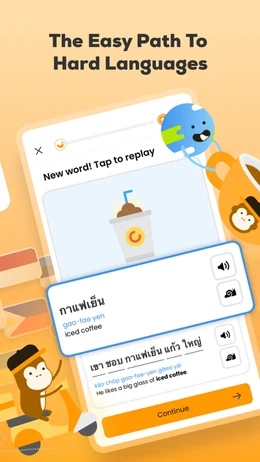
Three touches genuinely help Mandarin beginners inside that loop:
- Real native voices. Ling's Help Center states every course uses human native voices instead of synthetic speech, keeping tones natural.
- Variable audio speed. Ling's sound FAQ adjusts playback from half speed to 1.5x, helpful for fast lines like what is your name, 你叫什么名字.
- A clean pinyin toggle. Ling's transcription guide lets you hide romanisation via the gear icon once characters stick.
Ling's biggest Chinese perk is variety under one login. One plan unlocks four separate courses: Simplified Chinese, 简体字, Traditional Chinese, 繁体字, Cantonese and Taiwanese Hokkien. Very few apps bundle all four together.
Look closely at Ling's Traditional Chinese page, though, and the shared mould shows cracks. Beyond swapping the label, it clones the Simplified course text word for word and displays Simplified blog snippets for Lantern Festival, 元宵节, and Happy New Year, 新年快乐.
We found no Ling page stating whether its Traditional course uses Taiwan words and voices or simply flips mainland text into Traditional glyphs. If Taiwan is your goal, read our Simplified vs Traditional Chinese guide and check ChineseSkill's Taiwan track first.
Even Ling's own site disagrees on its language count, ranging from 40+ on the pricing table to 82 in the footer.
Grammar notes, rigid answers and the missing HSK map
Matching words alone will not teach you Mandarin word order, measure words or particles. This is where Ling's broad mould falls well behind Chinese-built apps.
First, Ling's deeper notes skip many courses. Ling's pricing page and blog state Grammar Notes and Culture Notes exist "in several languages" or for a "select group". Ling's Help Center even confirmed its Word-by-Word breakdown launched "only available for the Thai language course".
Ling publishes no chart showing which extras exist in Simplified or Traditional Chinese. A Yoruba subscriber wrote in November 2026 after seventy lessons: "Charging full price without disclosing that certain languages are missing core features feels misleading."
Second, sentence sorting accepts only one strict answer. Ling's Help Center admits the app marks valid alternative phrasing wrong unless it matches the unit's exact pattern, asking users to tap "Report an error".
Mandarin lets you shift time words and topics naturally, so single-answer sorting turns grammar work into guessing one author's phrasing. You can patch that gap with our common Chinese grammar mistakes guide or free Chinese Grammar Checker, yet Chinese-only apps teach rules upfront.
Third, Ling publishes no HSK map at all. We read its Simplified, Traditional, FAQ, Help Center and store pages in November 2026 without spotting any mention of HSK 2.0, HSK 3.0 or a Mandarin word count.
Instead, Ling's February 2026 LingoDeer comparison says upper lessons aim roughly at CEFR B1. With regular HSK 3.0 exams starting in December 2026 and adding spoken papers from HSK 3, as our HSK 3.0 guide details, exam learners on Ling must track syllabus gaps alone.
Character tracing exists, yet Chinese details stay hidden
Reading and writing hanzi take clear stroke logic, radicals and spaced recall. Ling includes finger tracing, yet leaves every Mandarin detail unpublished.
On its comparison blog, Ling lists "Finger tracing for several non-Latin scripts". Its store gallery shows the grid with Animation, Show Arrow and freehand Writing controls.
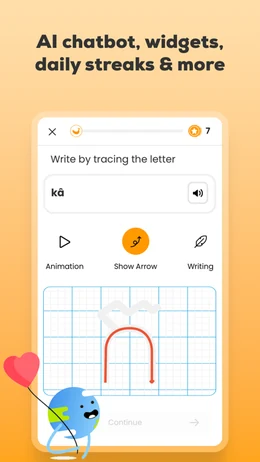
Look closely at that official App Store screen. The headline plugs "AI chatbot, widgets, daily streaks & more", yet the phone itself traces the Thai consonant kâ.
Simya also built a separate writing app called Write Me on iPhone, though Apple's store shows no update since December 2020. Inside the main Ling app, we found no public count of how many Chinese characters you can trace, nor whether strokes are strictly graded or radicals taught.
Without component logic, tracing feels like copying loose shapes from memory. Learners build literacy faster by learning core parts first, as our Chinese radicals guide shows, then drilling strokes in a dedicated tool or Skritter.
Speaking relies on speech-to-text, not tone tracking
Ling puts pronunciation scores and a chatbot near the top of its store pitch. Read Ling's own help docs, though, and Mandarin learners hit a clear flaw.
Ling's Speaking Game FAQ spells out the exact pipeline: "The app records what you say and sends it to a third party. The third-party transcribes it into text and then sends it back to us. We evaluate the returned text."
Think about what that means for Mandarin tones. Ling does not track your pitch curve to see if a third tone stayed low or a rising tone climbed cleanly. It feeds your audio to outside speech-to-text software and checks the returned characters.
That design leaves two big gaps for Chinese learners:
- Context hides bad tones. Speech-to-text guesses expected words in full lines like "I want iced coffee", 我要冰咖啡, yet trips on short pairs like buy, 买, versus sell, 卖, or dumplings, 水饺, versus sleep, 睡觉.
- No tone-accuracy test exists. Ling shares zero numbers on how well it catches tone slips. A 2024 review of fifteen studies in ReCALL found speech tools help clear sounds far better than tonal pitch.
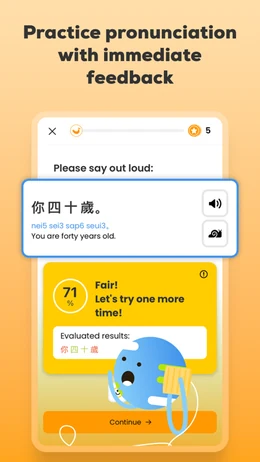
Even Ling's own App Store image for pronunciation feedback shows its lean. The Traditional Chinese sentence on screen, 你四十歲, uses Cantonese Jyutping rather than Mandarin pinyin and returns a 71% score with red and green highlights.
Store reviews flag hardware bugs too. Across the 150 recent Apple reviews we coded, fourteen users reported broken mics, frozen screens or voice checks rejecting clear speech. Eight of those fourteen still gave four or five stars overall, showing bugs hit fans as well as critics.
A UK user on a newer iPhone wrote in November 2026 that voice checks were "diabolical", forcing them to skip speaking drills. A Canadian Farsi user in September 2026 said even a native speaker failed the check.
What about Ling's "AI chatbot"? Ling's own review and Help Center describe Dialog as a guided script where you pick options from a list, fill blanks or record a set line. It drills preset scripts rather than holding an open talk.
If clear spoken Mandarin matters, train your ear first with our Chinese tones guide and check single syllables on our free Tone Checker.
Offline study works for lessons, not for speaking
Commuters and flyers do get one welcome perk on Ling. Ling's product guide confirms paid mobile plans let you save lessons for offline study.
Two clear catches narrow that perk. First, Ling's Speaking Game guide confirms voice drills always need steady internet because clips route through an outside server. Second, while paid accounts include Ling Web with synced progress, a UK user in October 2026 reported web links looped back to the sign-up quiz instead of loading lessons.
Android speaking drills also need the Google app installed with mic access on. That leaves voice checks fragile inside mainland China or on phones without Google services.
What 150 recent App Store reviews reveal about Ling
At first glance, Ling's mobile store stars look strong. Here is where its public profiles stood on 25 November 2026:
US App Store
- Rating
- 4.65
- Count
- 17,268
- Note
- Version 9.1.0, updated 23 Nov 2026; 81% five-star, 5% one- or two-star
Google Play
- Rating
- 4.68
- Count
- 44,362
- Note
- 1M+ downloads; updated 19 Nov 2026; IAPs $0.99 to $349.99
Trustpilot
- Rating
- ~2.8–3.0
- Count
- Low volume
- Note
- Unclaimed profile with only a small handful of web ratings
Sources: Apple iTunes lookup (US star split: 14,006 five-star, 1,840 four-star, 613 three-star, 255 two-star, 554 one-star), Google Play and Trustpilot, checked 25 November 2026.
High averages hide who actually loves the app and why others leave. We pulled 150 recent written Apple App Store reviews across the US, UK and Canada from May through November 2026.
Across all 150 written reviews, the mean sat at 4.03 stars: about seven in ten gave four or five stars, while roughly one in five gave one or two stars. One finding stood out right away. Across all 150 recent English reviews, zero learners mentioned Mandarin Chinese. Meanwhile, ten praised Tagalog, seven praised Cantonese, six studied Thai and four studied Lao.
Every Cantonese reviewer gave four or five stars, often citing family roots where Duolingo offered nothing. One Canadian user called Cantonese "as good as I remember Duolingo being".
We hand-coded all 150 reviews across their main praise and complaint themes:
Source: hand count of 150 consecutive written Apple RSS reviews pulled 25 November 2026 (US 26 Oct–24 Nov 2026; UK 5 Aug–22 Nov 2026; Canada 29 May–12 Nov 2026). Reviews can raise multiple themes; 108 of 150 gave four or five stars overall. How we coded them.
Four clear complaints repeat across recent posts:
- Lost progress and freezes: A US user in November 2026 asked why updates wiped progress, and a Canadian member quit in July 2026 after an update reset lessons.
- Unchecked course errors: A US user in November 2026 checked Russian, Uzbek and Persian, flagging transliterated "expert" Russian, wrong Uzbek verbs and missing script lessons, calling it casually AI-made.
- Billing and refund circles: A US user in October 2026 reported repeat yearly bills after cancelling a 2024 trial, while a UK buyer in September 2026 said a £70 bill outside Apple blocked an Apple refund.
- Strict sentence grading: A four-star Canadian daily user in November 2026 liked cultural tips yet flagged word-order drills rejecting valid phrasing.
Public threads on r/ChineseLanguage and r/languagelearning checked in November 2026 echo our count. Reddit users back Ling for Cantonese or rare Asian languages, yet call its Mandarin path a cookie-cutter shell and point beginners straight to HelloChinese, SuperChinese, LingoDeer or Pleco.
Ling App vs HelloChinese, Duolingo and SuperChinese
Most beginners looking at Ling are weighing three bigger Mandarin names at once. We put them side by side.
Ling App vs HelloChinese
For Mandarin alone, HelloChinese wins cleanly at a lower everyday price. HelloChinese Premium costs $69.99 a year against Ling's $89.99. It covers over 2,500 words, explains grammar clearly, drills stroke writing and supports Traditional characters.
HelloChinese's main catch is that its full story shelf needs Premium+, and it teaches Mandarin only. Unless you also want Cantonese, Thai or Eastern European courses on one login, HelloChinese is the sharper first Mandarin app.
Ling App vs Duolingo
Between Ling and Duolingo, you are trading native audio against a real free tier. Duolingo keeps its whole ~6,000-word Mandarin course free with ads, while Ling locks most lessons right after the start.
Ling wins on human voices, practical dialogues and Traditional scripts, since Duolingo sticks to Simplified and skips handwriting. Still, paying $89.99 yearly to leave Duolingo for Ling rarely makes sense when Chinese-only apps fix Duolingo's gaps better, as our Duolingo alternatives guide shows.
Ling App vs SuperChinese and LingoDeer
SuperChinese beats Ling on annual price and long-term value. SuperChinese PLUS runs $59.99 a year on Apple's store and still sells Lifetime for $139.99, tracking eight levels to old HSK 5 with scored speaking on every line.
LingoDeer costs slightly more yearly at $95.99, yet was built for Chinese, Japanese and Korean with upfront grammar notes and stroke guides. Notably, Ling's own February 2026 comparison post openly advises picking LingoDeer if you learn "popular languages like Spanish, French, or Chinese". We agree with Ling on that call.
Who should buy Ling, and better Mandarin picks
We would still consider paying for Ling if:
- You want Cantonese or Taiwanese Hokkien beside Mandarin. Getting all four Chinese courses with human voices in one app is rare.
- You study a second overlooked language. Pairing Mandarin with Thai, Tagalog, Lao, Khmer, Serbian or Albanian stretches one yearly fee further.
- You want short offline trip phrases. Downloaded audio units handle basic travel phrases before a flight.
We would skip Ling if Mandarin is your sole language, if you want a true free tier or Lifetime deal, or if you need pitch-aware tone coaching.
Here is what we would pick instead for each Mandarin job:
A full free gamified course
- Pick
- Duolingo
- US price
- Free; Super from $9.99/mo
- Why it beats Ling here
- Entire ~6,000-word course unlocked at $0
The clearest beginner Mandarin course
- Pick
- HelloChinese
- US price
- $11.99/mo or $69.99/yr
- Why it beats Ling here
- 2,500+ words, 430+ grammar points and stroke writing
Cheapest HSK course or Lifetime
- US price
- $11.99/mo, $59.99/yr or $139.99 life
- Why it beats Ling here
- 8 levels to old HSK 5 with scored speaking
Mainland, Taiwan and Cantonese together
- Pick
- ChineseSkill
- US price
- $11.99/mo or $59.99/yr
- Why it beats Ling here
- Dedicated Taiwan Traditional and Cantonese tracks for less
Deep East Asian grammar notes
- Pick
- LingoDeer
- US price
- $14.99/mo or $95.99/yr
- Why it beats Ling here
- Upfront grammar lessons and 3- or 6-year web plans
Free stroke-order character SRS
- US price
- Free with an account
- Why it beats Ling here
- 1,200 new HSK writing and 1,940 reading characters
Offline Chinese dictionary and flashcards
- Pick
- Pleco
- US price
- Free; $29.99 bundle
- Why it beats Ling here
- Essential dictionary plus 2026 HSK 3.0 flashcard lists
Graded stories for HSK 1 to 3
- Pick
- SayMei Stories
- US price
- $2.99/mo
- Why it beats Ling here
- 169 books in 1,161 chapters, Simplified and Traditional
Live spoken lessons with tone feedback
- Pick
- SayMei Premium
- US price
- $5.99/mo
- Why it beats Ling here
- 200 live Mei Lin minutes monthly plus Stories and FSRS
Live human conversation and coaching
- Pick
- An italki tutor
- US price
- About $20/hour
- Why it beats Ling here
- Median across Chinese tutors for human tone correction
Sources: SayMei's live competitor guides and SayMei pricing, checked 25 November 2026.
To build a full beginner stack across apps, check our best apps to learn Chinese guide or our HSK 1 study guide.
Where SayMei fits, and where it doesn't
SayMei is our app, built only for Mandarin Chinese. One account works on saymei.app and in our iPhone and Android apps. SayMei is also an app for iPhone and Android: get the app.
Three parts address the exact gaps Mandarin learners hit on Ling:
- Spoken Mandarin that answers back. SayMei Premium costs $5.99 a month for 200 live spoken minutes with Mei Lin across HSK 1 to 6, correcting tones as you speak. Unused minutes roll over while subscribed, and Boost top-ups never expire.
- Clear character writing and HSK 3.0 tools. SayMei Characters is free with an account and trains stroke order across the November 2025 HSK lists in Simplified or Traditional. Free accounts also unlock 402 printable PDF workbooks and free HSK 1 to 9 word lists.
- Graded reading, real videos and pitch checks. SayMei Stories runs $2.99 a month, or comes inside Premium, with eight whole books free. SayMei TV plays free videos with tappable words, and our free on-device Tone Checker names tones right 80% of the time against 984 reference clips.
We want to be plain about where Ling beats us, and where SayMei stops short. SayMei teaches Mandarin only, so Ling easily wins if you want Cantonese, Taiwanese Hokkien, Thai or Albanian in one app. Live Mei Lin lessons also need an internet link, so offline study on SayMei covers due flashcard reviews in our mobile apps and paper PDFs rather than full offline audio units.
We also do not build an offline dictionary or camera OCR like Pleco, and we are not a human-tutor marketplace. Stories stop at HSK 3, and our iPhone app is not yet on the App Store in the EU, mainland China, Morocco or Afghanistan. SayMei's seven-day trials for Premium and Stories Unlimited also take a card and auto-renew unless cancelled.
What to do next
- Try Ling's free unit only if you also want Cantonese, Hokkien or a rare second language. Test audio speed and mic capture before starting any trial.
- Pick a Chinese-built starter course for Mandarin alone. Weigh HelloChinese, SuperChinese or LingoDeer before paying for an 80-language app.
- Fix tones and stroke order early. Check your pitch with a tone tool and practise strokes with spaced recall instead of untimed tracing.
- Protect your wallet if you trial Ling. Save a checkout screenshot showing the refund rule, and set an alarm two days before day seven ends.
Ready to speak Mandarin out loud right now? Read our speaking guide or start a live session with Mei Lin above.
FAQ
Is Ling App worth it for learning Mandarin Chinese?
For Mandarin alone, we say no at November 2026 prices. Ling asks $89.99 yearly on the web, publishes no HSK syllabus, limits grammar notes to select courses and grades speech via plain speech-to-text. HelloChinese and SuperChinese PLUS cost less yearly and teach Mandarin deeper, leaving Ling mainly for Cantonese or multi-language learners.
How much does Ling App cost in 2026, and is there still a Lifetime plan?
In November 2026, Ling's live site charges $16.99 monthly or $89.99 yearly, with a six-month tier and a Black Friday deal at $69.99 a year. Ling quietly retired its Lifetime plan from public checkout and US App Store lists by mid-2026, though its FAQs page and older blogs still mention legacy offers.
How much of Ling App is free for Chinese?
Ling is free to download, yet free access ends fast. Both the US App Store and Google Play promise two free units in any language. However, Ling's own Google Play replies and fifteen recent iOS reviewers describe hitting a paywall after unit one or greetings. Treat it as a short preview rather than a free course.
Is Ling App better than HelloChinese or Duolingo for Chinese?
HelloChinese beats Ling for structured Mandarin, packing over 2,500 words, grammar notes and stroke writing into a $69.99 yearly plan. Duolingo keeps its whole Mandarin course free with ads, though Ling beats Duolingo on human voices and Traditional scripts. Even Ling's own February 2026 blog recommends LingoDeer over Ling for Chinese.
Does Ling App teach Traditional Chinese, Cantonese and HSK levels?
Yes to scripts and varieties, no to HSK. One Ling subscription unlocks four separate courses: Simplified Chinese, Traditional Chinese, Cantonese and Taiwanese Hokkien. Across Ling's Chinese pages, FAQs and store listings checked in November 2026, Ling publishes no HSK 2.0 or HSK 3.0 map and no Mandarin word count, aiming loosely at CEFR B1.
Does Ling App check Mandarin tones accurately?
Ling publishes no tone-accuracy test, and its own FAQ shows why tone grading stays weak. The Speaking Game sends your voice clip to outside speech-to-text software and scores the returned text instead of tracking pitch curves directly. Across 150 recent Apple App Store reviews checked in November 2026, fourteen users also flagged mic failures or voice glitches.
Can you use Ling App offline or on a computer?
Partly. Ling's official product review confirms paid mobile members can download lessons for offline study, and Ling Web syncs progress on a desktop browser. However, Ling's Speaking Game FAQ warns voice drills always need an internet link. Android speech checks also require the Google app installed with microphone permission turned on.
How do you cancel Ling App and get a refund?
Cancel where you subscribed at least a day before your trial or renewal ends, because deleting the app never stops billing. Apple handles every iOS store refund directly. For web and Android bills, Ling's live November 2026 pages clash between seven, fourteen and thirty days, so save a checkout screenshot and email support@ling-app.com promptly.
Sources
Checked 25 November 2026 unless noted. No account was created, no trial was started and nothing was bought.
- Ling official pages: Homepage, pricing, Black Friday 2026, Chinese Simplified, Chinese Traditional, Cantonese, Taiwanese Hokkien, About, FAQs and Terms of Use (updated 7 May 2025)
- Ling official blog posts: Ling App review (50 units, 200+ lessons, offline mode), Ling vs LingoDeer (16 February 2026, CEFR B1, Chinese recommendation) and Ling App Macedonian (13 June 2026, no lifetime option)
- Ling Help Center (help.ling-app.com, dated 14 September 2025): cancellation and 30-day refund policy, how to cancel, Speaking Game speech-to-text architecture, Conversation Game, transcription toggle, Word-by-Word Thai-only note, single accepted answers, languages and native audio and Ling Web
- Wayback Machine snapshots (ling-app.com/pricing/): 25 June 2025, 9 December 2025 and 28 February 2026
- App stores and community: US App Store (4.65 stars, 17,268 ratings, v9.1.0), Apple US RSS feed (plus UK and Canada feeds), Google Play (4.68 stars, 44,362 reviews, 1M+ downloads), Trustpilot and public r/ChineseLanguage and r/languagelearning threads checked 25 November 2026
- Competitors and research: SayMei's live November 2026 reviews (HelloChinese, Duolingo, SuperChinese, LingoDeer), SayMei pricing, and Ngo, T. T.-N., Chen, H. H.-J. & Lai, K. K.-W. (2024), ReCALL 36(1), doi:10.1017/s0958344023000113
Methods
We checked Ling's public pages, Help Center, Terms of Use, archived pricing pages and app store listings on 25 November 2026 without creating an account, starting a trial or paying for a plan.
- Pricing and refund audit: We compared live US prices on ling-app.com/pricing/, ling-app.com/bfcm/, Google Play and Apple's US App Store in-app purchases against Internet Archive snapshots of ling-app.com/pricing/ from June 2025 through February 2026.
- App Store review audit: We pulled the 50 most recent written reviews from Apple's RSS feed in each of the United States (26 October to 24 November 2026), United Kingdom (5 August to 22 November 2026) and Canada (29 May to 12 November 2026), for 150 consecutive English-store reviews in total. We counted every language mentioned and hand-coded each review across six core themes; a single review could appear in more than one theme.
- Screenshots and competitors: All three figures use official US App Store images from Apple's lookup feed, inspected visually to describe the exact on-screen scripts and text. Competitor prices match SayMei's live November 2026 reviews, and all Mandarin characters and pinyin were checked against standard dictionary readings.
If you spot an error or price change, tell us: we update and fix mistakes.