Traditional Chinese legend, retold in simple Mandarin
Journey to the West: The Four Pilgrims
西游记:师徒四人
Journey to the West: The Four Pilgrims (西游记:师徒四人, Xīyóujì: Shītú sì rén) is a story from Journey to the West, the Chinese classic by Wu Cheng'en, retold in simple Mandarin as an 8-chapter story with audio for learners at about HSK 2 (Elementary).
Retold from Wu Cheng'en's classic novel Journey to the West: a gentle monk frees the Monkey King from under a mountain, and a dragon, a greedy pig and a quiet river monster join them on the long road west.
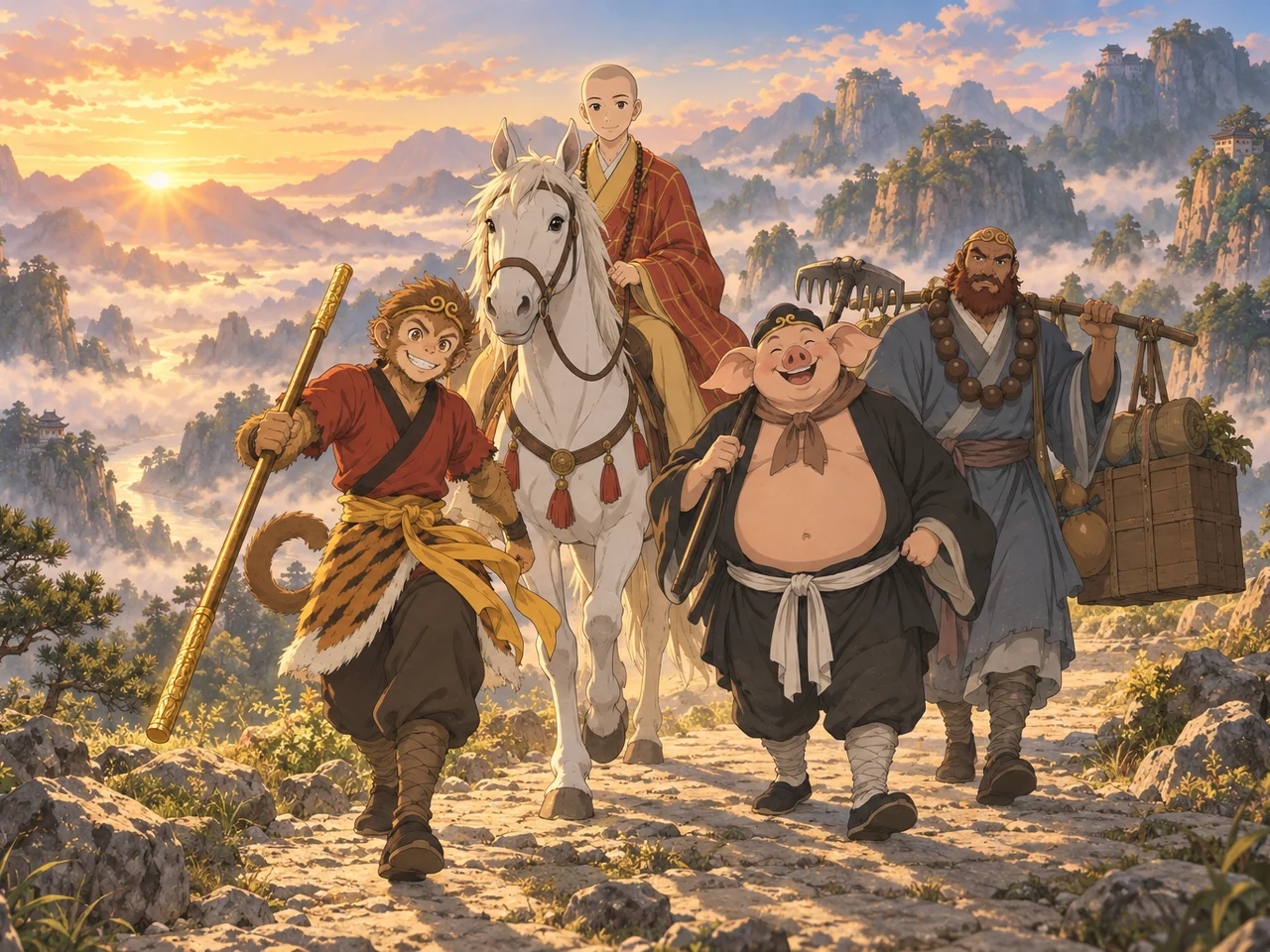
Meet the voices
- Narrator · 旁白 — An old storyteller who tells how one monk and a monkey became a team of four on the road to the West.
- Sun Wukong · 孙悟空 — The Monkey King, freed after five hundred years under a mountain: brave, boastful, quick-tempered and fiercely loyal to his new master.
- Tang Seng · 唐僧 — A gentle young monk walking all the way to the West for the scriptures: kind to everyone, easily frightened, and quick to cry.
- Zhu Bajie · 猪八戒 — Once a marshal of heaven, now a pig-faced monk: lazy, greedy, always hungry, and always teasing the monkey.
- Sha Wujing · 沙悟净 — A heavenly general sent down to the Flowing Sand River for one broken cup: quiet, steady and loyal.
- Guanyin · 观音菩萨 — The kind Bodhisattva of mercy, who has quietly arranged every step of the monk's journey.
- Little White Dragon · 小白龙 — The son of the Dragon King of the Western Sea, hiding in a mountain stream to make up for a big mistake.
- Old Gao · 高太公 — A worried old farmer whose son-in-law works like ten men, eats like twenty, and has the face of a pig.
- Robber · 强盗 — The loudest of six robbers who pick the wrong travelers to rob.
- Muzha · 木叉 — Guanyin's young disciple, sent with a little red gourd to help the pilgrims cross the river.
8 chapters, one journey
Chapter 1: The Monkey Under the Mountain
五行山下
Five hundred years under a mountain is a long time for a monkey. Then one morning a young monk comes down the road, and he might be the one the monkey has waited for.
Free to read
Chapter 2: The Golden Headband
头好疼
A new master, a new promise, and six robbers in the road. By sunset Wukong will also have a pretty new cap, and a very big headache.
SayMei Stories
Chapter 3: The White Dragon Horse
白龙马
A dragon has swallowed Tang Seng's horse and won't come out of the river. Wukong needs help from above, and somebody owes the pilgrims a horse.
SayMei Stories
Chapter 4: The Monster Son-in-Law
高老庄
Old Gao's son-in-law works like ten men, eats a hundred buns for breakfast, and has the face of a pig. Tonight, a very unusual bride will be waiting for him.
SayMei Stories
Chapter 5: A Pig Called Eight Rules
猪八戒
A fight that lasts all night, a very embarrassing story from heaven, and a new disciple for Tang Seng, with a very big appetite.
SayMei Stories
Chapter 6: The Flowing Sand River
流沙河
A river eight hundred li wide, no boat, and a monster who won't let anyone cross. At last Bajie gets to show off, and Wukong gets to be impatient.
SayMei Stories
Chapter 7: The Third Disciple
沙和尚
Guanyin asks Wukong one simple question, and he doesn't like the answer. Then one name, called twice, brings up the river monster faster than a whole day of fighting.
SayMei Stories
Chapter 8: Heading West Together
一起往西走
The pilgrims cross the river at last, swap stories about their troubles in heaven, and set off west together. But Wukong doesn't like the look of the next mountain.
SayMei Stories
Key words in Journey to the West: The Four Pilgrims
Behind the story
This book retells chapters 14 to 22 of Journey to the West (西游记), the 16th-century novel usually credited to Wu Cheng'en (吴承恩). It picks up where Havoc in Heaven ends: after five hundred years under the mountain, the Monkey King is set free by a gentle monk, and one by one the famous team comes together. Chinese readers call them 师徒四人, “the master and his three disciples.”
Tang Seng (唐僧) is based on a real monk, Xuanzang (玄奘), who left the Tang capital in the 7th century and spent many years traveling to India and back to bring home Buddhist scriptures. The novel turned his journey into a fantasy, and his three disciples are now as familiar as family in China: clever, hot-tempered Wukong; lazy, greedy, lovable Bajie; and steady, quiet Sha Wujing.
Did you know?
- The name 八戒 means “eight precepts,” eight rules to keep. In the novel, Tang Seng chooses it because the pig has given up eight kinds of food since meeting Guanyin: five strong-smelling plants such as garlic and onions, and three kinds of meat.
- Sha Wujing calls Bajie 二师兄, “Second Elder Brother,” and the name has become a joking nickname for pigs in Chinese. When pork prices go up, people joke that 二师兄 has become expensive.
- The spell Tang Seng learns is called the 紧箍咒, the “tight-band spell.” People still use the word for anything that keeps someone in check, like a strict rule or a boss's warning.