Pinyin and Tones Workbooks
By Mei Lin
Pinyin spells the sounds of Mandarin in Latin letters, with marks for the four tones. These workbooks cover every initial and final, the tone marks, the 20 tone pairs, tone changes and the sounds English doesn't have, such as q, x, zh and ü.
Total beginners start here, and so do learners who picked up Mandarin by ear. By the end you can read any pinyin syllable on signs, menus and apps, put tone marks in the right place and say tone pairs in real words. The tone pair books have free audio.
22 workbooks. Free.
Best first book
The Chinese Alphabet: Pinyin Workbook for Beginners in 12 Lessons
Every initial, final and tone mark in 12 lessons, so you can read any pinyin syllable on signs, menus and apps. You need nothing to begin.
Pronunciation & tones workbooks (22)
Learn pinyin
From zero, or to sort out what you picked up by ear.

The Chinese Alphabet: Pinyin Workbook for Beginners in 12 Lessons
Total beginner · 42 pages
Pinyin Chart with Pronunciation Cues: Initials, Finals and Spelling Rules
Total beginner · 18 pages
Complete Pinyin Table PDF: Every Mandarin Syllable with All Four Tones (Printable)
Beginner · 14 pages

Mandarin Pronunciation Guide for English Speakers
Total beginner · 27 pages
Zhuyin–Pinyin Bridge: Sounds, Symbols & Practice
Total beginner · 9 pages

How to Type in Chinese: Set Up a Pinyin Keyboard and Send Your First Messages
Total beginner · 14 pages
Chinese Numbers 1–100 Chart: Pinyin, Tones and Practice
Total beginner · 10 pages

Pinyin and Tones Practice Book: Pinyin Chart, Pronunciation Guide, Tone Pairs and Tone Changes in One PDF
Total beginner · 156 pages
Practise tones
Tones shift when words sit next to each other.
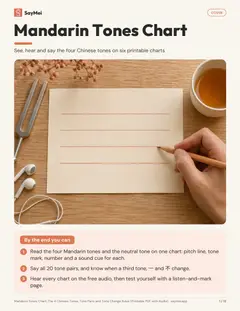
Mandarin Tones Chart: The 4 Chinese Tones, Tone Pairs and Tone Change Rules (Printable PDF with Audio)
Beginner · 12 pages

Chinese Tone Pairs Practice: All 20 Tone Pairs, with Audio
Beginner with pinyin · 28 pages · practice online
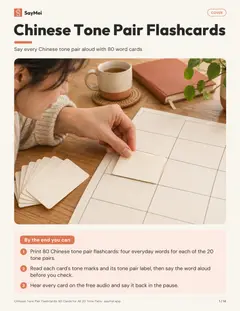
Chinese Tone Pair Flashcards: 80 Cards for All 20 Tone Pairs
Total beginner · 14 pages

Tone Sandhi in Everyday Mandarin: Third Tone, Yī and Bù Tone Changes
Beginner with pinyin · 18 pages

Mandarin Tongue Twisters: 20 Rhymes for Clearer Pronunciation
Beginner · 11 pages
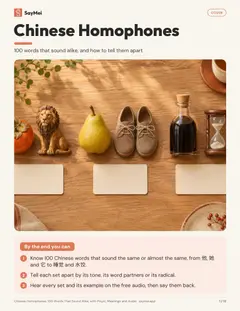
Chinese Homophones: 100 Words That Sound Alike, with Pinyin, Meanings and Audio
Beginner to intermediate · 12 pages
Test yourself
Check your tones and sounds, with audio and an answer key.
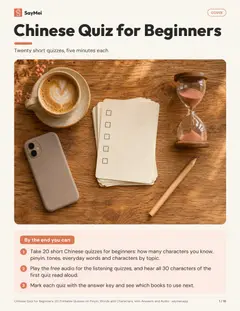
Chinese Quiz for Beginners: 20 Printable Quizzes on Pinyin, Words and Characters, with Answers and Audio
Beginner · 16 pages
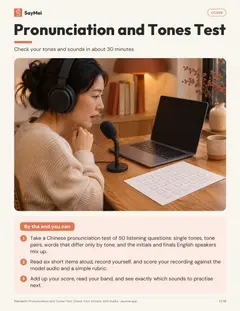
Mandarin Pronunciation and Tones Test: Check Your Accent, with Audio
Beginner · 12 pages
Worksheets
Printable practice pages with an answer key.
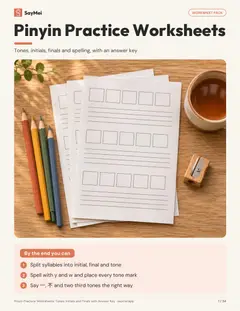
Pinyin Practice Worksheets: Tones, Initials and Finals with Answer Key
Beginner · 35 pages
For kids
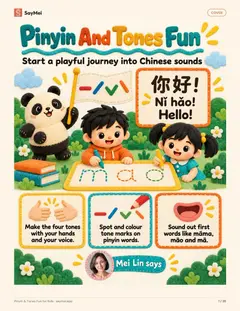
Pinyin & Tones Fun for Kids
Kids 5-9 (pre-A1) · 27 pages · Kids
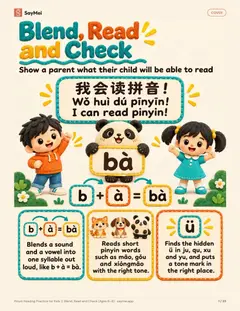
Pinyin Reading Practice for Kids 2: Blend, Read and Check (Ages 6–8)
Kids 6-8 (pre-A1) · 33 pages · Kids
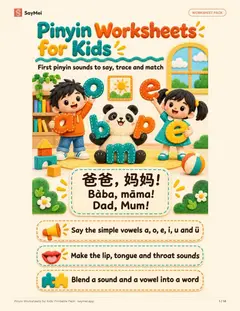
Pinyin Worksheets for Kids: Printable Pack
Kids 5-8 (pre-A1) · 15 pages · Kids
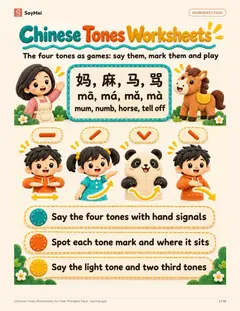
Chinese Tones Worksheets for Kids: Printable Pack
Kids 5-8 (pre-A1) · 15 pages · Kids

Chinese for Kids Ages 6–8: Complete Workbook (Pinyin, Characters, Handwriting, Numbers and Time)
Kids 6-8 (pre-A1) · 177 pages · Kids
Frequently asked questions
Is there a free pinyin chart in PDF?
Yes. Pinyin Chart with Pronunciation Cues shows which initials and finals combine, where your mouth makes each sound, and the spelling and tone-mark rules. To hear each sound, use the free pinyin chart with audio linked on this page.
How do I practise Chinese tones?
Learn the four tones, then practise them in pairs, because that's how you meet them in real words. Chinese Tone Pairs Practice has a chart of all 20 tone pairs with a key word for each and free audio. Tone Pair Flashcards adds 80 cut-out word cards.
Why do tones change in some words?
Two third tones in a row, and the words 不 and 一, change in everyday speech, and some syllables take a light neutral tone. Tone Changes in Everyday Mandarin covers each of these.
Which sounds are hardest for English speakers?
Usually j, q, x, zh, ch, sh, z, c, s, r and ü, plus the airflow difference between b and p. The Mandarin Pronunciation Guide for English Speakers shows what your tongue, lips and breath do for each.
Related tools and guides
Other collections
By level: Total beginner · HSK 1 · HSK 2 · HSK 3 · HSK 4 · HSK 5–6 · For kids
By goal: Grammar · Characters & writing · Pronunciation & tones · Reading · Speaking PDFs · Speak & conversation · Travel & daily life · HSK exam prep · School & other exams · Business Chinese · Listening · Traditional Chinese · Preschool & toddlers · Immersion parents · Festivals & culture · Kids 4–6 · Kids 6–8 · Intermediate
By exam: AP® Chinese · GCSE Chinese · IB Chinese · TOCFL · IGCSE Chinese · SQA Mandarin · A level & Leaving Cert · Singapore O Level & Chinese B · HSC Chinese · VCE & Year 12 Chinese · NCEA Chinese · AAPPL, STAMP & OPI · US school, college & job tests · YCT & CCCC for kids
By format: HSK mock tests · HSK speaking tests · Teacher guides · Textbooks & course books · Flashcards · Cheat sheets & charts · Worksheet packs · Vocabulary lists · Games & puzzles